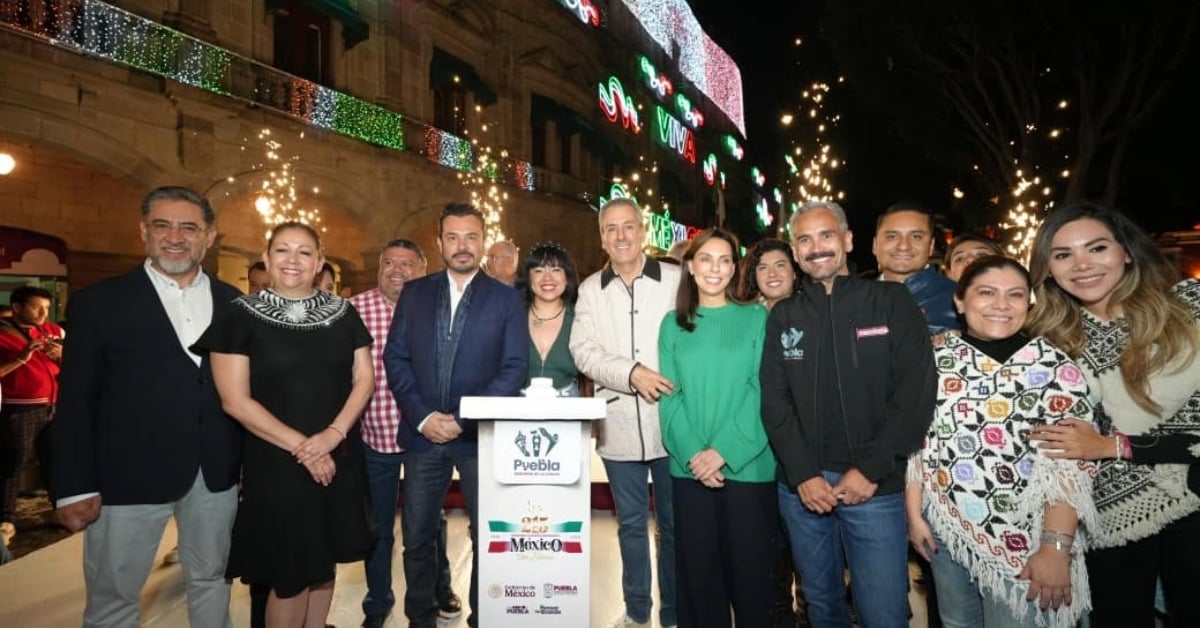
The heart of Puebla lit up for September’s celebrations as the city flipped the switch on more than 2,400 LED decorations around the Zócalo and nearby avenues. The lighting marks the start of a month of civic events in the UNESCO-listed Historic Center, with the Grito in the main square and a mass concert at Paseo Bravo. City officials also detailed crowd management, a temporary alcohol ban in the first square, and routes for the popular verbena on Reforma. Here’s what’s confirmed, why it matters, and how the city says it’s paying for it.
Families filled Puebla’s Historic Center on Sunday night, August 31, as the city switched on its patriotic lighting for the 2025 Independence festivities. City Hall says the display features more than 2,400 LED pieces installed at emblematic sites, including the Municipal Palace, Boulevard 5 de Mayo, Paseo Bravo, and Avenida Reforma, transforming the downtown core into a tricolor corridor through September.
The lighting ceremony was led by Mayor Pepe Chedraui, who framed the switch-on as the formal start of Puebla’s month of civic activities. Multiple local outlets and a municipal note corroborate the locations and scale of the installation, emphasizing the use of LED technology for efficiency and durability during the extended holiday stretch.
Puebla Zócalo shines for Independence Day
Beyond the spectacle, the city is tying the decorations to Puebla Brilla. This broader public lighting modernization effort prioritizes LED fixtures to reduce maintenance costs and energy consumption while improving safety. The administration has repeatedly described Puebla Brilla’s public benefits in official materials, linking brighter, more reliable lighting to crime-prevention and quality-of-life goals.
Financing is always a public question in September. This year, officials have stated that installing the patriotic adornments did not draw on the municipal budget, asserting that the work falls under the existing concession with lighting contractor Citelum. That claim was made in mid-August and reiterated as pieces went up; it’s a point residents will watch as September invoices come due.
What’s planned for September 15
The Independence Eve plan splits festivities across two main venues. The formal Grito de Independencia is scheduled for the Zócalo at midnight, while a free concert by Julión Álvarez will take place at Paseo Bravo. Authorities are planning for roughly 19,000 people at the Zócalo and up to 40,000 at the concert, with the popular verbena set along Avenida Reforma. City officials have confirmed these details in briefings, which regional media have widely reported.
To manage crowds, the municipality has outlined restrictions that include a temporary ban on alcohol sales and consumption in the first square on the night of September 15, with rules in effect until 2:00 a.m. on September 16, and additional enforcement in auxiliary juntas. Police and civil protection agencies will deploy checkpoints and alcoholimeters around the historic core and the concert zone.
These steps mirror policies used in other large Mexican cities during national holidays; however, Puebla’s geography requires careful routing. With the Zócalo and Paseo Bravo just a short walk apart, crowd flow along Reforma—where vendors are authorized to set up—will determine how comfortable the night feels for families. The city has announced that it will concentrate informal trade on Reforma and restrict alcohol sales there to mitigate risk.
A UNESCO-listed backdrop—and responsibility
The Historic Centre of Puebla is a UNESCO World Heritage Site (inscribed in 1987) noted for its baroque architecture, grid plan, and landmark religious buildings. Lighting and event infrastructure in a protected district come with stewardship obligations: installations must respect sightlines, façades, and the integrity of heritage structures. Puebla’s use of modular LED elements helps reduce physical impact while achieving visibility across large public spaces.
That setting is part of why Puebla’s September calendar resonates beyond the city limits. The Zócalo provides a civic stage steeped in history, while Paseo Bravo offers a vast, adaptable space for mass concerts and crowd circulation. Together, they allow officials to balance ritual and entertainment—a formula that, when managed well, keeps families returning year after year.
Energy, safety and civic pride
This year’s lighting underscores a through-line: symbolism matters, but so do operations. The city is promising an energy-efficient display, financed under a standing concession, and a security plan that aims to keep the celebration “familiar” in the literal sense—safe for kids and grandparents to attend. The proof will come mid-month, when the Zócalo and Paseo Bravo are at capacity and the verbena hums along Reforma. For now, the switch has been flipped, Puebla’s colors are up, and the capital is officially in September mode.