
Hotel occupancy figures and declining airport traffic raise questions about Puerto Vallarta’s tourism competitiveness heading into 2027.
Puerto Vallarta, Jalisco, November 24, 2026 – Puerto Vallarta is heading into another winter tourism season, and while local officials are optimistic about the coming months, tourism specialists are already sounding the alarm about 2027.
The concern isn’t simply whether Vallarta can fill its hotel rooms over Christmas or New Year’s. It’s whether the city can continue attracting enough visitors throughout the year as vacations become more expensive and travelers have increasingly attractive alternatives.
Puerto Vallarta’s cumulative hotel occupancy stood at 61.9% through September, down from 64.3% through August. September alone reportedly registered just 43.8% occupancy.
Former Mexican Tourism Secretary Enrique de la Madrid, who recently visited Puerto Vallarta, believes the hotel industry could face even greater difficulties next year.
And there are reasons to take that warning seriously.
The numbers deserve a closer look
September has traditionally been a slow month in Puerto Vallarta. Empty hotel rooms during the rainy season aren’t exactly breaking news for anyone who has lived here for a few years.
But there were signs of weakness during the high season, too.
The federal government’s March 2026 hotel monitoring report listed Puerto Vallarta’s occupancy during the first three months of this year at 73.7%, compared with 83.5% during the same period in 2025.
There is, however, an important complication with the latest numbers.
Vallarta Daily reviewed the federal Tourism Secretariat’s preliminary September report, which leaves Puerto Vallarta’s cumulative 2026 occupancy figure unavailable and specifically flags differences in the information available for year-over-year comparisons.
That means the reported 61.9% figure still requires independent confirmation, and direct comparisons with last year’s occupancy should be treated cautiously.
Fortunately, there’s another way to measure how Vallarta’s tourism economy is performing. And those numbers are considerably clearer.
More than 700,000 fewer passenger movements
According to the latest passenger traffic report from Grupo Aeroportuario del Pacífico, Puerto Vallarta International Airport handled approximately 4.89 million passenger movements between January and October.
During the same period last year, it handled 5.62 million.
That’s a decline of 12.9%, representing approximately 722,000 fewer passenger movements.
International passenger traffic fell even further, dropping 19.5% during the first ten months of the year.
October was particularly disappointing. Overall passenger traffic declined 19.8% compared with October 2025.
Airport passenger statistics include arrivals and departures, residents and visitors, so these numbers don’t translate directly into lost tourists. Nevertheless, they establish a substantial reduction in air travel through Puerto Vallarta.
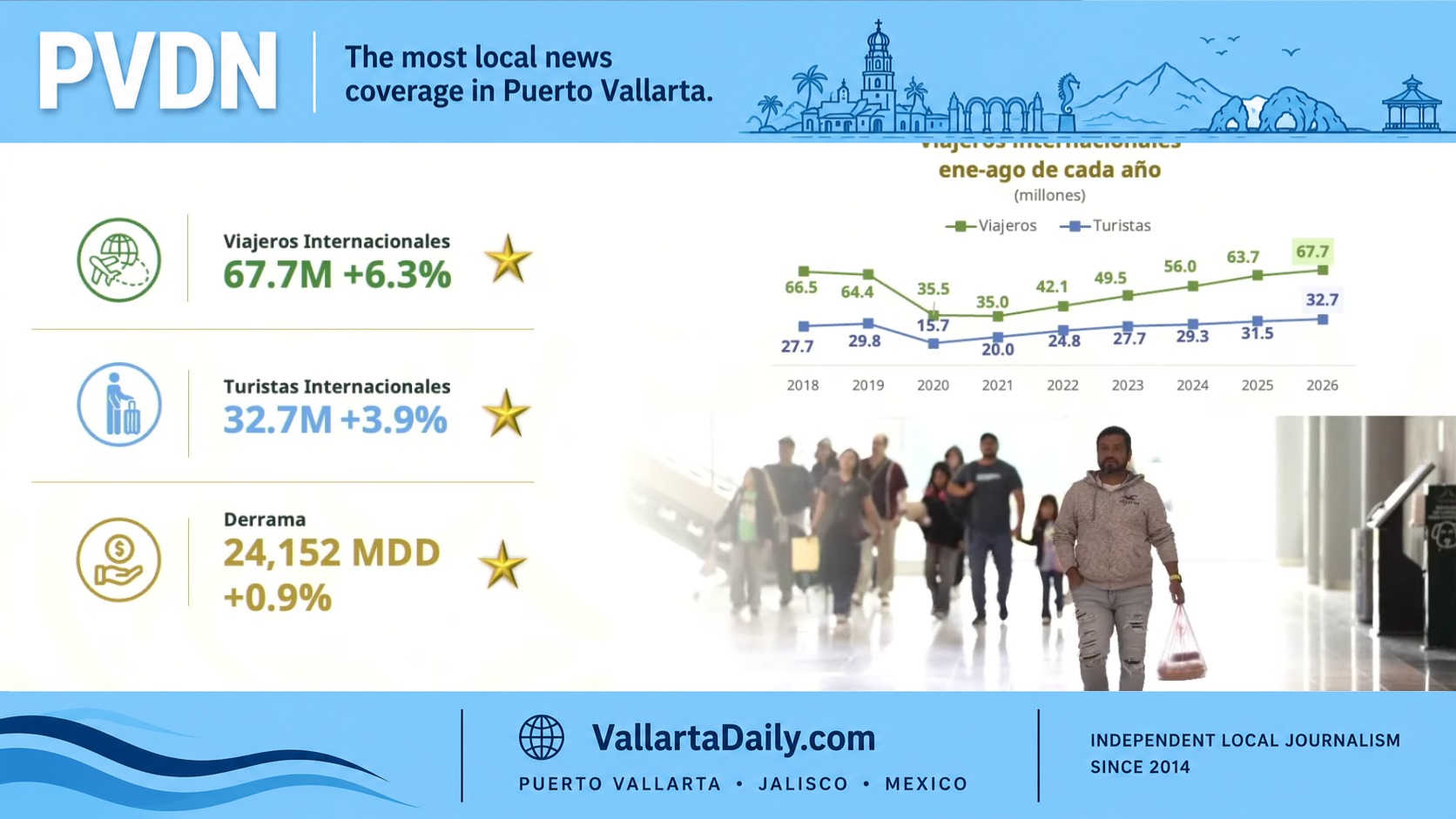
What’s interesting is that Mexico as a whole isn’t experiencing the same pattern. The country’s official tourism statistics show international tourist arrivals increased 3.8% nationally through September.
The measures aren’t directly comparable, but Mexico’s overall tourism growth makes Vallarta’s declining airport traffic worth investigating.
Is Vallarta becoming too expensive for its own good?
Last week, we explored this very question in our Insider report, Puerto Vallarta Is Getting More Expensive. Is It Becoming Less Desirable?.
One of the biggest issues facing Puerto Vallarta is the relationship between what visitors pay and what they receive in return.
There’s nothing inherently wrong with Vallarta becoming a more expensive destination. Plenty of expensive vacation destinations around the world are enormously successful.
The problem begins when the experience no longer justifies the price.
People planning a vacation aren’t necessarily comparing today’s Puerto Vallarta with the Puerto Vallarta they visited ten years ago. They’re comparing it with today’s Cancún, Costa Rica, the Dominican Republic, Colombia and other destinations competing for the same vacation budget.
And unlike someone who owns a home here or has family in the city, a tourist can simply choose somewhere else.
De la Madrid has warned that hotels may need to lower room rates to attract customers in 2027, potentially putting additional pressure on their revenues.
That’s a difficult position for an industry facing its own operating costs, including wages, electricity, maintenance and supplies.
It also raises an uncomfortable question for Vallarta’s wider tourism economy. How much more can businesses charge before enough customers decide the trip simply isn’t worth it?
We don’t yet have a comprehensive local pricing study or visitor survey that establishes rising prices as the primary cause of Vallarta’s tourism slowdown. But affordability is clearly one factor worth examining alongside air connectivity, security perceptions and competition.
Mexico is making vacations a little more expensive
Adding to those concerns is the federal government’s decision to increase Mexico’s nonresident visitor fee in January 2027.
The fee, commonly known as the DNR, will increase from 983 pesos to 1,158 pesos for travelers subject to the charge.
For a family of four required to pay the fee, that’s another 700 pesos added to the cost of a Mexican vacation.
On its own, that probably won’t convince many families to cancel their holiday. But combined with airfare, accommodation, airport transportation, meals and entertainment, it becomes another consideration.
Puerto Vallarta’s hotel industry had already expressed opposition to increasing the visitor fee when an even larger increase was being considered earlier this year.
Tourism economist Humberto Molina has also identified reduced airline capacity, aviation fuel costs, safety concerns, insufficient destination marketing and competition from vacation rental platforms as possible contributors to Mexico’s weaker hotel performance.
In other words, there is no single problem with a single solution.
Selling paradise means taking care of paradise
Another part of this conversation is happening right here at City Hall.
On Monday, Vallarta Daily reported that local hotel operators have offered to help maintain public spaces as the municipal government struggles with basic services.
That offer says something about how closely the tourism industry depends on the condition of the city surrounding its hotels.
A beautifully maintained resort can only control what happens on its own property. Once guests leave to explore Puerto Vallarta, their experience depends on sidewalks, roads, beaches, public cleanliness, transportation and the general condition of the community.
These things matter.
A tourist might forgive an inconvenient construction project or a poorly maintained street during one vacation. But if the overall experience feels less enjoyable while the cost of returning continues to rise, that traveler may reconsider next year’s holiday.
Municipal services aren’t separate from tourism policy. In a city like Puerto Vallarta, they are part of the tourism product.
What this could mean for condo owners
Hotel owners aren’t the only ones who should be paying attention.
Puerto Vallarta has a substantial vacation rental market, and many property owners depend on rental income to offset maintenance fees, property expenses and mortgage payments.
We recently examined the financial implications of weaker vacation rental demand in our Insider report, Can your Vallarta condo pay its bills at 36% occupancy?.
Hotel occupancy and vacation rental occupancy are different measurements and shouldn’t be compared directly. But both accommodation markets compete for some of the same travelers.
If hotels start discounting rooms to attract customers, privately owned condos may face additional pricing pressure.
A condo that looked like a profitable investment based on optimistic rental projections can become considerably less attractive when owners must reduce nightly rates while their fixed expenses remain unchanged.
The same applies to restaurants, tour companies and other businesses that built their financial expectations around continued tourism growth.
There are reasons for optimism this winter
None of this means Puerto Vallarta is about to experience a tourism collapse.
Jalisco tourism officials continue to anticipate a winter tourism recovery in Puerto Vallarta, with improving reservations and seasonal air service offering reasons for optimism.
Last week, the city was also forecasting hotel occupancy above 92% for the Revolution Day holiday period, although that was a projection rather than a confirmed final result.
Puerto Vallarta still has considerable advantages. Its natural setting, established international community, culinary scene and loyal repeat visitors aren’t going to disappear overnight.
But a handful of busy holiday weekends won’t necessarily compensate for months of weaker demand.
The real test will come after the winter holidays, when hotels need to fill rooms on ordinary weekdays and local businesses can no longer rely on Christmas crowds or holiday travelers.
The bigger question for 2027
For years, Puerto Vallarta has benefited from being a destination that people fall in love with and return to repeatedly.
That loyalty is valuable, but it shouldn’t be mistaken for an unlimited willingness to pay more.
Over the coming months, the numbers worth watching will include hotel occupancy, actual room rates, airline seat availability, international passenger traffic and visitor spending.
Together, they’ll help establish whether 2026 was simply a difficult year or the beginning of a more lasting shift in Vallarta’s tourism economy.
Puerto Vallarta doesn’t necessarily need to become a cheaper destination to remain successful. It does, however, need to remain a destination where people believe their money is well spent.
And that’s a challenge that extends well beyond the hotel lobby.