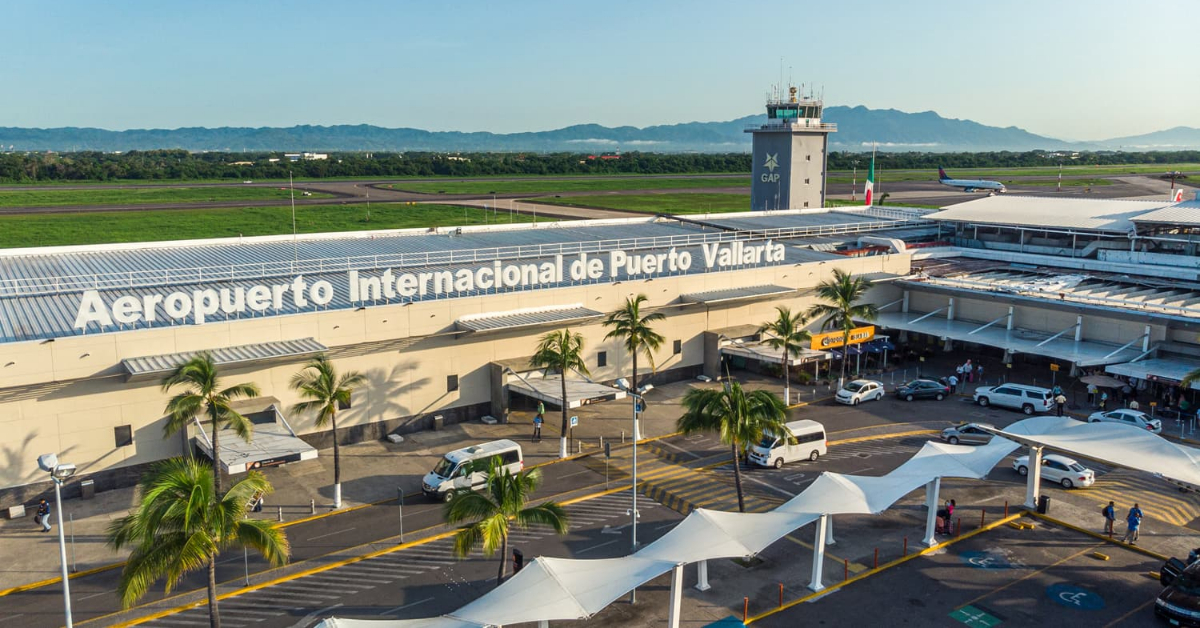
Puerto Vallarta’s airport is starting 2026 with a shift that local businesses, travelers, and residents will want to watch. After a record-setting 2025, international passenger numbers have now fallen for three straight months. April brought one of the sharpest drops so far, with fewer foreign arrivals and a weaker overall count. The airport is still expanding, but the latest figures show a more complicated picture for one of Mexico’s best-known beach destinations.
Puerto Vallarta airport records another drop in international traffic
Puerto Vallarta International Airport recorded its third straight month of year-over-year declines in international passenger traffic, extending a slowdown that began after a strong January.
In April 2026, the airport handled 287,500 international passengers, down 23.5% from the same month last year. In April 2025, the airport recorded 375,700 international passengers.
The decline was not limited to foreign arrivals. Total passenger traffic, including domestic and international travelers, fell 17% in April. The airport handled 542,600 total passengers, compared with 654,100 in April 2025.
The latest figures point to a softer spring for Puerto Vallarta’s air market. They also come after a year in which the airport reached a new passenger record, making the current downturn more notable for the local tourism economy.
The international slide has now lasted three months
The April report confirms a pattern that began in February and sharpened in March.
International passenger traffic fell 6.2% in February, followed by a 32.1% drop in March. April’s 23.5% decline marks the third consecutive month in negative territory.
For the first four months of 2026, Puerto Vallarta handled 1.56 million international passengers. That was down 15.2% from the 1.84 million recorded during the same period in 2025.
Total passenger traffic from January through April also weakened. The airport recorded 2.46 million total passengers in the first four months of this year, down 11.3% from 2.78 million during the same period last year.
The domestic market also slipped in April, but less severely than the international side. Domestic passenger traffic fell 8.4%, from 278,400 passengers in April 2025 to 255,100 in April 2026.
Fewer passengers can mean fewer seats, not only weaker demand
Passenger declines do not always mean fewer people wanted to travel. Sometimes they reflect fewer available flights or reduced airline capacity.
That distinction matters for Puerto Vallarta because the airport depends heavily on international air service, especially from the United States and Canada. When airlines reduce frequencies or adjust seasonal schedules, passenger totals can fall even if planes remain fairly full.
Across the airport group that operates Puerto Vallarta, available seats fell 8.3% in April compared with April last year. At the same time, the group’s load factor rose from 80.8% to 81.5%.
That means the broader airport network had fewer seats for sale, while a slightly higher share of those seats was filled. The companywide figure does not isolate Puerto Vallarta, but it helps explain why traffic declines can reflect both demand and airline scheduling.
For travelers, this can show up as fewer flight choices, less flexible schedules, or higher prices on certain routes. For local businesses, it can mean fewer international arrivals even when hotels, restaurants, and tour operators remain busy during peak periods.
February disruptions may have deepened the early-year decline
February’s figures were affected by flight cancellations tied to security-related events in Jalisco.
Puerto Vallarta airport recorded 89 cancellations on February 22 and 52 cancellations on February 23, for a total of 141 cancellations over two days. Those disruptions contributed to a weaker month and helped start the current run of year-over-year declines.
March then brought a much steeper drop. The airport handled 576,600 total passengers that month, down 24.4% from March 2025. International passenger traffic was the main driver, falling 32.1%.
April’s results show the slowdown continued even after the immediate February disruption had passed. That makes the next few monthly reports important for understanding whether the decline is temporary, seasonal, or part of a broader adjustment in international air service.
Puerto Vallarta is coming off a record year
The decline follows a strong 2025 for the airport. Puerto Vallarta handled about 6.9 million passengers last year, setting a new annual high.
That record included roughly 3.8 million international passengers and 3.1 million domestic passengers. The balance shows how important foreign air service is to the destination, while also showing the strength of Mexico’s domestic market.
A drop after a record year does not automatically signal a long-term downturn. Air traffic can be influenced by exchange rates, airline capacity, safety perceptions, hotel pricing, economic conditions, and seasonal travel patterns.
Still, three consecutive months of international declines create a warning sign for a destination where air connectivity supports hotels, restaurants, transportation providers, tour companies, and short-term rental demand.
Local tourism may feel the decline unevenly
The impact of fewer international passengers will not be the same across Puerto Vallarta’s tourism economy.
Hotels that depend heavily on foreign guests may notice the slowdown more than businesses serving domestic visitors. Tour operators, airport transportation companies, and restaurants in tourist-heavy zones may also feel changes in visitor volume.
At the same time, Puerto Vallarta’s spring tourism picture was not entirely weak. Semana Santa and Easter travel were expected to bring strong domestic visitor numbers, with hotel occupancy projections near 80% for the main holiday period and 75% for the following week.
That kind of domestic demand can soften the impact of weaker international traffic. It does not fully replace it, especially for businesses built around longer-stay foreign visitors or winter-season travelers.
For residents, the most visible effect may be more subtle. Airport crowds may feel lighter outside peak travel days. Some routes may become less frequent. Seasonal fares may also change as airlines adjust supply.
The airport is still preparing for long-term growth
The current decline comes as Puerto Vallarta’s airport remains in the middle of a major expansion plan.
The airport operator has announced a broader investment program for its Mexican airports, including work at Puerto Vallarta. The plan includes a new terminal that is expected to double the airport’s capacity.
That long-term investment suggests the airport operator still sees Puerto Vallarta as a growth market. The short-term passenger decline does not cancel that outlook, but it does show that expansion and demand do not always move at the same pace.
For a destination like Puerto Vallarta, more capacity can help attract new routes and reduce congestion. But new infrastructure only reaches its full value when airlines and travelers continue to support the market.
The next reports will show whether the trend is temporary
The key question is whether April represents the bottom of the current slide or another step in a longer slowdown.
May and June will help show whether international traffic stabilizes after the spring shoulder season. Summer schedules will also show how airlines are treating Puerto Vallarta outside the winter high season.
The Canadian market will be especially important later in the year. So will U.S. airline capacity, which remains central to Puerto Vallarta’s international arrivals.