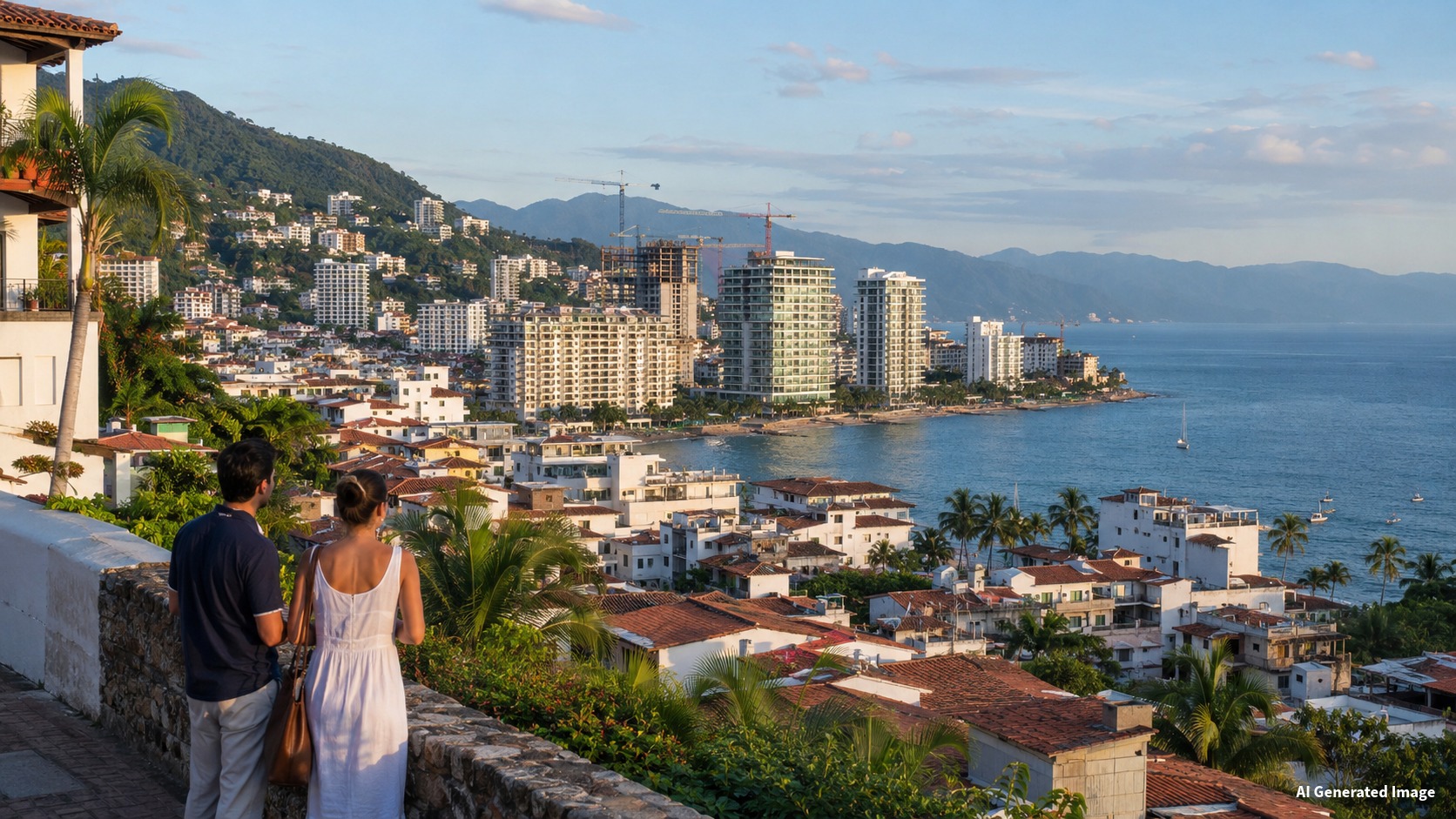
Puerto Vallarta real estate did not fall off a cliff in June. It cooled into a more normal market, with buyers taking longer, sellers losing easy leverage, and condos holding up better than houses across the bay.
The latest full market numbers available this month come from MLS/Flex data for Puerto Vallarta and Riviera Nayarit. They show a split market. Condo inventory down from a year earlier, detached-home inventory higher, and sales activity slower than in 2025.
I would not call June a buyer’s market across the board. I would call it a market where the wrong price now gets punished. Well-located condos in walkable zones still draw interest. Older homes, ambitious luxury listings, and properties needing work face harder questions.
Condos held firmer than houses
The strongest part of the market remained condominiums. The median condo sale price was $412,500 in May, nearly flat from $415,000 one year earlier. Active condo inventory fell 9.3 percent, from 3,294 listings in May 2025 to 2,988 in May 2026.
Sales volume was the softer signal. Condo sales from January through May fell from 590 last year to 399 this year. That 32.4 percent drop shows buyers are more selective, even when prices do not move much.
One line from the June market update is blunt enough to quote: “The market is not weak. It is becoming more balanced.” The numbers support that, but the balance is not evenly distributed across all property types.
Detached homes carried more pressure. Single-family inventory rose from 628 homes to 802, while the median sale price fell from $444,500 to $330,000. That does not mean every house lost a quarter of its value. Median prices can shift when fewer high-end homes close, more lower-priced homes sell, or buyers reject older listings at peak-era prices.
Rental income still works but less automatically
The rental story is also more complicated than the sales pitch. Puerto Vallarta still has a large short-term rental market, but revenue is not rising across the board.
AirDNA’s June 2026 market data counted 12,314 active short-term rental listings in Puerto Vallarta. Average occupancy stood at 52 percent, up 6.3 percent year over year. But average annual revenue slipped 3.2 percent to $18,800, while the average daily rate fell 2.4 percent to $202.
That points to a more crowded and price-sensitive rental market. Owners may be booking more nights, but not always at the rates they expected.
Neighborhood yield estimates still favor central, walkable areas. Recent gross-yield estimates place 5 de Diciembre at 6.5 to 7.7 percent, Versalles at 5.5 to 7 percent, and Zona Romántica at 5 to 6.5 percent. Those are gross figures before vacancy, HOA fees, management, maintenance, taxes, and furnishing costs.
A more conservative rental model puts net yields closer to 3 to 5 percent for long-term rentals and 4 to 7 percent for short-term rentals after costs. That makes building rules, HOA budgets, and property management less of a side note and more of an investment test.
Pre-construction keeps selling but buyers are sharper
Pre-construction remains active because it offers newer buildings, staged payments, and a chance to choose units before delivery. Projects in 5 de Diciembre, Versalles, the Hotel Zone, and Marina Vallarta continue to lean on that appeal.
Palmaré in 5 de Diciembre is one current example of the product buyers are seeing. A smaller condo tower in a walkable neighborhood, close to Centro and the Malecón. That kind of project fits the 2026 demand pattern, but it also requires a more disciplined review.
Buyers still need to verify permits, construction timing, title structure, penalties for delay, finishing standards, HOA rules, and rental restrictions in writing. PVDN has recently reported on real estate fraud concerns and buyer legal risks across the bay, and those risks become sharper when pre-sale marketing moves faster than paperwork.
Tourism is no longer a guaranteed tailwind
Real estate demand in Vallarta still leans on tourism, second homes, seasonal stays, and rental income. June’s broader tourism signals were mixed.
Grupo Aeroportuario del Pacífico reported that Puerto Vallarta airport traffic fell 14.4 percent in May compared with May 2025. International passenger traffic fell 26.5 percent for the month, and total passenger traffic from January through May was down 11.8 percent year over year.
That does not kill the real estate market, but it does weaken the easy argument that every new rental unit will perform like a high-season winner. Buyers now need to underwrite shoulder-season occupancy, airfare shifts, exchange-rate risk, and competition from thousands of existing rentals.
Non-Mexican buyers face more than the sticker price
The claim that non-Mexican buyers can buy in Mexico “without restrictions” is too loose for Puerto Vallarta. Coastal property sits inside Mexico’s restricted zone, where direct ownership is limited. Most non-Mexican residential buyers use a bank trust, known as a fideicomiso, to hold property rights.
Closing costs also deserve a wider cushion than the simple 3 to 5 percent often repeated in sales conversations. Mexico property purchases can include acquisition tax, registry fees, notary fees, appraisals, permits, and fideicomiso setup and annual fees when buying near the coast.
That means the all-in number should be calculated before an offer, not after emotion takes over.
The bay’s new price test
June’s real estate market leaves Puerto Vallarta in a more demanding place. Sellers can still win, but not with 2021 pricing habits. Buyers have more leverage in houses, less automatic room in good condos, and more homework in pre-construction.
The best-positioned property now is not always the newest or cheapest. It is the one with clear paperwork, believable carrying costs, transparent HOA rules, and a price that reflects 2026 rather than the boom years.