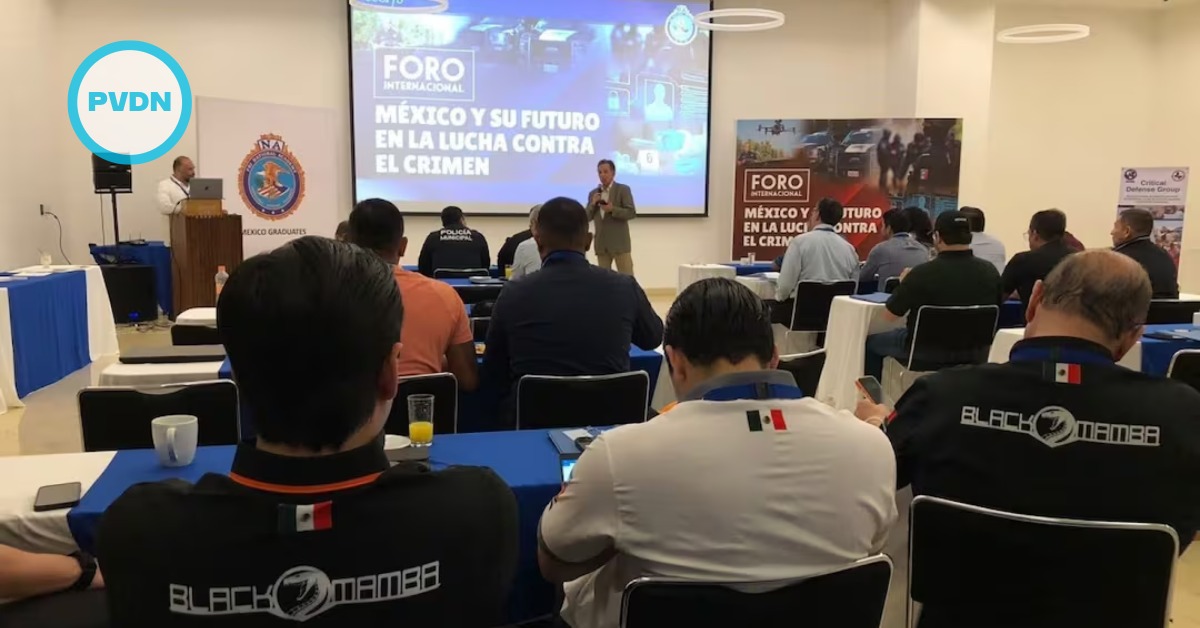
At the Puerto Vallarta security forum, Mexican and US officials vowed coordination against cartels, fentanyl trade and violence on the border.
Puerto Vallarta’s seafront hotels and conference rooms spent a day talking less about beaches and more about bullets. The city hosted the International Forum “Mexico and its Future in the Fight Against Crime,” where specialists from Mexico and the United States met to compare how each country is confronting organized crime and tightening its strained border.
According to organizers, the Puerto Vallarta security forum was built around a simple idea. Neither country can face transnational criminal networks alone, and any gap between them becomes a new opportunity for cartels, human traffickers and weapons smugglers. Security officials, diplomats and analysts took turns outlining what they see on the ground, from fentanyl labs and trafficking routes to migration pressures and violence in border communities.
The United States Embassy in Mexico described cooperation with Mexico as essential to protecting communities on both sides of the border. Its message echoed through the meetings in Puerto Vallarta. The embassy, headed by Ambassador Ronald Johnson, stressed that criminal networks must be confronted together, border security strengthened in a coordinated way, and families protected from violence, trafficking and the flow of synthetic drugs.
From Puerto Vallarta to the front lines
The forum came at a time of a wider push to rebuild and formalize security cooperation. In recent years, both governments have relied on mechanisms such as the Military Bilateral Cooperation Roundtable, created in 2016 to link United States Northern Command with Mexico’s armed forces on training, disaster response and regional defense. Those meetings have produced joint exercises, planning sessions and technical exchanges that rarely make headlines but shape how both militaries react when crises hit.
Within that framework, Mexico received General Gregory M. Guillot, commander of United States Northern Command, on November 19. At the headquarters of the Secretariat of National Defense in Mexico City, Guillot met with Defense Secretary Ricardo Trevilla Trejo and Ambassador Johnson. Mexican authorities later explained that the session formed part of the long-running cooperation roundtable and focused on current and future military training opportunities planned for 2026.
Officials said those talks followed basic principles that both sides now repeat in almost every statement. They highlight reciprocity, shared and differentiated responsibility, mutual trust and respect for sovereign decisions and territories. In public comments, the United States ambassador framed the meeting as a sign of real cooperation, greater joint preparedness and a shared mission to keep both nations safe.
The agenda behind these phrases is not abstract. Both governments are under pressure to show results against cartels, especially groups tied to fentanyl and other synthetic drugs that drive record overdoses in the United States and deadly violence in Mexico. High-level statements in recent years have repeatedly named synthetic drugs and firearms trafficking as shared threats and promised stronger border controls, better intelligence sharing, and closer coordination between civilian agencies and the armed forces.
Why the Puerto Vallarta security forum matters
Seen together, the Puerto Vallarta discussions and the Mexico City meetings show how security cooperation now works: in rounds of technical forums, not flashy summits. In Puerto Vallarta, experts walked through problems that stretch from Pacific ports and clandestine labs to official border crossings and small towns on both sides of the line. In the capital, military leaders tried to turn that diagnosis into a concrete training agenda for the coming year.
For people living along the border, the test will be whether this coordination reduces violence, makes crossings safer and slows the flow of fentanyl and other synthetic drugs. Past cooperation efforts have led to greater joint training on inspection techniques, shared protocols for responding to cross-border incidents, and closer collaboration among specialized units. Officials argue that repeating and expanding those steps is the most realistic way to protect communities without undermining national sovereignty.
Mexican authorities also stress that cooperation must respect the limits set by the country’s constitution and courts, which restrict foreign security forces from operating freely on Mexican soil. That is why the language of shared responsibility and respect for territory appears so often in official statements. For them, it is a reminder that cooperation cannot mean open-ended intervention, even as both governments say they want stronger results against cartels.
Still, the choice of Puerto Vallarta as a venue sent its own quiet message. By bringing a high-level crime and border security forum to a tourist city that depends on international visitors, both countries signaled that security is not just a border checkpoint issue. It is about the safety of families, workers and businesses in places that rely on travel, trade and trust.
Whether the commitments voiced in Puerto Vallarta and Mexico City lead to measurable change will take time to see. For now, the forum and the meetings around it show that, despite political tension and public skepticism, Mexico and the United States are still sitting at the same table, trying to turn shared concerns into shared action.