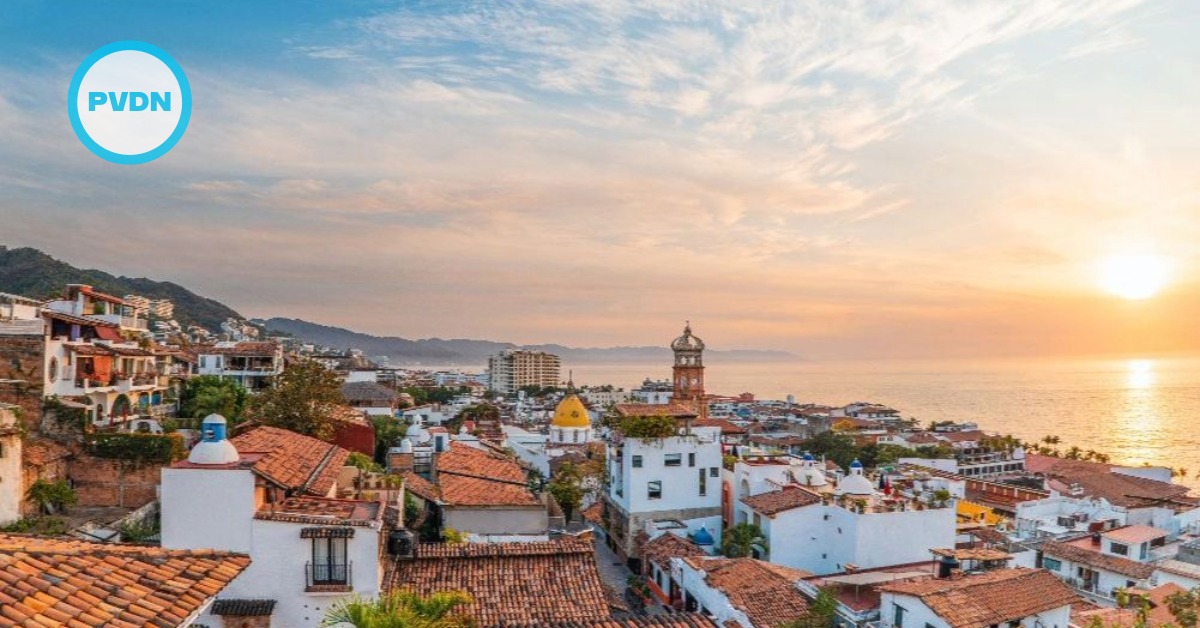
Puerto Vallarta closed 2025 with five million visitors, strong hotel occupancy and cruise arrivals, reinforcing its status as a leading beach city.
Puerto Vallarta’s tourism authorities are closing the year with a clear message after a new state report: Puerto Vallarta’s tourism 2025 strategy held its ground amid a complicated climate and kept the local economy moving. The figures presented by Jalisco’s tourism secretary, Michelle Fridman, at the city’s convention center show five million visitors, an economic impact of 32 billion pesos, an average hotel occupancy of 70 percent and 123 cruise ship arrivals carrying more than 392,000 passengers during 2025.
For the municipal government, led by Mayor Luis Munguía, the report is more than a set of favorable indicators. Local tourism director Alejandra Cornejo described it as proof of a solid year built on sustained promotion, closer coordination with the state government and steady support from the private sector. Business leaders from the hotel, restaurant and business chambers attended the presentation, underlining how dependent the city’s economy remains on visitor numbers and travel spending.
Those headline numbers come with important nuances. According to the state’s own breakdown, the five million visitors and 32 billion pesos in tourism revenue correspond to the period from January to October, with preliminary figures pointing to a stable year in terms of total arrivals, a one-point increase in occupancy and a rise of almost ten percent in average spending by international tourists compared with 2024. In other words, Puerto Vallarta did not necessarily receive more visitors than in 2024, but it did get more value out of each stay.
Puerto Vallarta tourism 2025
The stability in arrivals contrasts with what happened in Jalisco as a whole. While the state closed 2025 with roughly three percent growth in total visitors, mainly driven by its Pueblos Mágicos and inland destinations, Puerto Vallarta’s count stayed flat. Yet the beach city still contributed a significant share of tourism income, helped by higher rates and a hotel sector that kept occupancy near 70 percent across ten months of the year.
State officials have repeatedly described 2025 as a demanding year for tourism, marked by a cooling of the United States market and shifting travel patterns after the post-pandemic surge. In that context, maintaining five million visitors, growing hotel occupancy by one percentage point and increasing average spending looks less like stagnation and more like resilience. Local authorities argue that this outcome reflects quick moves to diversify source markets and a greater push in digital and trade show promotion aimed at both traditional tour operators and online travel buyers.
Cruise tourism also played a visible role in the balance. The report attributes 123 arrivals and more than 392,000 cruise passengers to Puerto Vallarta during 2025, reinforcing the port’s position on Pacific itineraries. Each call brings thousands of day visitors into the city’s waterfront, tours and shops, and helps sustain jobs in transport, guiding and small commerce that depend heavily on these short but frequent spikes in demand.
Beyond occupancy and arrivals, the structure of the hotel market is shifting. Industry analyses for the first months of 2025 point to average hotel occupancy in Puerto Vallarta of just under 73 percent, slightly higher than the broader January to October figure in the state report, and highlight how much of the room inventory is now classified as upper scale or luxury. That trend has attracted new investment and higher nightly rates. Still, it also raises questions about affordability for domestic travelers and the local workforce that increasingly faces higher costs in a city built for visitors.
What the strong year leaves pending
With this backdrop, local officials are eager to frame 2025 as a successful year that still leaves work to do. The new tourism observatory that the state government is setting up is expected to give Puerto Vallarta better information on who is visiting, how long they stay and what they spend money on. Municipal leaders say that kind of detail will be essential for designing promotions that extend benefits beyond the traditional high season and support neighborhoods outside the beachfront core.
Business groups that attended the report presentation have also emphasized the need to match strong tourism indicators with improvements in infrastructure, urban services and safety. A destination that receives five million visitors and hundreds of thousands of cruise passengers in a year must manage congestion, waste, water use and public space in a way that protects residents’ daily life as much as it supports the visitor economy. Those conversations are happening in parallel with investment plans and longer-term discussions about how much additional growth the city and its services can handle.
For now, Puerto Vallarta enters the next season with something rare in a volatile industry: a sense of stability. Visitor numbers are steady, spending is rising and hotel occupancy remains high even as some competing destinations struggle. The real test for 2026 will be whether the city can turn that solid performance into more balanced growth, protecting the qualities that draw travelers here while keeping tourism livable and worthwhile for the people who call Puerto Vallarta home.