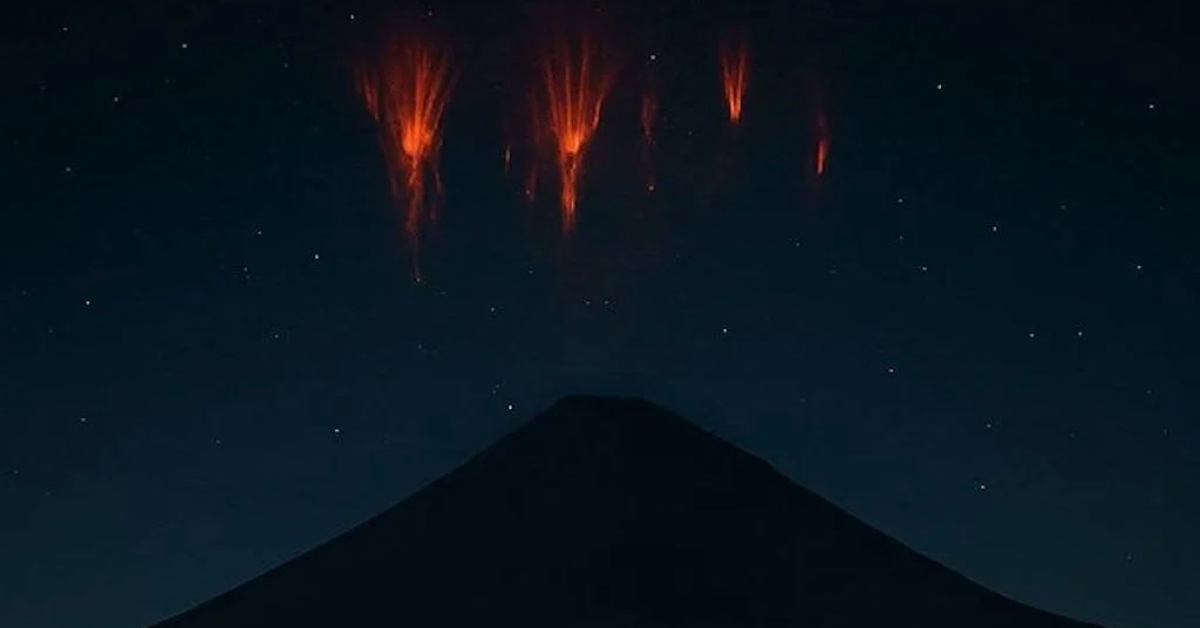
Colima News – In the predawn darkness of Monday, July 21, 2025, observers witnessed a fleeting but vivid light show. Red sprites in Colima danced across the sky above western Mexico. At precisely 3:44 a.m. local time, volcanic monitoring cameras aimed at the towering Fuego Volcano recorded a burst of reddish and orange flashes. Though the bolts seemed to erupt from the volcano’s summit, the display actually took place dozens of kilometers to the north. This was an optical illusion born of camera perspective and the angle of view.
The brief event belongs to a family of rare atmospheric spectacles known as transient luminous events (TLE). Sprites appear high above intense thunderstorms, in the mesosphere between 50 and 90 kilometers above Earth’s surface. However, they can reach altitudes of up to 100 kilometers. Each flash lasts only a few milliseconds, making them nearly impossible to see with the naked eye. Yet volcanic and weather‑monitoring cameras set to record overnight can catch these ethereal glows when thunderstorms rage nearby.
Red sprites in Colima
Unlike ordinary lightning, red sprites arise from positive electrical discharges between cloud tops and the ground. The powerful currents momentarily reshape electric fields in the upper atmosphere. Those shifts excite nitrogen molecules, causing them to emit the trademark reddish glow. In this instance, towering storm clouds north of Fuego generated the necessary charge. While the volcano’s silhouette provided a dramatic backdrop, it deceived the eye and lens alike.
Scientists classify sprites alongside other high‑altitude phenomena such as blue jets and giant jets. Blue jets shoot upward from thundercloud tops to about 50 kilometers, glowing with a cerulean hue. Giant jets combine characteristics of both sprites and blue jets. They span thundercloud tops to the ionosphere more than 70 kilometers above. Each plays a role in Earth’s electrical circuit, linking powerful storms to the rarified air of the upper layers.
Researchers and storm‑chasers have long studied TLEs for the clues they offer about atmospheric electricity and thunderstorm dynamics. The red sprites sighting has drawn fresh attention because it occurred near one of Mexico’s most active volcanoes. Volcanic areas often host unusual weather patterns, and the plasma‑rich ash plumes can influence electrical fields. Although Fuego did not erupt during the event, the visual pairing of volcano and sprite has captivated both scientists and the public.
The July 21 sighting also underscores the value of continuous monitoring. Cameras installed to track volcanic activity operate night and day, collecting hours of footage that can reveal unexpected phenomena. By reviewing overnight recordings, researchers can identify the precise moment and location of a sprite event. Those data help modelers refine maps of electric fields and enhance simulations of how thunderclouds interact with the upper atmosphere.
Studying red sprites in Colima
Atmospheric experts say that each documented TLE strengthens our understanding of the planet’s electrical environment. Studying red sprites in Colima and their kin may improve forecasts of severe weather. This is because the underlying storm properties often drive both ground‑level lightning and high‑altitude discharges. Better forecasts, in turn, help communities prepare for powerful storms that can disrupt power lines, aviation, and communication networks.
While everyday observers may never catch a view of these ghostly lights, their existence reminds us of the hidden drama playing out far above our heads. The recent display over Colima invites us to look beyond familiar thunderstorms and consider the vast, electrically charged sky that envelopes our world. Even in the stillness before dawn, the atmosphere can stage a spectacular, millisecond‑long performance. This performance illuminates both science and wonder.
volcano, atmospheric phenomena, Colima, red sprites, transient luminous events