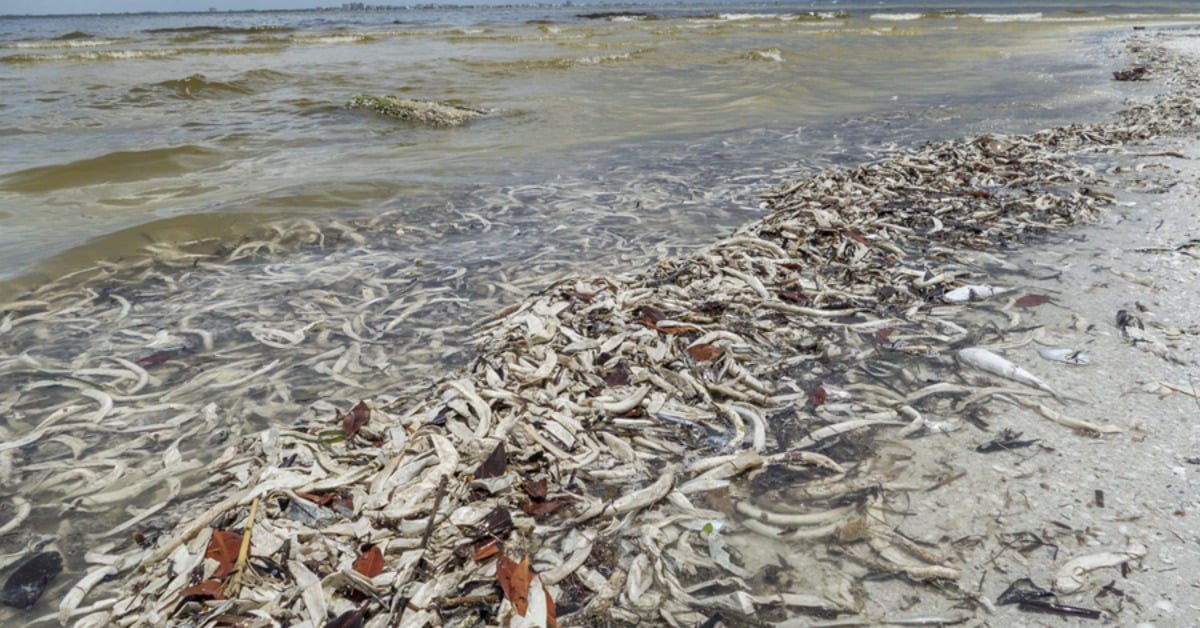
State and federal authorities have confirmed a toxic red tide stretching along the Yucatán coast from Progreso to Celestún, triggering an immediate fishing ban and health advisories for residents and visitors. Laboratory tests detected dangerous concentrations of the microalgae Prorocentrum lima and Pyrodinium bahamense, both capable of producing toxins harmful to humans and marine life.
The announcement came after the Inter-Institutional Committee for the Monitoring and Evaluation of Red Tide 2025 convened on Tuesday. The group, which includes state health officials, environmental agencies, and federal maritime authorities, declared the phenomenon officially active and began rolling out emergency measures along the 40-kilometer affected stretch of coastline.
Health and environmental measures
Authorities ordered a total ban on fishing for all marine species within the impacted area, extending the restriction up to 40 kilometers offshore. Patrols from the Navy, state police, and municipal protection agencies have been deployed to enforce the closure and to prevent the sale of contaminated seafood.
Health officials advised the public to avoid swimming in waters between Progreso and Celestún, warning that contact could cause skin rashes, eye irritation, or respiratory problems. They also urged people not to collect or eat fish, shellfish, or other marine animals found washed ashore.
The state’s environmental monitoring teams will continue daily sampling and satellite tracking to determine how the bloom develops. The committee will remain in permanent session until the algae concentrations drop to safe levels.
A sudden shift from last week’s message
Just five days ago, state officials had downplayed concerns over red tide, stating that water samples from the Progreso, Chelem, and Chuburná areas contained no toxins at levels hazardous to human health. At the time, the government described the discoloration in the water as a “harmful algal bloom” but said it posed little risk beyond mild irritation from organic matter in decomposition.
Now, with new test results confirming the presence of toxin-producing species, the state has moved quickly to impose strict restrictions. The reversal has left many locals frustrated, especially those whose livelihoods depend on fishing and coastal tourism.
Voices from the shore
For small seafood restaurants in fishing towns, the news could not have come at a worse time. “People are already afraid to eat seafood… it’s hurting us,” said María Caamal, who runs a family eatery in Chuburná Puerto.
Fishermen say the ban not only halts their income but also compounds the emotional toll of seeing marine life perish. “It was heartbreaking to see so many fish coming up dead, but we can’t use them… it’s a blow to all of us here,” said Eugenio Ricardez, a local fisherman.
Waiting for the water to clear
With the fishing ban in place, coastal communities face an uncertain period that could last weeks. Recovery depends on wind patterns, currents, and temperature shifts that can disperse the algae. Until then, scientists and health officials will watch the coast closely, balancing public safety with the economic survival of Yucatán’s fishing towns.