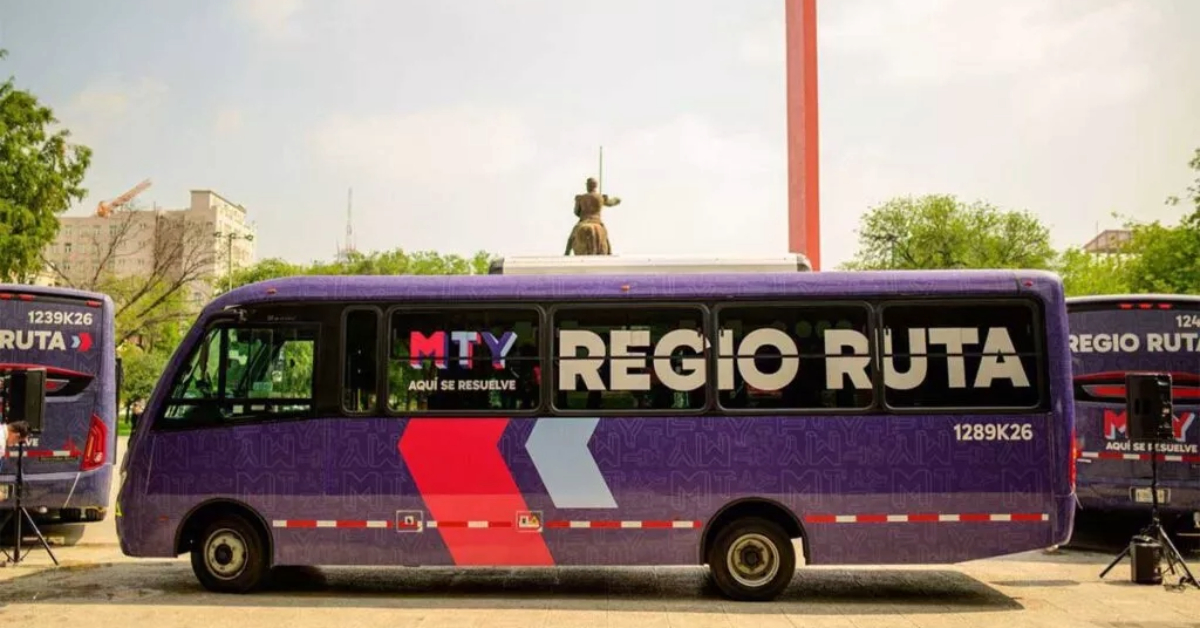
Monterrey News – Regio Ruta Monterrey, the city’s ambitious free bus service, officially began operations this week. Route D now carries passengers between Obispado, Macroplaza, and Fundidora. The state capital’s government says that by rolling out five color‑coded lines, the system will eventually knit together over 320 neighborhoods across Monterrey. Inaugural corridor, Route D, opened to the public on July 24. Routes A, B, C, and E are set to join from August 4 in a phased launch.
Regio Ruta Monterrey expansion plan
Monterrey authorities plan to introduce four additional lines after the success of Route D. Route A will traverse Macroplaza, Mederos, and La Rioja. Route B will link Solidaridad, Plutarco Elías Calles, and Valle Verde. Also, Route C will serve Gloria Mendiola and San Bernabé. Lastly, Route E will connect Colonia Moderna with Félix U. Gómez. Together, the five lines will form a grid designed for convenient transfers, minimizing travel times. This will also reduce reliance on private vehicles.
Service runs from 5:00 a.m. to 11:00 p.m. Monday through Saturday, and from 7:00 a.m. to 11:00 p.m. on Sundays and holidays. During weekdays, buses arrive every 15 to 20 minutes, while weekend headways stretch to 25 minutes. Officials say these frequencies balance efficiency with cost controls, and they will monitor passenger demand to adjust schedules as needed.
Residents of Nuevo León, regardless of their home municipality, can ride any Regio Ruta bus free of charge. The only requirement is to obtain an electronic card at one of the Municipal Service Centers (CAM). Applicants must present a valid photo ID and proof of address. Cards will be activated immediately and can be reloaded at CAM offices or via a forthcoming mobile app. By centralizing the card issuance, the government aims to prevent fare evasion. They also want to simplify data collection for service improvements.
City planners emphasize that Regio Ruta Monterrey aligns with broader sustainability goals. By offering a no‑cost alternative, the network is expected to lure commuters out of cars and onto buses. This change would ease congestion on major arteries like Constitución and Morones Prieto boulevards. In turn, fewer vehicles on the road should lower greenhouse‑gas emissions and improve air quality. The metro area has long been plagued by smog.
Local businesses welcome new system
Local business associations have welcomed the system. Emma García, president of the Monterrey Retailers’ Council, noted that better transit options encourage foot traffic downtown and in emerging commercial corridors. “Accessible, dependable buses will help our employees commute more easily. They will also bring customers into areas that were once difficult to reach without a car,” she said.
Despite the fanfare, some critics urge caution. Urbanist Enrique López warns that without dedicated bus lanes, Regio Ruta could be slowed by the same traffic jams that plague private buses. The government has committed to repurpose select lanes on Avenida Constitución for exclusive Regio Ruta use. Officials say they will work with traffic engineers to optimize signal timing along key segments.
As Regio Ruta Monterrey scales up with Routes A through E, city leaders hope the network will set a new standard for affordable, eco‑friendly transit in Mexico. With service now under way on Route D and expansion on the horizon, Monterrey faces a chance to redefine how its citizens move. Perhaps it can also serve as a model for other metropolitan regions.
Monterrey,Regio Ruta,Nuevo León,public transportation,free transit