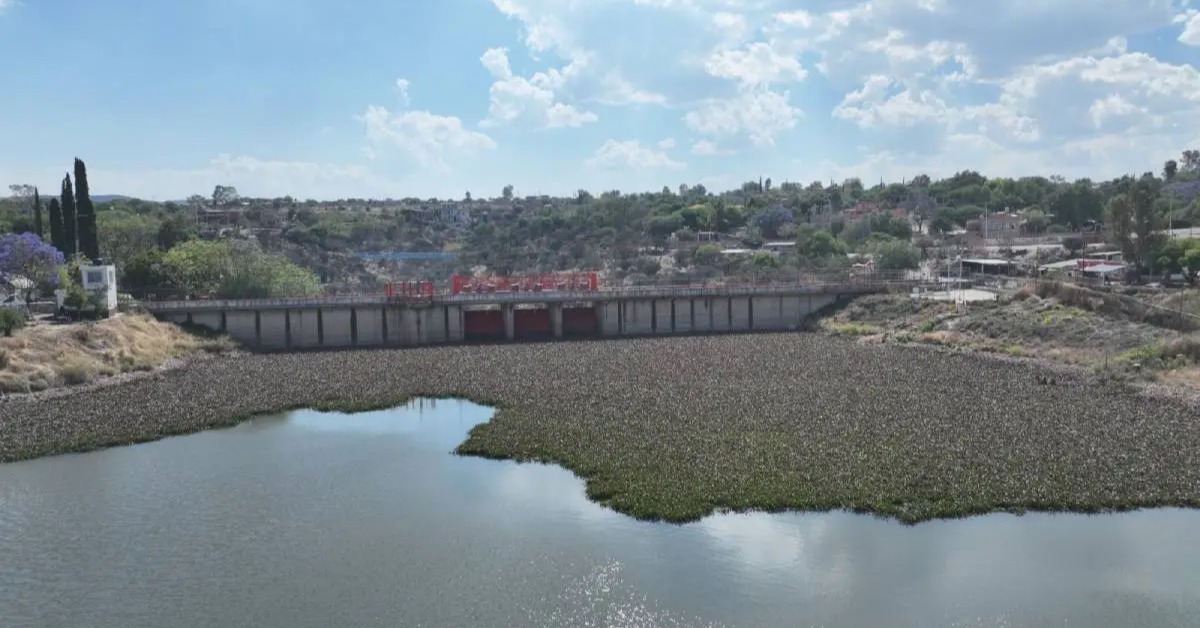
Residents living near Presa Allende are asking federal water officials to support regular Saturday cleanups as communities continue removing water hyacinth, an invasive plant that has spread across parts of the reservoir.
The request was presented during a meeting with representatives of Conagua’s Guanajuato office. Residents proposed a more organized system for continuing the work, including better equipment, local labor support, and a follow-up committee with community representation.
The reservoir, officially known as Presa Ignacio Allende, sits between San Miguel de Allende and Dolores Hidalgo. It is an important water body for nearby communities, fishermen, rural residents, and local recreation.
For many residents, the issue has moved beyond appearances. Thick mats of water hyacinth can block access to the water, complicate fishing, slow boat movement, and make manual removal difficult. The plant also grows quickly when conditions are favorable, which means one cleanup is rarely enough.
What residents are asking Conagua to do
The community proposal focuses on keeping the work going after the first rounds of official intervention.
Residents asked for excavators to be adapted with side rakes or similar tools. They said this could help machinery pull the plant from the water more efficiently.
They also requested temporary employment support for machinery operators and local workers. Some residents suggested that youth-employment programs could help bring in more hands for the cleanup effort.
Conagua representatives said the agency may not be able to attend every Saturday workday. Residents, however, said they want to keep organizing local cleanups each weekend.
Federal officials also said a follow-up committee could be formed within about a month. The committee is expected to include community delegates, fishermen, and civil groups involved in the cleanup.
That committee could become important because the cleanup will likely require repeated work. Water hyacinth moves with wind and water conditions, and crews may need to shift machinery as the plant collects in new areas.
Machinery has helped, but residents say it is not enough
Heavy machinery has been brought in to help remove the plant. But residents said the equipment has not always been ideal for the job.
Some machinery has reportedly been difficult to move around the reservoir. Residents also said some vehicles have had mechanical problems, while others have operated only intermittently.
Conagua representatives acknowledged that the available equipment is not perfect for the terrain and conditions. They asked residents to work with what is currently available while the cleanup advances.
This is one reason residents are asking for better attachments and more technical planning. Removing water hyacinth by hand can be slow and physically demanding. Removing it by machine can also be difficult if the equipment is not suited to the site.
The current work has focused on the area near the dam curtain. Officials and residents are now considering a second work front at another access point.
Why water hyacinth is such a hard problem
Water hyacinth is one of the most difficult aquatic invasive plants to manage. It can form dense floating mats that spread quickly across reservoirs, canals, lakes, and wetlands.
Its growth is often linked to nutrient-rich water. That can include runoff, wastewater discharges, and other sources of organic material. When those conditions are present, mechanical removal may clear part of the surface, but the plant can return.
That is why the Presa Allende cleanup is also tied to a wider discussion about wastewater treatment.
Conagua officials said they have been meeting with water-system operators in San Miguel de Allende and Dolores Hidalgo. The goal is to review treatment-plant operations and identify changes needed to improve performance.
Authorities also discussed municipal slaughterhouses as part of the broader review of local discharge sources. In both municipalities, temporary suspensions at slaughterhouse facilities were discussed.
For residents, that part matters. If water entering the reservoir continues to feed the plant, cleanup crews may keep removing hyacinth without solving the cause of its growth.
A local environmental issue with economic effects
The spread of water hyacinth has also affected people who depend on the reservoir.
Fishermen in the area say the plant has reduced access to fishing zones and made the use of nets more difficult. Some have reported sharp drops in income as catches became harder to reach.
Boat rides and small tourism activities have also been affected in some lakeside communities. When the surface is covered, boats can become trapped or unable to operate safely.
The affected communities include areas around San Marcos, Presa Allende, and Flores de Begoña. These are places where fishing and access to the reservoir are part of daily life, not just scenery.
For foreign residents in San Miguel de Allende, the issue is also a reminder that water management affects more than household supply. It shapes local livelihoods, public health, recreation, rural economies, and the condition of natural spaces around the city.
What happens next
The next community assembly is expected on May 16 in Flores de Begoña. A large cleanup day is also expected that same day.
Conagua has committed to a monthly mass cleanup. Residents are pushing for Saturday cleanups to continue between those greater efforts.
The main question is whether the work can become consistent enough to slow the plant’s spread. That will likely depend on several pieces moving simultaneously.
Machinery must be adapted or improved. Local labor needs to be organized. Communities need clear schedules. Authorities need to track progress. Wastewater and discharge controls must also improve.
Without that wider plan, Presa Allende could face a cycle seen in many water bodies: cleanups remove visible plants, but new growth returns because the underlying conditions remain.
For now, residents are asking for a role in the solution. Their proposal would keep the pressure on authorities while giving local communities a formal place in the cleanup process.