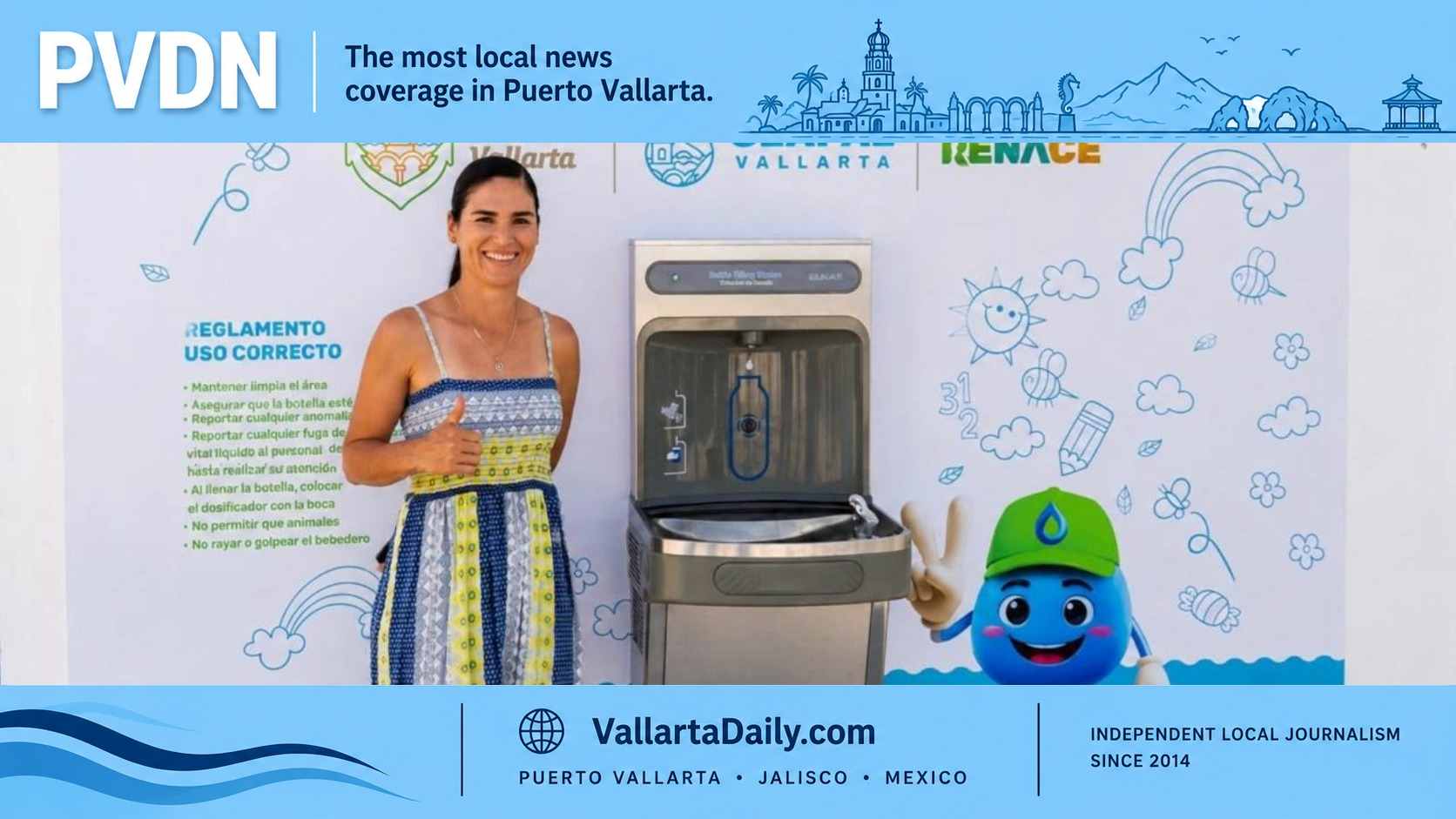
Puerto Vallarta, Jalisco, August 7, 2026 – Seven free public drinking-water stations are planned for busy locations around Puerto Vallarta, but the project is also reviving a service the city has tried before, with a history that includes damaged equipment and a Malecón installation that ran into trouble with municipal inspectors just this week.
SEAPAL’s initial plan calls for three stations at the Agustín Flores Contreras sports complex, with one each at the La Lija sports complex, the Unidad Municipal Administrativa (UMA), SEAPAL’s headquarters and the Malecón.
The stations will provide potable water at no charge and are intended for people exercising, walking through the city, working nearby, or spending time in public spaces, according to the announcement released Thursday.
What the announcement does not provide is an installation schedule, project cost or maintenance plan. It also does not say whether all seven stations are new installations.
That distinction is relevant at Agustín Flores Contreras. In June, SEAPAL announced three drinking-water dispensers and a bottle-refilling system for the Vibra Jalisco World Cup fan zone in front of the sports complex. The latest announcement again identifies three stations at Agustín Flores Contreras without specifying whether they are those same units, permanent replacements, or additional equipment.
Public drinking fountains themselves are also not new to Puerto Vallarta.
SEAPAL records from 2018 show six stations operating under the earlier Agua para Todos program. They included fountains at Agustín Flores Contreras, the Centro and Zona Romántica sections of the Malecón, Marina Vallarta and SEAPAL’s offices. Those installations included bottle-filling taps and accommodations for children, people with disabilities and pets.
Keeping the equipment operating proved to be another issue. In May 2024, Tribuna de la Bahía documented damage to two fountains at Agustín Flores Contreras. One was described as badly damaged and no longer supplying water, while the other remained functional but had also deteriorated.
The history makes maintenance of the new stations an important unanswered part of the current plan.
The Malecón installation has a more immediate complication.
Puerto Vallarta’s Urban Development Department recently placed closure seals on construction there after department director Edén Castillón said he did not know what the structure was and sent inspectors to investigate. It was subsequently identified as a SEAPAL drinking-water station.
SEAPAL director Carlos Ruiz then said the design would be scaled down. The original structure was intended to provide water for people and pets, but nearby businesses objected to its dimensions. The revised station will be smaller and intended only for people.
SEAPAL’s latest announcement says the Malecón station has been discussed with businesses and residents in Centro. The sequence nevertheless shows that construction reached the Malecón before the city’s Urban Development director was aware of the project’s purpose.
The quality of the municipal supply itself has recently cleared state review. Vallarta Daily reported in July that Puerto Vallarta retained its sanitary certification for the public drinking-water system. That certification covers SEAPAL’s supply network and water-quality controls, rather than guaranteeing conditions at every individual faucet or outlet.
For the new public stations, the remaining questions are therefore less about whether Puerto Vallarta has potable municipal water and more about when the fountains will be available, how they will be maintained, and whether this version of the public-water program can remain functional over time.