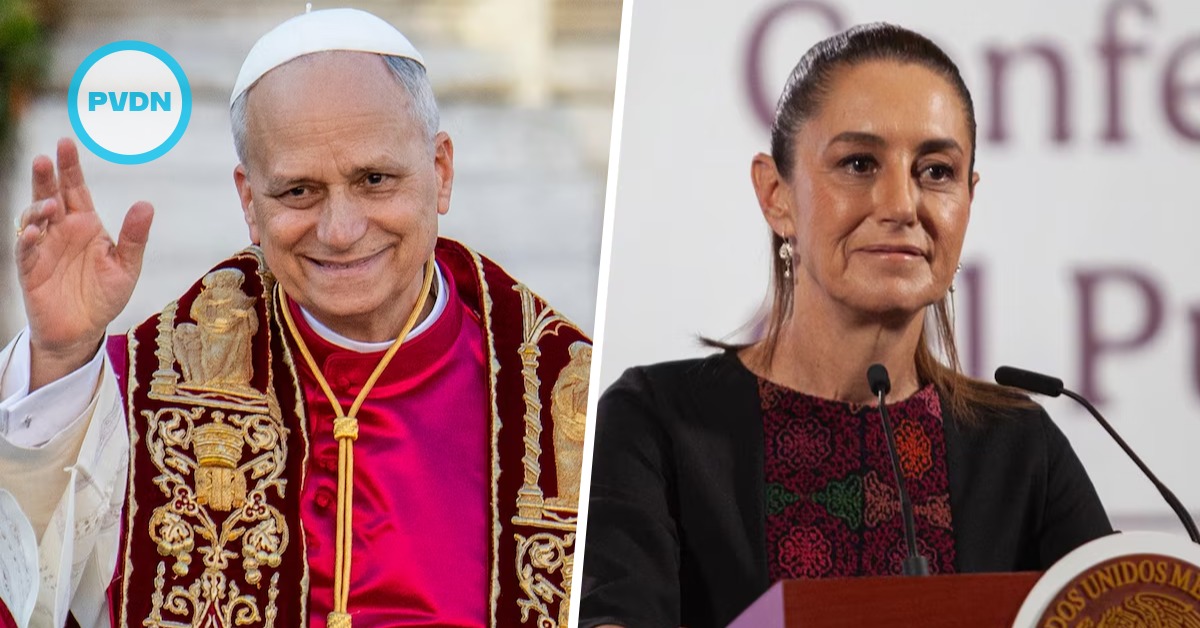
Sheinbaum phoned Pope Leo XIV on Dec. 12, inviting him to Mexico and tying it to Guadalupe celebrations as pilgrims filled the capital.
Mexico’s president made a high-profile call on one of the country’s most emotionally charged dates. On Friday, Dec. 12, Sheinbaum calls Pope Leo XIV, inviting him to visit Mexico.
Sheinbaum shared the news in a brief message posted on social media, and Mexico’s presidency later echoed the same account in an official note. The call took place on the Feast of Our Lady of Guadalupe. Mexico City fills with pilgrims, traffic closures, and a mood that is part devotion and part civic ritual.
The timing also mattered inside Mexico’s daily news cycle. The invitation spread first through her social channels, not the presidential podium.
City authorities expected about 13 million people to arrive around the Basilica of Our Lady of Guadalupe during the peak days of the celebration. The basilica complex sits in the north of the capital, but the devotion reaches far beyond Mexico City. Pilgrims travel for days from distant towns, often on foot, to reach the shrine.
In her message, Sheinbaum said the Pope sent greetings and blessings to Mexicans on the feast day. She also framed the moment carefully for a secular republic. Sheinbaum said they agreed that the Virgin of Guadalupe is a symbol of identity and peace for Mexicans. She said that holds beyond any one religion, and within a secular state.
No date was announced for any papal trip. The Vatican has not confirmed whether Leo XIV accepted the invitation. But the call places Mexico near the front of the line for an early Latin America visit by a pontiff still in his first year.
The call also fits a familiar pattern in Mexican politics, where leaders often acknowledge Guadalupe as a national symbol even while keeping government formally secular. That balance is never perfect, and it is often debated. But Dec. 12 remains a day when public officials, quietly or loudly, have to decide how to show respect without blurring the line.
Officials framed the exchange as cordial and brief, not a negotiation. A papal visit, if it comes, would take months of planning.
Sheinbaum calls Pope
The Dec. 12 invitation was not Mexico’s first move. In May, Mexico’s interior minister, Rosa Icela Rodríguez, attended the Vatican ceremony marking the start of Leo XIV’s pontificate. She delivered a formal letter from Sheinbaum inviting him to Mexico.
That earlier outreach matters because papal travel is not arranged on the fly. The Holy See usually coordinates routes and security well in advance with host governments and local church leaders. A public invitation is one thing. A second invitation, tied to Mexico’s biggest religious feast day, signals the administration wants the visit to feel diplomatic and culturally grounded.
The choice of date also explains why the message landed quickly. Dec. 12 is not just another holy day. For many Mexicans, Guadalupe is part faith and part national story. It appears in family altars, neighborhood murals, and public life. The line between religion and civic identity often blurs.
That blurring can be politically sensitive. Mexico’s constitution establishes a secular state, and modern presidents generally avoid the appearance of governing through a religious lens. Sheinbaum’s wording leaned into that line. She did not present the call as a religious act. She presented it as recognition of a symbol that many Mexicans treat as cultural, even when they do not practice Catholicism.
The Vatican, for its part, kept the day on its own calendar. Leo XIV celebrated a Mass in St. Peter’s Basilica for the Feast of Our Lady of Guadalupe. In his homily, he spoke of Mary as a mother who brings joy where human joy is lacking. He urged a faith that shows itself in love for people who are suffering.
For Mexico, the politics of the day play out on the streets. Each year, authorities deploy large-scale traffic controls, medical teams, and public safety operations around the basilica complex. The crowds are a reminder that any papal trip would have a massive public dimension. That is true even if the visit is framed for a secular country.
Leo XIV, born Robert Francis Prevost, became pope in May 2025. In his early messages, he has repeatedly spoken about peace and dialogue. That profile helps explain Sheinbaum’s emphasis on his focus on the poor and on peace. She has often centered social policy and public security in her public message.
In recent days, Sheinbaum had already signaled she wanted direct contact with the pontiff. Early in December, she said her government was seeking a call to extend the invitation personally. Friday’s announcement suggests that effort succeeded, at least to the point of making the request directly.
There is also a practical reason the invitation is being framed early and often. Vatican travel plans can shape local calendars for months. They require coordination with dioceses, municipal governments, and federal security teams. Even small schedule changes can ripple across transport plans in a city as dense as Mexico City.
If a Mexico trip happens, the Basilica of Guadalupe would be an obvious focal point. It is also a place where a pope’s words can travel beyond church walls. The image of Guadalupe is used as family heritage, a national emblem, and comfort in hard times.
In May, after the inaugural Mass, Mexico’s interior ministry said Rodríguez delivered the invitation letter during the greeting of official delegations. The same statement said the Pope also sent a message back to Sheinbaum. The details of that message were not made public. It underscored that Mexico’s outreach has been active since the first days of the new pontificate.
The Vatican’s own profile of Leo XIV points to a leader shaped by the Americas. Born in Chicago, he spent many years in Peru and is a member of the Augustinian order. That background helps explain why Latin America is often mentioned early when questions turn to his future travel plans.
Even with an invitation, the path to a papal visit is slow. The Holy See typically confirms foreign travel only after planning and talks with bishops and the host government. Dates can shift, and itineraries are often announced in stages. For Mexico, that means the invitation is the start of a process, not the end.
What a Mexico visit would signal
A papal trip to Mexico is never just a photo opportunity. It carries diplomatic weight with the Holy See. It also lands in a country where Catholic tradition remains influential. Public life is formally secular, and religious practice is changing.
Mexico has also been a focal point for papal messaging in the past. Pope Francis visited in February 2016, with events in Mexico City that included a Mass at the Basilica of Guadalupe. That visit blended pastoral themes with pointed remarks on poverty, migration, and violence. Any return by a new pope would invite comparisons, especially if the trip included a stop at the basilica and meetings with government leaders.
For Sheinbaum, an eventual visit could open space for a softer kind of diplomacy. Mexico’s agenda with the Vatican is not about trade or military ties. It is more symbolic, but still real. It touches on peacebuilding, migration, and the role of Catholic social work in communities affected by violence and inequality.
The invitation also lands during a busy moment in Rome. The Catholic Church is in a Jubilee year with frequent events that draw large pilgrim crowds to the Vatican. Leo XIV has suggested that major foreign travel may be scheduled gradually. That may leave more room in 2026.
Still, the political signal is already clear. Sheinbaum aligned her invitation with a day when Mexico’s public space is filled with faith and cultural identity. She also used language meant to reassure Mexicans who value the secular character of the state.
For many readers, the most practical question is simple. Will Leo XIV come, and when? As of Friday, there is no date, and no confirmation of acceptance. What exists is a public invitation, a prior formal letter, and a moment of mutual symbolism on Dec. 12.
If the Vatican eventually says yes, Mexico would likely hear familiar themes: peace, care for the poor, and dignity for migrants. In Mexico City, the center would almost certainly be Guadalupe, where faith and identity overlap in plain sight.