Washington’s new Shield of the Americas coalition was built without Mexico, but Mexico will still feel its effects. The issue is not only security. It also touches sovereignty, trade leverage, migration talks, and the balance of power in the bilateral relationship. As the United States pushes a more militarized cartel strategy, Mexico must decide how far it can cooperate without yielding control. The real question is whether this new pressure weakens Mexico’s position or gives it new bargaining tools.
What Washington launched and why Mexico was absent
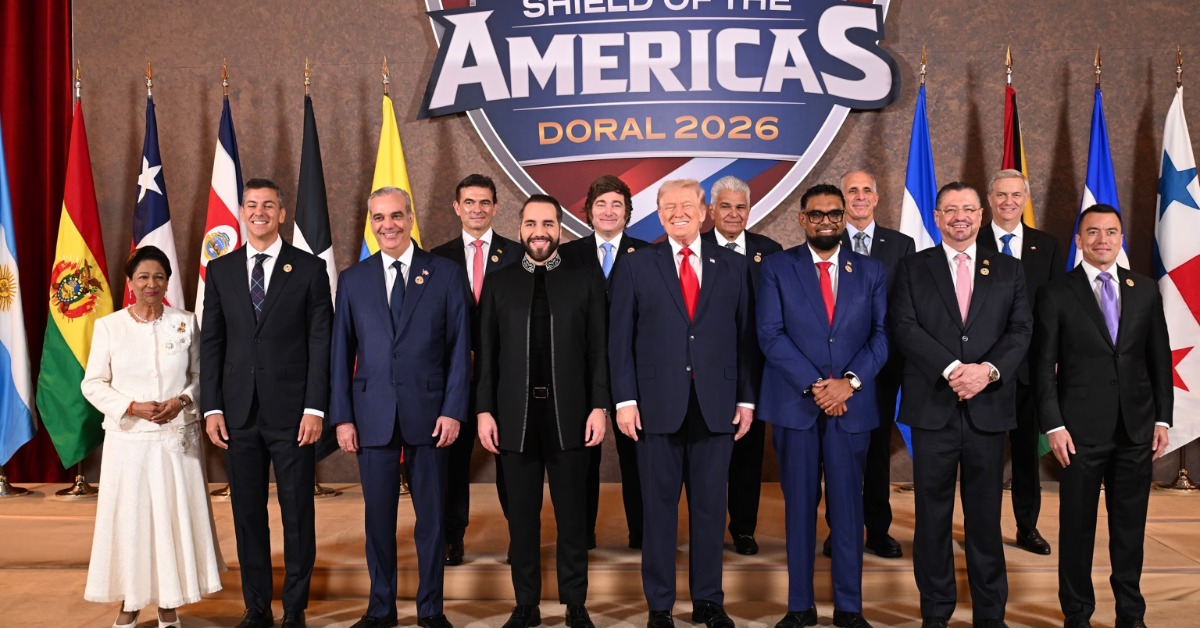
The Shield of the Americas initiative was unveiled at a March 7, 2026, summit convened by Donald Trump at Trump National Doral Miami. At the event, Trump announced a new regional military coalition aimed at “eradicating cartels” in the Western Hemisphere and said “17 nations” had formally joined. In parallel, the U.S. released a proclamation titled “Commitment to Countering Cartel Criminal Activity,” which frames counter-cartel action as a coordinated, hard-power project.
The proclamation’s text makes the coalition’s intent unusually explicit. It asserts that the administration has already designated “a number of cartels and transnational gangs” as foreign terrorist organizations, describes them as entities that “control territories and commerce,” and calls for partners to “operationalize hard power.” It also states that the U.S. will “train and mobilize partner nation militaries,” while linking the effort to keeping “malign foreign influences” out of the hemisphere. In press coverage, Trump also used the summit to cast Mexico as a central locus of cartel activity and to warn against “hostile foreign influence,” including in strategic infrastructure such as the Panama Canal.
Mexico’s absence was not an accident of scheduling. Multiple accounts describe an “ideological” guest list and note the absence or exclusion of major regional powers, including Brazil, Colombia, and Mexico. In contrast, the leaders mentioned as present included counterparts from Argentina, Ecuador, and El Salvador, among others. The net effect is a new security format designed to work around—not through—the traditional U.S.–Mexico security architecture.
Mexico’s sovereignty doctrine and constitutional friction points
Mexico’s modern sovereignty posture is not only political; it is embedded in constitutional text that constrains how far any Mexican administration can go in accommodating foreign “kinetic” action on its territory. In the English-language constitutional text published by Mexico’s electoral tribunal, Article 76 grants the Senate the power to authorize the executive to permit “passing of foreign troops through the country” and the “stay of foreign troops for more than one month on Mexican waters.” Separately, the Supreme Court’s English translation of Article 89 lists the guiding principles of foreign policy as “self-determination,” “non-intervention,” and “pacific settlement of disputes,” among others. These provisions do not eliminate security cooperation, but they create legal and political tripwires around any U.S. military presence or unilateral action.
Those constraints have been repeatedly invoked by Claudia Sheinbaum. After a January 2026 call with Trump, Sheinbaum publicly ruled out U.S. military intervention and framed collaboration as “coordination without subordination,” explicitly tying the boundary to sovereignty. Reuters and other reporting around the same period describe escalating U.S. threats and requests related to cross-border action against fentanyl labs, which Sheinbaum declined.
The sovereignty issue sharpened further when the U.S. applied “terrorism” labels to major cartel groups. In February 2025, reporting on the designations captured Sheinbaum’s position in plain terms: she rejected any move that implied extraterritorial action in Mexico while signaling openness to joint investigation and U.S.-side enforcement (such as targeting money laundering networks). That combination—cooperate while preserving jurisdictional control—maps closely onto the constitutional principles cited above.
Mexico’s modern non-intervention posture also has a deeper historical narrative that continues to influence current diplomacy. A legal history discussion of the Genaro Estrada doctrine traces how Mexico’s 20th-century experiences with external interference, including U.S. actions during periods of internal conflict, fed a long-standing preference for non-judgmental and non-interventionist foreign policy. In today’s context, Shield of the Americas is landing on a sovereignty doctrine designed, in part, to limit precisely the kind of externally driven security agenda now being proposed.
The legal-policy shift behind the coalition
The Shield of the Americas coalition sits atop a broader U.S. policy turn: the relocation of cartel-fighting from a law-enforcement framing to a militarized doctrine. At a March 5, 2026, gathering hosted at U.S. Southern Command, Stephen Miller said cartels “can only be defeated with military power,” explicitly contrasting the meeting with a “conference of lawyers.” Reporting around the same week describes U.S. defense leadership urging Latin American partners toward a more offensive posture.
This shift is not only rhetorical. On January 20, 2025, the White House published an order establishing a process for designating “international cartels” and other groups as Foreign Terrorist Organizations (FTOs) under immigration law and as Specially Designated Global Terrorists (SDGTs) under sanctions authorities, while declaring a national emergency under IEEPA. The order directs rapid interagency recommendations and instructs operational preparations under the Alien Enemies Act in defined circumstances, signaling how closely the administration is linking immigration tools to cartel policy.
The designations that followed are documented in primary U.S. government records. A February 2025 State Department notice published via the Federal Register lists eight organizations designated as FTOs: Tren de Aragua; Mara Salvatrucha; Sinaloa Cartel; Cartel de Jalisco Nueva Generación; Cárteles Unidos; Cartel del Noreste; Cartel del Golfo; and La Nueva Familia Michoacana. A later Treasury alert reiterates the same list and frames the resulting sanctions and criminal liability risks for U.S. and foreign entities.
For Mexico’s sovereignty and bargaining power, the “terrorism” designations matter because they widen U.S. enforcement reach in ways that do not require U.S. troops to cross a border. U.S. law makes it a federal crime to provide material support to a designated FTO (18 U.S.C. § 2339B), and the designation statute itself is codified at 8 U.S.C. § 1189. The Treasury’s own guidance emphasizes that foreign financial institutions could face correspondent or payable-through account sanctions if they knowingly facilitate significant transactions for designated organizations, and that non-U.S. persons may themselves become exposed to sanctions or penalties through dealings touching U.S. jurisdiction. This creates a path for Washington to apply pressure through finance, compliance, and corporate risk, even when Mexico resists direct military involvement.
Trade dependence and leverage around the USMCA review
Mexico’s bargaining power over a U.S.-led cartel coalition is shaped by a separate reality: deep trade interdependence and the timing of formal treaty reviews. On a goods-only basis, the U.S. Census Bureau lists Mexico as the United States’ top trading partner in 2024, with $839.9 billion in total goods trade that year (Census basis, unrevised). From Mexico’s side, the concentration is clearer: a World Bank trade summary reports that Mexico’s exports to the U.S. accounted for about 79.95% of Mexico’s exports in 2023.
The 2026 timing adds leverage—and risk—because the trade agreement itself is built around a scheduled review. The text of Article 34.7 requires the parties to meet on the sixth anniversary of entry into force for a “joint review,” and it requires each head of government to confirm in writing whether they wish to extend the agreement term for another 16-year period. In practical terms, this creates a high-stakes negotiating window in which security, migration, and trade issues are often discussed in the same political arena, even if they are not formally linked in treaty law.
Recent U.S.–Mexico exchanges show how quickly trade threats can become bargaining instruments in cartel policy. In 2025, reporting described U.S. tariff pressure on Mexico alongside large-scale extraditions and renewed U.S. demands for crackdowns, with Sheinbaum acknowledging additional lists of targets for extradition. Separate reporting in early 2026 notes U.S. messaging that “incremental progress” on border security is “unacceptable” and that upcoming engagements would require “concrete, verifiable outcomes” tied to dismantling “narcoterrorist networks” and reducing fentanyl trafficking.
For residents and expats living in Mexico, the economic channel is not abstract. The peso’s sensitivity to political risk can be tracked day-to-day using official Mexican data: Banco de México publishes the daily “FIX” exchange rate and describes the methodology as a wholesale-market average. That makes it possible to measure whether major rhetoric spikes—such as threats of missile strikes or new sanction authorities—coincide with short-lived currency volatility or changes in domestic rate expectations.
Migration and security coordination as bargaining channels
Mexico’s sovereignty stance is being tested not only by cartel policy but by the way Washington is merging cartel issues with border management. A January 2026 call between Mexico’s foreign minister and Marco Rubio produced a joint statement reaffirming the partnership, while the U.S. publicly warned that incremental progress was insufficient and that future engagements required “concrete, verifiable outcomes.” This matters because border control and fentanyl flows are among the few issue areas where Washington can demand near-term metrics and use them to justify near-term pressure.
The most direct test of sovereignty remains U.S. requests for operational presence in Mexico. A Reuters report on U.S. pressure described U.S. officials seeking U.S. forces—either special operations troops or CIA officers—to accompany Mexican forces on raids targeting suspected fentanyl labs. Sheinbaum’s rejection of U.S. military intervention and her “coordination without subordination” formulation indicate that Mexico is trying to hold the line at intelligence sharing, domestic enforcement, and extraditions rather than joint kinetic operations involving U.S. personnel.
The coalition framework amplifies leverage by creating alternative partners for the U.S. When Mexico is not at the table, Washington can point to other governments willing to align publicly with the hard-power strategy, then use that alignment to increase diplomatic isolation or to set a “regional standard” of cooperation. At the same time, the U.S. can pursue operational models elsewhere—such as joint military actions announced with Ecuador—reinforcing the claim that hard-power cooperation is feasible with willing partners.
What the coalition changes for Mexico’s sovereignty and bargaining power
The central change is structural: Shield of the Americas creates a U.S.-led security bloc that treats cartel policy as a military coalition problem, while Mexico’s doctrine treats internal security and the use of force on its territory as core functions of sovereignty governed by constitutional principles. When these two systems collide, Mexico’s options narrow into trade-offs between jurisdictional control and bilateral friction management.
A sovereignty-preserving posture remains available, but it likely requires Mexico to demonstrate measurable cooperation that does not cross into “subordination.” The record of recent actions often cited in bilateral dynamics includes extraditions and transfers, along with commitments to pursue fentanyl and arms-trafficking cases. That approach aligns with Sheinbaum’s position that Mexico will cooperate while rejecting U.S. military intervention, and it fits the constitutional guardrails on foreign troop presence.
The coalition also creates a bypass risk: Washington can intensify operations with partners in other jurisdictions and claim momentum, potentially changing trafficking routes and enforcement pressure around Mexico without Mexico’s consent. U.S.–Ecuador joint operations announced through U.S. Southern Command illustrate an operational template the U.S. can point to when arguing that hard-power cooperation is already underway elsewhere. Even when U.S. personnel are described as not directly engaging in combat, the presence of U.S. training, intelligence, and deployment support still changes regional expectations about what “cooperation” means.
Mexico’s bargaining power, meanwhile, is not only defensive. Integrated supply chains make the relationship costly to disrupt for both sides. With Mexico the top U.S. goods trading partner and with export concentration heavily tilted toward the U.S., both governments face high economic stakes in any escalation. The 2026 USMCA joint review requirement further heightens the cost of prolonged deterioration because it creates a formal moment when political trust can affect expectations of trade continuity. In that context, Mexico’s leverage is strongest when it can credibly offer outcomes (fentanyl reductions, high-value arrests, extraditions, or financial disruption of networks) while refusing measures that trigger domestic constitutional or political backlash.
The most consequential—and least visible—pressure channel may be compliance and finance rather than military action. The Treasury’s OFAC alert explicitly flags “sanctions and criminal liability risks” for U.S. and foreign financial institutions and notes material-support exposure for dealings with designated entities, while OFAC’s guidance states that foreign financial institutions may face sanctions risk if they facilitate significant transactions involving SDGTs. For Mexico, this implies that national sovereignty debates may increasingly be shaped by how banks, exporters, and multinational firms adjust risk tolerance, not only by diplomatic statements about troop presence.