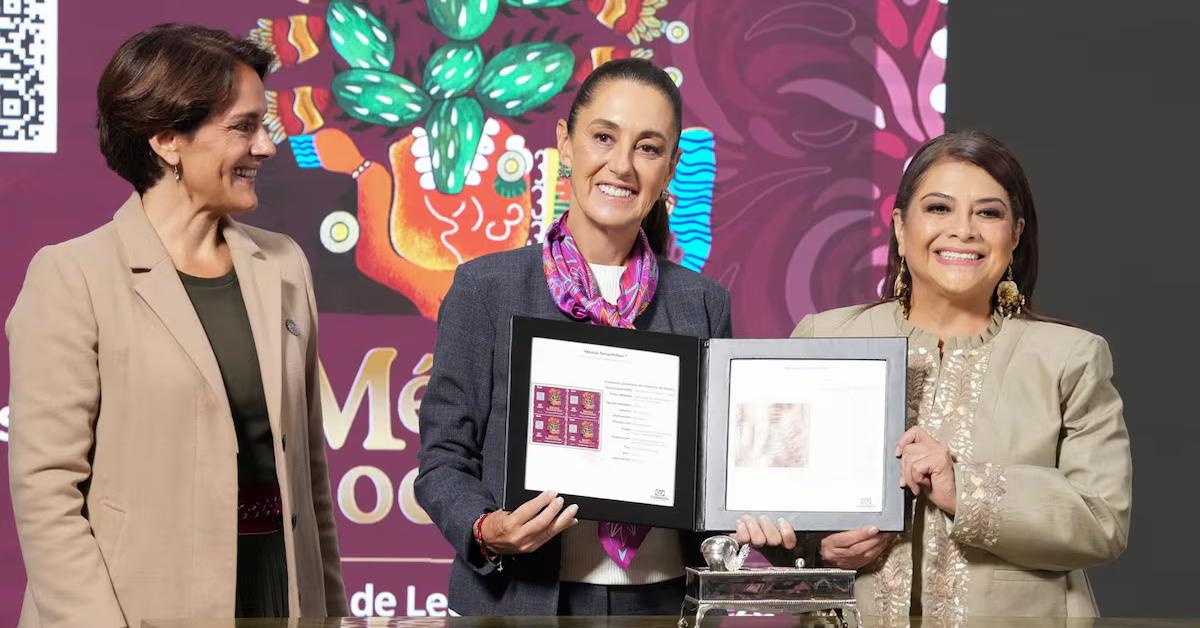
Mexico News – The city built on a lake marked its seventh centenary with ink, paper, and legend. During President Claudia Sheinbaum’s morning press conference, Head of Government Clara Brugada and Correos de México director Violeta Abreu presented a new postage stamp that carries the image at the heart of Mexico’s origin story: the eagle devouring a serpent atop a prickly pear cactus. Brugada called it “an artistic and documentary piece that will bring the memory of this city built on water to every corner of the country,” and an invitation to reflect on the founding of México-Tenochtitlan.
Tenochtitlan 700 years
The stamp anchors a national remembrance of Tenochtitlan 700 years, a milestone for one of Mesoamerica’s great capitals. Abreu said the issue pays homage not only to the city’s greatness but also to the postal workers who have moved messages across this land for centuries. Tradition meets technology on this small square: a QR code lets anyone with a phone pull up more information on the anniversary and the history behind it.
Correos de México chose a stamp because philately is part of the country’s “legacy of greatness,” a practice that began in 1856. This release keeps that legacy alive while opening a digital door to younger audiences. Abreu stressed that the service stands for continuity yet seeks to innovate. The QR element is a simple way to bridge past and present without losing the ritual of sealing an envelope.
A design loaded with symbols
Printed in burgundy, the stamp frames the central image with curved white and reddish lines. On the left sit the price, the QR code, and the Correos de México logo. On the right runs the legend: “México Tenochtitlan, siete siglos de legado de grandeza.” The cactus rises from Copil’s heart. The composition also shows the eagle of water and fire, a Nahuatl image of war that recalls the martial power tied to the city’s birth. José Alfonso Suárez del Real, Mexico’s representative to the Council of Europe, summed it up simply: “It’s a stamp that will travel the world.”
Price, reach, and print run
Two hundred thousand copies are on sale now. Each costs nine pesos and can frank national or international letters. With the Mexican postal service present in more than 190 countries, this small burgundy square is set to circulate far beyond the Valley of Mexico. For collectors, the run is modest enough to matter. For everyday senders, it is accessible and usable.
The heart beneath the cactus
The legend tied to the image runs deep. Copil, son of Malinalxochitl, sought revenge on his uncle Huitzilopochtli, the war god. He traveled from Malinalco to Chapultepec to confront him. Warned of the threat, Huitzilopochtli ordered his warriors to seize Copil’s heart. They did, and he had it buried under stones. By the next day, a massive prickly pear cactus had sprouted. It was on that very cactus, the story goes, that the eagle landed with a serpent in its beak, signaling the site where the Mexica would build their city.
That image later anchored the national coat of arms and the flag. Today it anchors a stamp meant to stir memory. Brugada framed it as legacy. Abreu framed it as duty and renewal. Suárez del Real framed it as motion across borders. Each view reflects a layer of the city’s story: myth, governance, and constant exchange.
Memory you can mail
Stamps are small, but they move. They pass through hands, slip into albums, and cross oceans. This issue asks senders to carry a fragment of the capital’s past in the corner of an envelope. It also asks recipients—who may scan the QR code out of curiosity—to read a short digital lesson on a city that rose from water and prophecy.
Seven hundred years on, the place once called Tenochtitlan remains Mexico’s political and cultural center. The stamp does not tell that full story. It does something humbler: it marks the date, sketches the myth, and keeps the symbol alive in daily life. In doing so, it turns a postal tool into a small act of remembrance for Tenochtitlan 700 years.