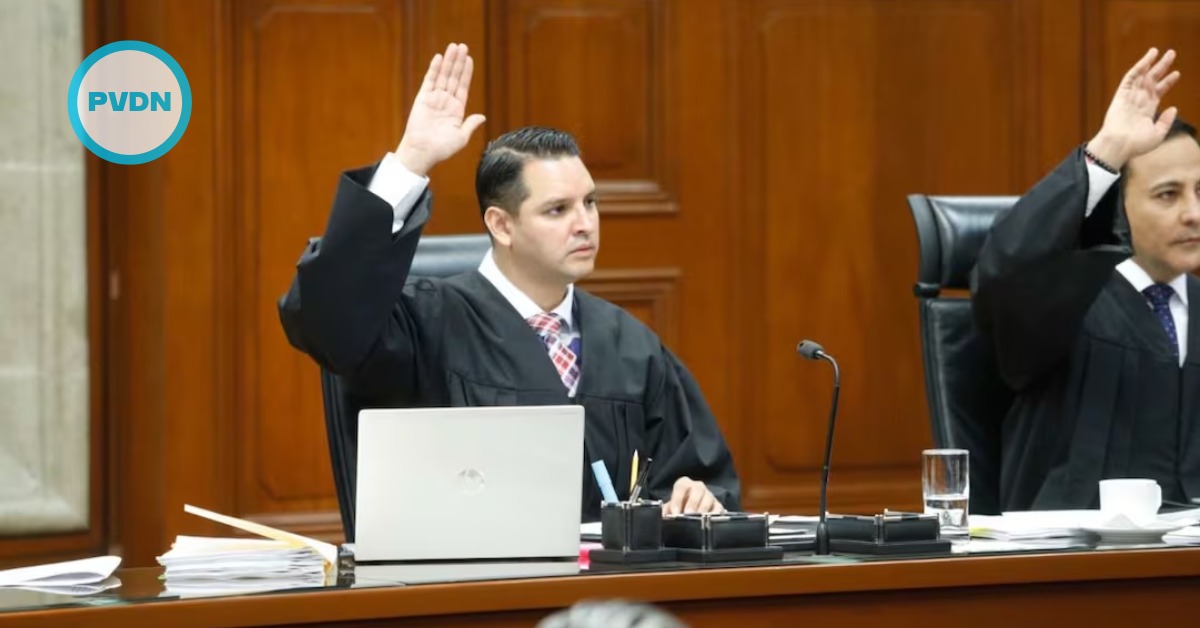
Mexico’s Supreme Court overturns a Tamaulipas law that labeled homosexuality as corruption of minors, reaffirming equality and LGBT rights.
Mexico’s highest court has thrown out part of Tamaulipas’ penal code that treated homosexuality as a way of “corrupting” minors, closing the door on one of the most openly homophobic provisions written into state law in recent years.
In a unanimous ruling, the Supreme Court of Justice of the Nation (SCJN) declared unconstitutional a section of Article 192 of the Tamaulipas Penal Code, which equated inducing a child to “homosexualism” with exposing them to alcohol, drugs, prostitution or criminal gangs. The justices held that the rule violated the rights to equality, non-discrimination and the free development of personality.
The case reached the bench through an action of unconstitutionality filed by the National Human Rights Commission after the local Congress, with a Morena majority, approved the reform in 2024. From that moment, Tamaulipas’ law defined corruption of minors as conduct that “recluta, obliga o induce a la práctica de la homosexualidad,” language that framed sexual orientation as something that can be recruited and forced.
Constitutional actions of this kind are reserved for laws that may clash with the federal Constitution or human rights treaties. By taking up the challenge, the Court signaled that it saw a broader problem than a single badly drafted article. At stake was whether criminal law could still be used to write old prejudices about sexual diversity into the statute books.
Tamaulipas homosexuality law
Presenting the draft judgment, Justice Arístides Guerrero García said the norm started from a discriminatory idea: that homosexuality represents a risk to the development of children and adolescents. He warned that the wording not only stigmatized gay and bisexual people, but also encouraged the idea that any adult who talks openly about sexual diversity with a minor could be treated as a potential criminal.
The Court went further and backed the invalidation of a related provision, Article 193 Bis, which mentioned homosexuality alongside alcoholism as a factor that could increase penalties. For the justices, tying a person’s orientation to vice on paper sends a message that spills far beyond the courtroom.
Justice Lenia Batres Guadarrama underlined that this is not an abstract debate. She recalled that Mexico ranks among the Latin American countries with the highest number of hate crimes against LGBT people and cited figures from a national observatory that has documented hundreds of killings and disappearances since 2014. Those numbers, she argued, show how prejudice can end in deadly violence when it is legitimized by law.
Independent monitoring backs that picture. Civil society group Letra S documented at least 80 murders of LGBT people in Mexico in 2024 alone, about 20 percent more than the previous year. Over the last three years, it has recorded 233 such killings, including 55 trans women murdered in 2024, the highest figure in recent years.
Another justice, Irving Espinosa Betanzo, stressed how serious it was that the Tamaulipas code placed “homosexualism” in the same list as prostitution, mendicancy, drug consumption and associating to commit crimes. Turning a sexual orientation into a legal risk factor, he argued, has no scientific basis and only reinforces the idea that LGBT people are a danger to children.
The ruling orders the state to remove those expressions from the type of crime known as corruption of minors and people who are unable to protect themselves. From now on, judges and prosecutors in Tamaulipas can no longer rely on that section to open investigations or bring charges related to someone’s orientation or consensual relationships between adults.
The decision also fits into a line of recent Supreme Court rulings that set clear limits on how far criminal law can go when gender identity and sexual diversity are involved. Earlier this year, the SCJN struck down a rule in Guerrero that shielded parents and guardians from punishment when they forced their children into so-called conversion therapies, reaffirming that these practices have no scientific basis and can amount to cruel or inhuman treatment.
The Tamaulipas judgment also aligns the state with a broader national trend. In recent years, states such as Aguascalientes, Baja California Sur, Campeche, San Luis Potosí, Sinaloa, Sonora and Puebla have erased similar references to “inducing to homosexualism” from their penal codes. All of these moves point in the same direction: the idea that criminal law cannot be used to punish non-normative orientations and identities, or to endorse stereotypes that paint LGBT people as predators.
A ruling on paper and in daily life
On the ground, nothing changes overnight. The Tamaulipas homosexuality law was recent, but its broad wording created the risk that ordinary conversations about sexual orientation or support for LGBT teenagers could be treated as suspect.
For those young people, the political signal matters. When a law suggests that their orientation is comparable to addiction or prostitution, it tells them that who they are is shameful. When the country’s highest court removes that label and bases its decision on dignity and equality, it sends the opposite message: their lives and identities are legitimate in the eyes of the state.
The Supreme Court’s message is aimed as much at those people as at legislators. Talking to a teenager about their identity, using inclusive language at school or defending a gay or trans child in the family does not make anyone a criminal. What the ruling does is draw a clear line between real crimes against children and the prejudices that some adults still hold about sexual diversity.
The next step lies with the Congress and authorities of Tamaulipas, who must adjust the text of the penal code and train justice officials to apply it under the new standard. For LGBT people in the state, the judgment does not erase the fear of hate attacks or everyday discrimination. But it removes from the books a rule that treated who they are as a threat, and it reinforces a principle the Court has been repeating in case after case: in Mexico, being gay is not, and cannot be, a crime.