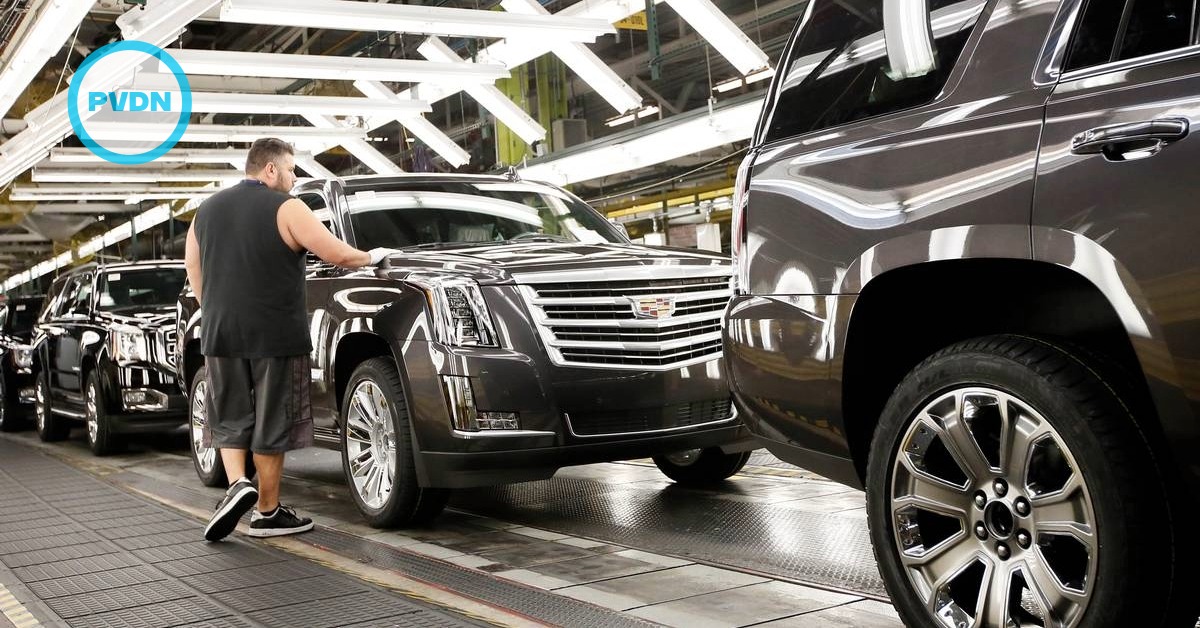
Mexico’s auto industry is sending more vehicles abroad this year, but the export map is starting to look different. The United States remains Mexico’s biggest buyer by far, yet its share has fallen in a way that stands out in the latest official data. Canada and Germany are gaining ground, Brazil has entered the picture, and tariff pressure is forcing automakers to rethink where Mexican-built vehicles go next.
Mexican Auto Exports Grow as U.S. Share Shrinks
Mexico’s auto exporters are selling more vehicles abroad this year, but the United States is taking a smaller slice of that business.
The latest official vehicle-industry report shows Mexico exported 1,388,236 light vehicles from January through May, up 4 percent from the same period of 2025.
The U.S. remained the dominant destination, and no other market comes close, but its share fell sharply. Mexico sent 1,047,208 vehicles to the U.S. in the first five months of 2026, equal to 75.4 percent of light-vehicle exports.
A year earlier, the U.S. took 1,079,690 Mexican-made vehicles, or 80.9 percent, according to the 2025 comparison report. That means overall exports rose, while U.S.-bound shipments fell by 32,482 units.
Canada and Germany gain ground
Canada increased its share of Mexican light-vehicle exports to 12.5 percent, up from 10.2 percent a year earlier. Germany rose to 3 percent, from 2.4 percent, while Brazil appeared among the named destinations with 24,266 units, or 1.7 percent of the total.
The change is modest relative to the scale of the U.S. market, but it shows automakers adjusting where they locate Mexican production while U.S. tariff rules remain unsettled. That pattern aligns with a broader trade reality, as Mexico’s economy still runs through the U.S., even when companies try to broaden their export options.
Tariffs are changing the math
Washington’s auto tariff proclamation imposed a 25 percent tariff on imported automobiles beginning in April 2025, with a special calculation for vehicles from Mexico and Canada that qualify under T-MEC rules. For those vehicles, importers can seek to apply the tariff only to the non-U.S. content, which makes parts sourcing and documentation a bigger part of the final cost.
The Federal Register procedures specify how importers can submit model-line documentation to identify U.S. content. The tariff benefit is not automatic, since it depends on paperwork, sourcing, and approval.
Economy Secretary Marcelo Ebrard framed that treatment as relief, but not a clean win. “Of course, we would love it to be zero,” he said last year, after the U.S. outlined how Mexican-built vehicles could receive a lower effective tariff when they carried U.S. content.
Rogelio Garza Garza, executive president of the Mexican Association of the Automotive Industry, has been blunter about the sector’s concerns. “We are asking for the removal of tariff type two thirty-two,” he said in comments on the 2026 T-MEC review, adding that the industry across the three countries is aligned because “We won’t be able to compete with that.”
Export growth is uneven by brand
The January-May figures show a split inside the industry, with some brands losing export volume while others gained ground fast.
Nissan’s exports fell 24.1 percent from a year earlier. BMW Group dropped 13 percent, Mazda fell 12.6 percent, Ford was down 9.4 percent, and Honda slipped 7.9 percent.
Volkswagen moved the other way, with exports jumping 61 percent, while Stellantis rose 45.1 percent, Audi increased 38.8 percent, and Kia gained 11.2 percent.
Production did not change much overall, with Mexico producing 1,642,083 light vehicles from January to May, nearly flat compared with the same period last year. In May alone, production fell 3.7 percent, while exports rose 1.7 percent.
That uneven mix helps explain the export map. Mexico is not simply making far more vehicles and sending the extra units abroad. Automakers are changing volumes by brand, model, and destination while the tariff system keeps shifting around them.
T-MEC review adds another layer
The U.S. and Mexico have already opened the 2026 T-MEC review process, with negotiators asked to examine import dependence outside the region, rules of origin, and North American supply chain security.
That puts the auto sector near the center of the talks, and the latest export figures give Mexico two facts to carry into those negotiations. The country is still deeply tied to U.S. demand, but it is also showing early signs of sending a larger share of Mexican-made vehicles elsewhere.