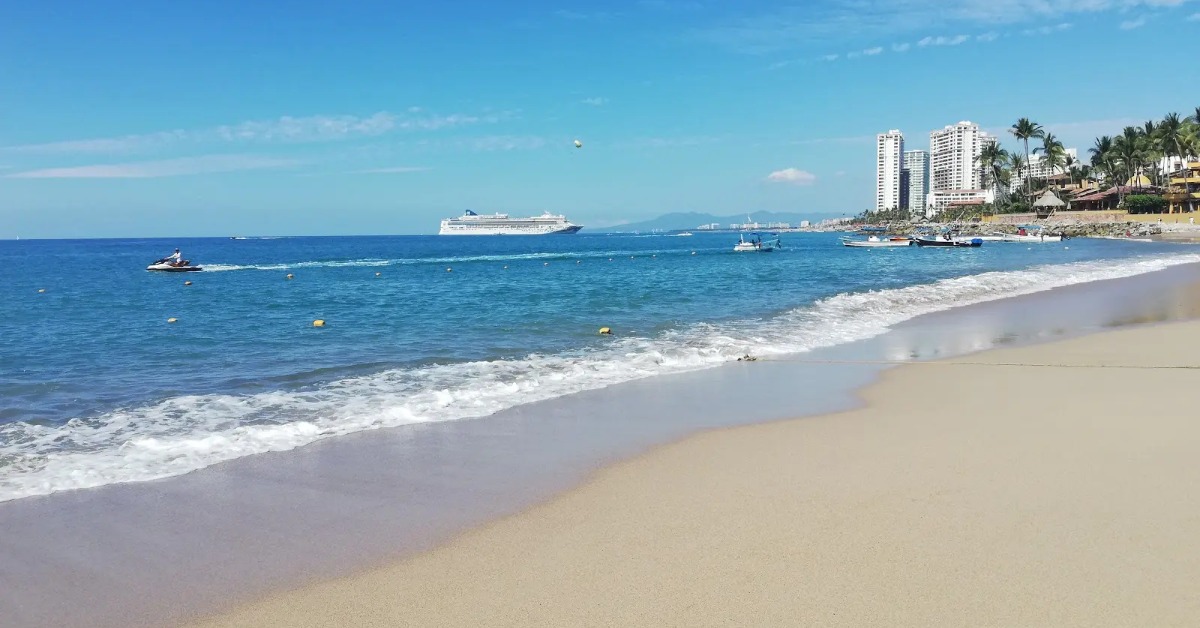
Puerto Vallarta, Jalisco, June 22, 2026 – Playa Holi, one of Puerto Vallarta’s most accessible public beaches, has lost more than 13,000 square meters of effective beach area in just over a decade.
The decline amounts to more than 30 percent of the usable recreational space at the Hotel Zone beach, based on coastal research from the CUCosta coastal management laboratory at the University of Guadalajara.
The finding turns Playa Holi into more than a beach story. It is now a warning sign for public access, hotel-zone concessions, tourism planning, and the way Puerto Vallarta manages the thin strip of sand that belongs to everyone.
The beach is still public, but there is less of it
Playa Holi sits between the mouth of the Pitillal River and the Los Tules arroyo, a nearly one-kilometer stretch used by residents, hotel guests, vendors, families, volleyball players, and visitors seeking a beach with parking and easy access.
Researchers measured 43,658.89 square meters of effective beach area in 2013. The latest measurements show 30,364.31 square meters. The difference is 13,294.58 square meters of lost usable beach.
Luis Fernando González Guevara, who leads the CUCosta laboratory, tied the reduction to natural coastal processes and human intervention. He pointed to breakwaters, rock structures, and other coastal works that can change how sand moves along the shore.
Role of Playa Holi in Vallarta
Playa Holi is not a remote shoreline where erosion goes unnoticed. It is one of the beaches people use because it is simple.
There is nearby parking. There are services. It is close to hotels, shopping areas, restaurants, and the main road through the Hotel Zone. For many residents, it is one of the few beaches that still feels practical for a quick day by the water.
That is why a smaller Playa Holi can quickly become a public-use problem.
Less sand means less space for families to set up without paying for chairs. It means less room for vendors and service providers. It also increases pressure around concessions and the federal maritime zone, where the line between public access and private use can become confusing for beachgoers.
PVDN has covered that larger issue before, including Puerto Vallarta’s effort to update its federal beach-zone maps and the city’s proposed Vallarta Playas Libres plan.
Concessions do not erase public rights
Mexican beaches are public by law. The Ley General de Bienes Nacionales states that access to maritime beaches and the adjacent federal maritime-terrestrial zone cannot be blocked, restricted, obstructed, or conditioned except under limited circumstances.
Beach chairs, umbrellas, restaurants, hotel frontage, vendors, and water activities may all operate under different permissions or concessions. None of that makes the beach private. PVDN explained this distinction in its earlier report on beach chair ownership in Mexico.
Erosion is not only a storm problem
Beach erosion is often noticed after rough surf, strong tides, or a period of mar de fondo. Puerto Vallarta has seen several recent swell alerts, including warnings about higher surf and rip-current risk along Jalisco and Nayarit beaches.
The CUCosta measurements cover more than a decade. That makes it a management issue, not only a weather issue. Coastal structures can protect one section while shifting erosion elsewhere. River mouths, seasonal storms, tides, sand movement, and construction all interact.
That is why researchers are calling for stronger coastal planning, not only beach cleanup or certification programs.
Clean beach labels are not enough
Playa Holi and nearby Playa de Oro have long been marketed as accessible, active beach areas in the Hotel Zone. Playa de Oro has also held environmental quality recognition, including Blue Flag and clean-beach credentials.
Those programs can help with water quality, services, safety, and maintenance. They do not automatically solve erosion or public-space loss.
A beach can be clean and still be shrinking.
That is the uncomfortable point behind the new numbers. Puerto Vallarta can keep improving bathrooms, signage, water testing, and lifeguard systems while still losing the physical beach that people came to use.
A smaller beach changes the local equation
The CUCosta research also looked at beach capacity. Under one-space standards, Playa Holi could physically accommodate thousands of people. Under more conservative conditions, and after adjusting for heat, rain season, and coastal changes, the real capacity drops sharply.
On crowded weekends, holidays, and high-surf days, Playa Holi may feel more congested than its official length suggests. Families may find fewer open areas. Vendors may be pushed into tighter corridors. Hotels and concessionaires may face more scrutiny over how much sand they occupy.
The beach will not disappear tomorrow. But it is smaller than it was, and the pressure is no longer theoretical.