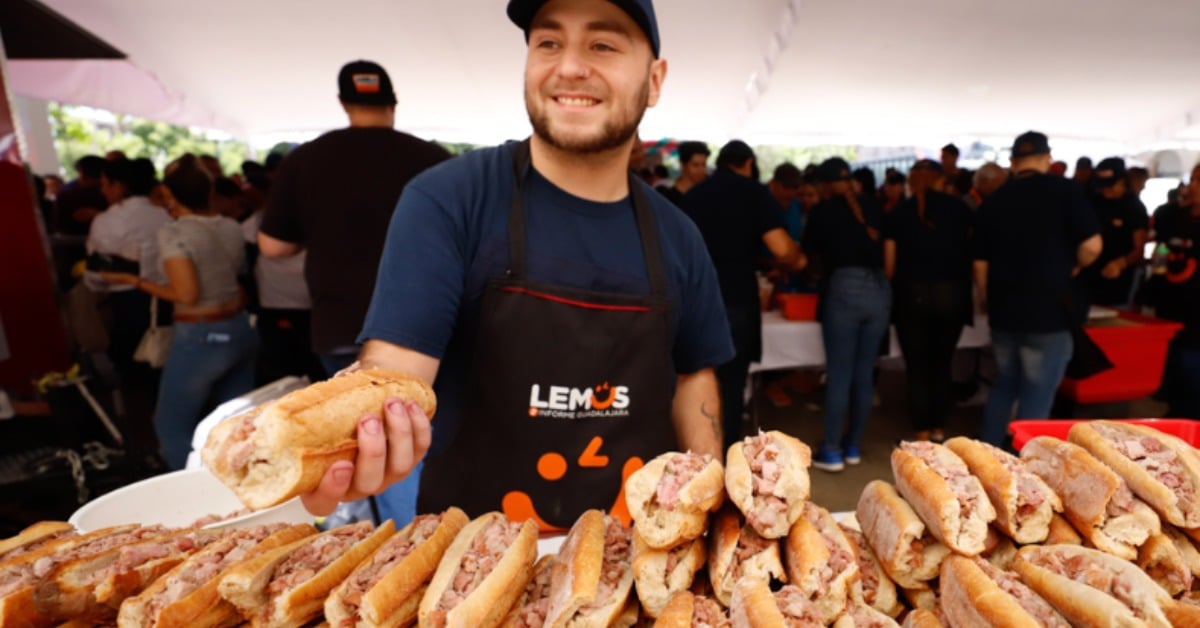
Thousands lined Paseo Alcalde as Guadalajara handed out 25,000 free tortas ahogadas to mark Tortas Ahogadas Day. Thirty vendors served under a massive tent, with the line looping around the Cathedral and music filling the historic center. City leaders pitched the event as both a party and an economic nudge for downtown restaurants. The dish’s staying power—crusty birote, carnitas, a flood of tomato salsa—was the day’s star, while a new salsa contest and a one-meter showpiece torta kept phones up and the crowd smiling.
Guadalajara turned its signature sandwich into a civic celebration, handing out 25,000 free tortas ahogadas in the city center on Sunday. The giveaway anchored Tortas Ahogadas Day along Paseo Alcalde, where 30 vendors worked shoulder to shoulder beneath a long tent between the Juárez and Morelos blocks. By mid-morning, lines curled around the Cathedral as families queued for a messy, tomato-drenched lunch.
Tortas Ahogadas Day
City coverage and university media framed this year’s party as the fourth edition of the municipal festival, an idea first launched under then-Mayor Pablo Lemus and continued by Mayor Verónica Delgadillo, who opened the event. The tradition is now set on the municipal calendar. The city formalized the day in 2022 for September 10, yet organizers moved this year’s celebration to Sunday, September 7, to catch weekend crowds.
On the ground, the scene was joyous and straightforward: a sea of birote salado and vats of tomato salsa and chile de árbol. Vendors offered classic carnitas, with some stands serving lechón or chamorro. One crew even rolled out a one-meter-long torta to draw smiles and phones. The goal was not only to feed people for free but to remind them why the sandwich still defines the city.
Queues, quotes, and a street-level read
From dawn, people drifted downtown despite overnight rain, and by late morning, the line “hugged” the Cathedral precinct. “We’re here to celebrate a dish that’s ours,” Mayor Delgadillo told the crowd, noting the 30 torteros invited to represent the industry. The city’s economic team pushed the same message: food keeps Guadalajara working. CANIRAC’s Jalisco leadership called the festival a needed boost for restaurants after a tough year, tying the crowd-pull to gastronomic tourism and fall spending.
Several vendors seized the opportunity to showcase their style. Karla Saucedo of El Lechón de Doroteo told local media that slow-cooked suckling pig brings a softer bite than standard carnitas, a texture regulars prefer. Another stand showcased a one-meter torta, promising heat for those who wanted it. The festival also added a new wrinkle this year: a community salsa contest, with neighborhood cooks putting family recipes before a panel.
The city’s preview set a 9:30 a.m. start on Paseo Alcalde. Coverage across local outlets confirmed the core numbers: 30 vendors, 25,000 free tortas, and a full day of music and contests in the historic center. That consistency matters in a space where headcounts and servings often inflate. Here, reports from Crónica, the University of Guadalajara network, El Informador, Mural/Reforma, Milenio, and El Occidental all landed on the exact figure and footprint.
Why this sandwich matters
The torta ahogada isn’t just a street bite. It’s a piece of local identity with a century-long story, built on birote salado—a crusty, faintly tangy roll that stands up to a complete dousing of tomato salsa. Government and cultural sources trace the dish to early 20th-century Guadalajara. The bread’s resilience is the point: it lets a sandwich take a bath and still arrive intact. That detail is why “birote” is not just a bolillo by another name.
The business behind the sandwich is also significant. A state data brief counted at least 1,319 companies in Jalisco with “ahogadas” in their name, 1,150 of them in the metro area—evidence of a dense, competitive market that a city-backed giveaway can highlight rather than undercut—the festival’s 25,000 free portions land as marketing for the other 364 days.
Some outlets called this the third municipal celebration; others called it the fourth. It depends on whether you start counting with the first city festival or with the formal declaration of the “municipal day.” What is clear is that the city now treats the torta ahogada as a civic emblem and a tourism hook, and it is leaning into both with programming and vendor partnerships.
A free-torta line that wraps a cathedral is a potent civic image. Guadalajara used it to fuse nostalgia, neighborhood pride, and a subtle pitch to visit the center more often. For vendors, it placed long-time stands in front of new customers. For the city, it was a headline that writes itself—and a reminder that a regional classic can still carry a festival.