Long before loud parties, posadas were neighborhood prayer walks, shared food, candles, and piñatas meant to teach and bind the block.
If you’ve lived in Mexico for even one December, you’ve probably heard the word “posada” used in two ways. Sometimes it means a faith-heavy reenactment with candles and verses. Other times it’s basically a Christmas party with a piñata. Both are real. But the older form blended those two worlds in a way that felt less like entertainment and more like a neighborhood ritual that belonged to everyone on the street.
Before modern life pulled people indoors, a posada was built around one simple idea: you don’t celebrate alone. You walk together, you sing together, and you end the night eating from the same pot.
Before the Party, There Was the Walk
The heart of an old-style posada was the peregrinación, the slow procession that reenacts Mary and Joseph’s search for shelter. It wasn’t just symbolic. It was physical, public, and slightly inconvenient, which is part of why it worked. The point was to leave your house, step into the shared space of the neighborhood, and take part.
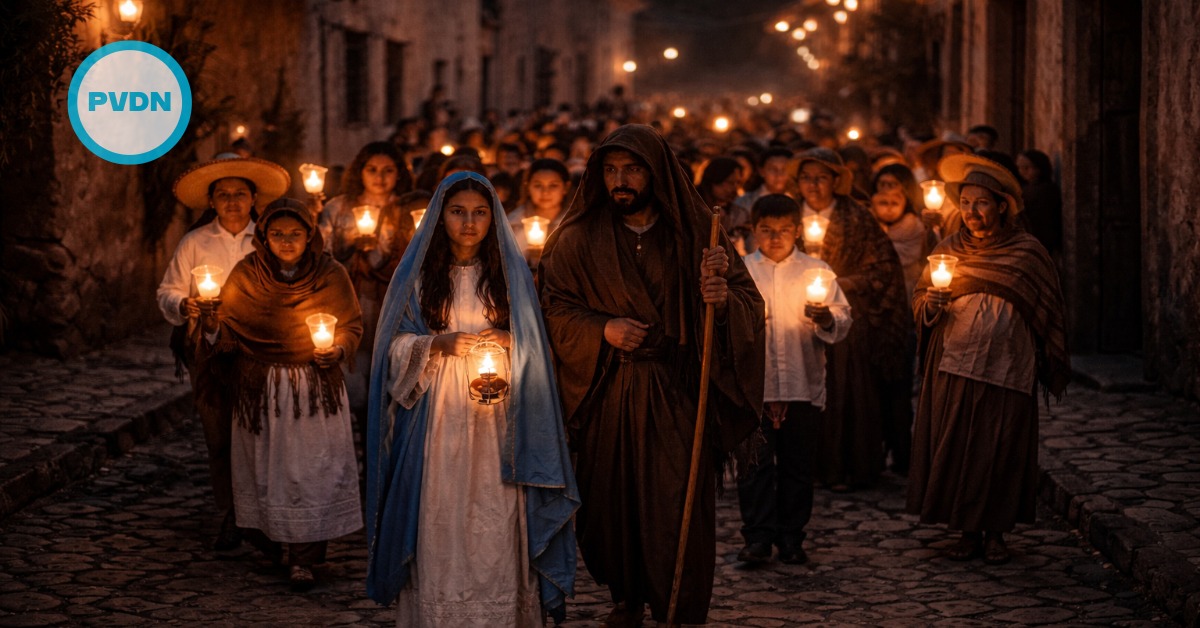
A line of people would move through the dark with candles, often protecting the flame with a hand cupped like a small roof. The singing mattered because it made the group one unit. The call-and-response wasn’t background music. It was the mechanism that turned strangers into a chorus.
The door scene was the emotional hinge. In many traditional versions, the group would “ask” at more than one house, getting turned away before finally being welcomed. You can hear the logic in it. Refusal first, then recognition. The moment the door opens, the entire night flips from outside to inside, from cold air and wax drips to warmth and noise.
And that welcome wasn’t supposed to feel private. Even when the host was a single household, the event was bigger than them. In older neighborhoods, especially in dense city housing, the posada became a way to practice convivencia in the most literal sense. You shared space because there wasn’t much of it to begin with.
A 16th-Century Origin Story
The “modern” posada is older than most people realize. Historians trace its roots to the colonial era, when Catholic orders used public rituals to teach the Christmas story in a place where many people were newly forced into a different religion.
One strong tradition places the earliest formal celebrations in San Agustín de Acolman, near present-day Teotihuacán, at an Augustinian convent designed with a large atrium and an open chapel. Those spaces weren’t architectural flourishes. They were practical tools for outdoor worship and mass participation.
A key detail in the origin story is permission from the Catholic hierarchy for a special nine-day set of services in December, what many sources call “misas de aguinaldo.” The dates line up with what people still recognize today: from December 16 through December 24, a novena that builds momentum toward Christmas Eve.
Timing wasn’t accidental. In central Mexico, December already carried ceremonial weight long before the Spanish arrived. The colonial strategy was often to overlap new religious practice with existing seasonal rhythms so it would stick. Over time, what began as enforced instruction was absorbed, adapted, and eventually claimed as something local and familiar.
That shift matters. It’s the reason posadas can feel both deeply Catholic and unmistakably Mexican at the same time.
Food Was the Glue
If the walk was the spine of the old posada, the food was the glue. People remember the prayers and the songs, but they remember the smell even more: fruit simmering, cinnamon in the air, warm cups pressed into cold hands.
In many regions, ponche became the signature drink because it’s practical and symbolic. It stretches to feed many people, it uses seasonal fruit, and it turns a gathering into a shared center. The same is true of atole and tamales in places where corn remains the core of community cooking. These aren’t random menu choices. They tie the celebration to the agricultural calendar, to harvest cycles, and to the older idea that winter fiestas are also a way of giving thanks and redistributing abundance.
Then there’s the aguinaldo, which originally wasn’t a corporate bonus or a shopping-season buzzword. In posada terms, it meant a small gift given at the end, often to children, often edible, and often assembled from humble things: fruit, peanuts, small sweets, bits of “colación.” In the older logic of the ritual, you prayed first, you participated first, and then you received.
That order told you what the community valued. You didn’t show up only for the payoff. You showed up because your presence was part of the offering.
The Piñata Was a Lesson
Today, piñatas are everywhere in Mexico, for birthdays, graduations, almost anything. But in the older posada tradition, the piñata wasn’t just “for fun.” It was a teaching tool with a script built into its shape.
The classic posada piñata was a clay pot dressed into a star with seven points. Those points, in Christian symbolism, represent the seven deadly sins. The bright colors represent temptation. The blindfold stands for faith. The stick becomes the strength to resist. And the reward that falls out, fruit and sweets, represents blessings gained after conquering what’s harmful.
In practice, kids mostly just wanted to take a swing, and adults mostly wanted to laugh. But that’s exactly why the tool worked. It carried doctrine disguised as excitement.
What’s especially telling is that this object also sits in a longer story of cultural layering. In some accounts of pre-Hispanic winter ceremonies, people broke decorated clay pots as offerings. Over the centuries, that idea of a suspended vessel, broken publicly, became part of the Christmas-season ritual in a new form. Whether you see that as adaptation, survival, or reinvention, it helps explain why the piñata feels so natural inside a posada. It’s not an imported accessory taped onto a local tradition. It’s a local tradition that learned to wear new clothing.
From Atriums to Vecindades
One of the biggest changes “before modern times” is where posadas lived. Early on, the setting was explicitly religious: convents, atriums, church spaces. Over time, especially after Mexico’s Independence and through the 19th century, the ritual moved into homes, courtyards, and shared housing. That shift turned the posada into something people hosted and owned, not something they attended under supervision.
In city life, the vecindad became a perfect stage. A shared courtyard makes a ready-made gathering spot. Neighbors already know each other’s routines, kids move freely, sound carries, and the whole block can participate without anyone needing a big private space. Even when money was tight, the ritual didn’t collapse. It adjusted. One family might provide the ponche, another the piñata, another the candles, and another the fruit. The posada became a community production.
That older structure also explains why some people feel something has been lost. As entertainment options grew, as streets became less communal, and as phones and screens began to pull attention inward, the posada’s social role weakened. In many places, the ritual shrank into a party format: fewer verses, fewer candles, a character-themed piñata, louder music, more drinking.
That doesn’t make today’s posadas “wrong.” Traditions move or they die. But it does mean that when older Mexicans talk about posadas with a kind of tenderness, they’re not only talking about religion. They’re talking about a time when neighbors depended on one another more, and the calendar forced you to practice being together.
Finding an Older-Style Posada Today
If you’re an expat hoping to recognize the older tradition, it helps to know what you’re looking for. The most “classic” posada is less about spectacle and more about participation. Someone will hand you a candle. You’ll be asked to sing even if your Spanish is shaky. Children will be front and center, not pushed to the margins. The night will feel structured, like a story with chapters, and the food will arrive as a shared release after the final verse.
When you do find that kind of posada, treat it the way locals do. Show up on time. Join in. Pay attention to the older people, because they usually carry the memory of how the ritual is supposed to flow. And if the night ends with sticky hands from fruit, warm breath in the cold air, and the sound of neighbors lingering instead of rushing home, you’ve just seen what posadas looked like before they became “events.”