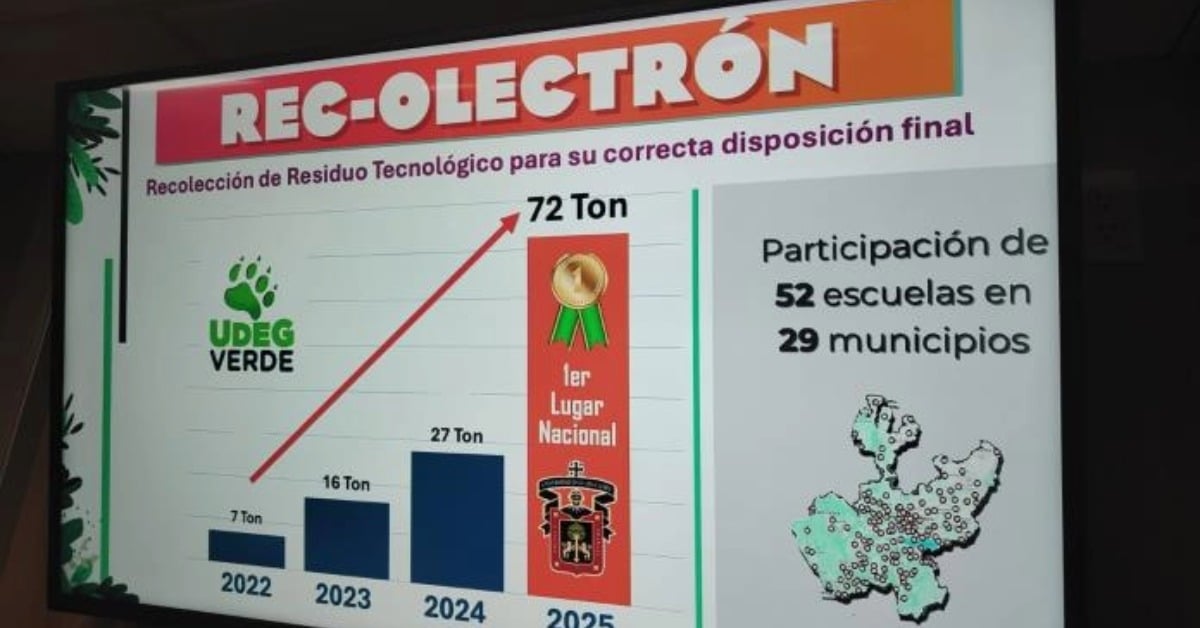
The University of Guadalajara didn’t just run a campus clean-out. In four weeks, students and neighbors hauled 72 tons of dead phones, monitors, and cables to official drop-off points—enough to make the UdeG e-waste collection the country’s top public drive this year. The bonus twist: proceeds funded a “technological lung” for a Jalisco nonprofit. What made this sprint work, and what does 72 tons really change in a state that ranks among Mexico’s biggest e-waste generators?
The headline result behind a simple idea
The University of Guadalajara’s sustainability team reports that this year’s campus-and-community initiative recovered 72 tons of electronic waste in just four weeks. The effort—branded REC-OLECTRÓN and coordinated by UDG Verde—established official collection points across the university’s network and invited the public to drop off obsolete devices for certified disposal. Organizers credit a broad mobilization across 52 schools in 29 municipalities, as well as steady student participation.
University officials also underline a public-facing design. This wasn’t a closed campus cleanup. By keeping the points open to anyone, the campaign moved beyond dorm closets and lab storerooms and into household drawers where old chargers and cracked tablets pile up for years.
UdeG e-waste collection as a social program
The campaign’s impact wasn’t only environmental. Organizers say the materials’ recovery value helped fund a “technological lung”—assisted-breathing equipment—donated to the Asociación de Distrofia Muscular de Occidente. For families managing a rare disease in Mexico without robust clinical guidelines, the equipment is a practical and immediate help. It also makes a larger point: responsible disposal can deliver visible social returns, not just feel-good recycling metrics.
Where the 72 tons came from
The university’s Rectoría General led internal contributions by tonnage, and several regional campuses followed close behind, including CUCsur, CUCBA, and CUCosta on the coast. Those names matter. They show that campuses outside the capital are developing their own local collection cultures, which is key because e-waste generation is not only a story of urban Guadalajara; when smaller cities in Jalisco have a nearby, trustworthy drop-off, participation spikes.
What 72 tons really means
Seventy-two tons won’t fix Mexico’s e-waste problem. It does, however, prevent thousands of batteries, screens, and circuit boards from being discarded in informal dumps, where they can leach lead, mercury, cadmium, and brominated flame retardants into soil and water. Health agencies warn that children are especially vulnerable to these toxins. For a state like Jalisco, which is among the highest generators of electronic scrap in Mexico, scaling formal collection and treatment is not optional. It’s a public-health baseline.
UDG Verde’s team also estimates the drive avoided tens of tons of CO₂-equivalent emissions, a reminder that proper recycling can reduce the need for virgin mineral extraction and energy-intensive manufacturing. The climate win isn’t the only metric, but it’s a real one.
The national picture and the rules that govern it
Globally, e-waste is rising faster than formal recycling can keep up, and Mexico is part of that trend. Recent international monitoring indicates that the country generates well over a million tonnes of electronic waste annually, as measured by the latest comparable year. That scale overwhelms sporadic cleanups and demands stable systems: year-round drop-off points, certified transporters, audited refurbishers, and downstream processors with traceable outputs.
Mexico’s legal framework already categorizes electronic waste (e-waste) as “residuos de manejo especial”, with the federal NOM-161-SEMARNAT-2011 standard guiding how large generators plan and manage these streams. Universities—huge device users and trusted conveners—are positioned to turn that paper framework into practice: safe collection, real logistics, and transparency about where the material ends up.
What comes next for Jalisco
The success of this REC-OLECTRÓN edition gives Jalisco a working model. The ingredients are clear: predictable dates, many sites, simple rules on what’s accepted, and competent partners. If authorities and universities can sustain that cadence—monthly or quarterly, not once a year—the state can chip away at the backlog sitting in homes and businesses. The softer benefit is cultural: when people see neighbors dropping old gear at a legit point, dragging out that dusty CRT or drawer of batteries feels routine, not tedious.
For now, organizers say the four-week, public-facing design is the differentiator. It’s realistic about habits, it meets people where they are, and it proves that a university “pack” can be more than a slogan when thousands move in the same direction.