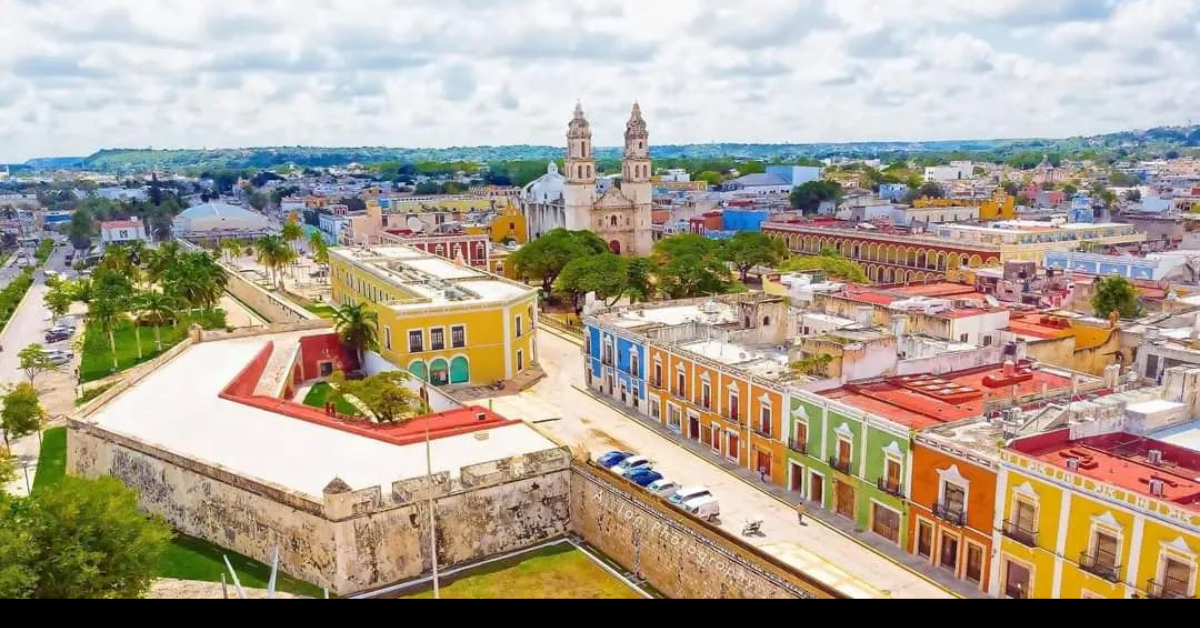
UNESCO and APCEC are aligning Campeche’s heritage preservation laws with international standards, urging private owners to protect historic buildings, inspired by Cartagena’s model.
In a joint effort to strengthen heritage preservation in southern Mexico, the United Nations Educational, Scientific and Cultural Organization (UNESCO) and the Campeche State Cultural Heritage Authority (APCEC) are working to update Campeche’s Cultural Heritage Law. The objective: to align it with international standards that emphasize sustainable, community-based conservation—and crucially, to bring private property owners into the process.
More than 600 historic properties in Campeche’s colonial-era historic center are in various states of disrepair. Rather than relying solely on government-led intervention, APCEC aims to cultivate a shared sense of responsibility among the city’s residents and property owners. This is a significant step in shifting the perception that heritage protection is the exclusive domain of the state.
“We are going to try to carry out this socialization so that private individuals assume their responsibilities,” said Rosa Olvera Salinas, director of APCEC. “These are not state-owned buildings. They are private assets, and it’s the owners who must take on commitments.”
International inspiration: learning from Cartagena
Campeche’s approach is modeled in part on successful conservation frameworks from other cities with UNESCO World Heritage status—particularly Cartagena, Colombia. There, historic preservation is not only enforced through regulation but encouraged through social and economic incentives. Owners of heritage buildings in Cartagena are educated on the importance of their properties and offered long-term restoration plans that balance architectural integrity with practical use.
The results have been striking. Cartagena has become a global case study in sustainable heritage tourism—where colonial-era buildings are not merely restored for their beauty, but actively inhabited and used in ways that maintain the city’s historic charm.
Campeche hopes to follow suit, not by copying the model outright but by localizing its principles. According to Olvera Salinas, this involves crafting “mesas de trabajo” or workgroups, where APCEC sits down with owners to explain legal obligations, management plans, and potential benefits—avoiding a punitive stance unless absolutely necessary.
A proactive record-keeping system
As part of its renewed preservation strategy, APCEC has developed a comprehensive digital and physical archive for every historic property in the Campeche city center. Each property has a file containing photographs, property titles, architectural elevations, and a documented history of past interventions. This registry not only supports regulatory oversight but also provides owners with a detailed reference for future work.
“There are over 600 houses classified as historic, and each one has a complete file,” said Olvera Salinas. “All of them need intervention, but we want to see a future where, as in Cartagena, the owners are the ones who take the lead.”
Intervention standards: 15 to 20-year sustainability
A key part of the reform is a shift in how interventions are planned and executed. Instead of one-off cosmetic repairs that often deteriorate quickly, the new framework emphasizes durability. The goal is for interventions to last at least 15 to 20 years, reducing financial strain on owners and ensuring that heritage investments are sustainable.
This long-term approach is in line with best practices promoted by UNESCO, which argues that heritage preservation must be seen not just as a cultural duty but as an economic and environmental necessity. By preserving original materials, employing traditional techniques, and involving local craftspeople, APCEC aims to strike a balance between authenticity and practicality.
Challenges ahead
Despite the support of UNESCO and the ambition of APCEC’s reforms, the effort will require significant public engagement. In many cases, property owners lack the funds or the motivation to invest in historically accurate restorations. Others may not be aware that their property holds heritage value. That’s why APCEC is focused on awareness campaigns, education, and making technical and legal assistance more accessible.
At the same time, there’s a broader goal: turning Campeche into a model for heritage preservation in Mexico. With many historic cities in the country—such as Guanajuato, Oaxaca, and San Miguel de Allende—facing mounting pressures from gentrification, mass tourism, and real estate speculation, Campeche’s collaborative model could offer an alternative path: one where culture, architecture, and community memory are preserved without pushing out those who live among them.