Mexico’s top security official says a U.S. government drone flew a legal, pre-cleared mission over the State of Mexico. Omar García Harfuch, head of the Secretariat of Security and Citizen Protection, said the aircraft operated at more than 24,000 feet and supported ongoing federal investigations. He framed the flight as prior authorization in action, not a covert incursion.
At a press conference, García Harfuch underlined that the platform was not a weaponized system. “It’s not a military aircraft,” he said, describing a request-driven tool that Mexican authorities deploy when specific investigative needs arise. The aircraft’s tasking, he stressed, was tied to public-security intelligence, not military operations.
unmanned aircraft over Valle de Bravo
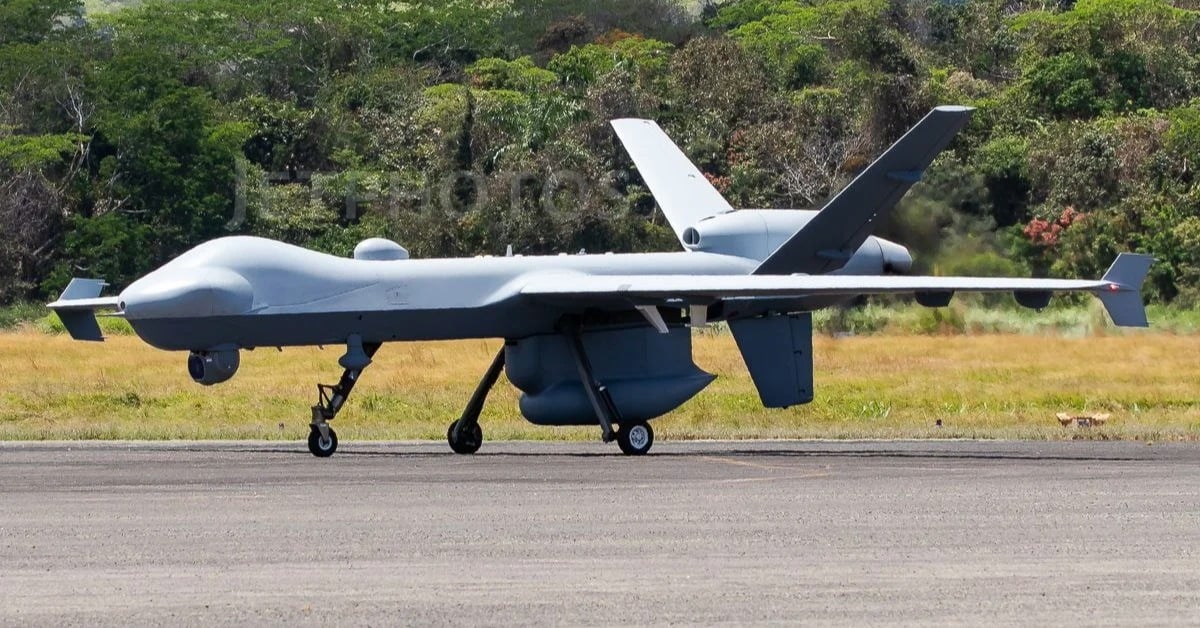
Public flight-tracking data showed a drone labeled CBP-113, linked to the U.S. Customs and Border Protection agency. The aircraft departed San Angelo, Texas, then crossed into Mexican airspace under the bilateral framework. It covered roughly 1,400 kilometers before arriving in Valle de Bravo, where it made several wide circuits.
Those circuits extended beyond the lakeside municipality. The aircraft traced patterns over Zacazonapan, Otzoloapan, Tejupilco, and Temascaltepec, according to the available track. Each pass was consistent with surveillance “laps” that airborne intelligence platforms use to dwell over areas of interest without descending into low airspace.
Coordination with U.S. agencies
García Harfuch said the mission formed part of a coordinated effort with U.S. counterparts. Mexican institutions, he added, decide when such flights occur and for what purpose. The entry into national airspace followed the established authorization process and remained under Mexican direction.
The framing matters. Mexico’s government has sought to show that cross-border tools can be used without ceding control. By emphasizing a request-and-approval model, the security chief aimed to preempt questions about sovereignty while preserving access to hardware Mexico does not operate at scale.
Focus on a high-risk corridor
Valle de Bravo and its southern belt sit on a strategic corridor touching Guerrero and Michoacán. Federal authorities have long flagged this terrain as a key zone for La Nueva Familia Michoacana. Officials identify brothers Johnny and José Alfredo Hurtado Olascoaga as central figures in the group and as priority targets for both countries.
That context helps explain the air tasking. Fixed-wing surveillance at high altitude allows long looks over rugged hills and forest. It also avoids ground risk for agents while preserving a broad field of view. In practice, that means watching routes, stash sites, and staging areas across municipal lines in a single sortie.
What the aircraft can do
The platform used is designed for intelligence, surveillance, and reconnaissance. These aircraft carry sensors that can resolve movement and structures from long standoff ranges. The model that CBP flies can remain aloft for dozens of hours, enabling overnight and dawn coverage without relaunching.
Such endurance allows pattern analysis over time. Crews can compare vehicle flows at different hours, spot shifts after enforcement actions, and cue ground teams only when needed. The goal is to make arrests and seizures safer and more effective by sending units when the picture is clear.
Why officials stress it is not a military flight
Labeling matters in Mexico’s security debate. By stating the aircraft was not military, García Harfuch signaled that the mission fell squarely inside civilian law-enforcement work. He also drew a line between support for investigations and combat operations, which carry different legal and political implications.
Officials want the public to see a bounded tool with defined rules. The message is that Mexico still authorizes, supervises, and directs every minute of flight. For the government, that framing protects both the investigation and national prerogatives while keeping foreign partners in a supporting role.
What comes next
Authorities did not disclose specific targets or operational outcomes. That secrecy is standard during live investigations. The broader aim is clear, though: tighten pressure on networks that drive violence in the State of Mexico and push narcotics toward the U.S. border.
Expect more of these joint technical missions as cases advance. High-altitude coverage can map logistics, confirm safe houses, and time interventions. If officials judge the tool effective, they will keep using it under the same authorized-entry model they outlined this week.