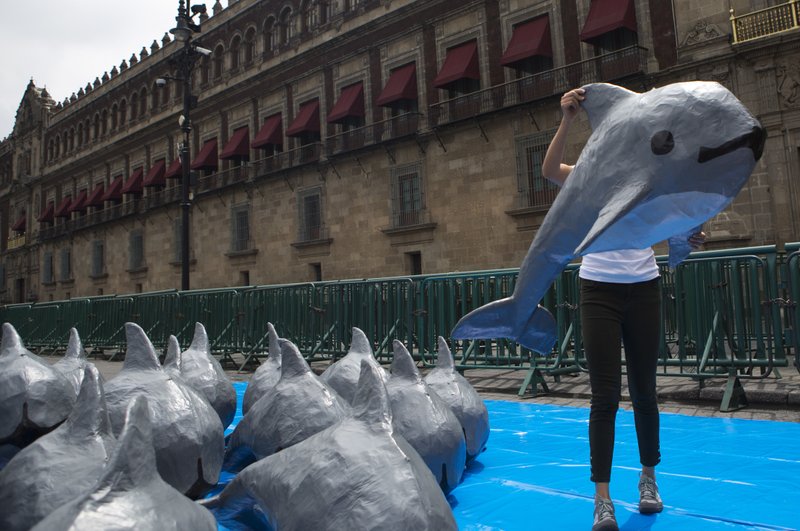
Conservation groups said Monday that the Mexican government’s lack of action is to blame for the near-extinction of the critically endangered vaquita marina porpoise.
The groups said the National Fisheries Commission didn’t supervise fishing season rules and improperly increased catch quotas in the upper Gulf of California. They said the commission also failed to give fishermen better nets to avoid trapping vaquitas.
Asked about the report, the fisheries council had no immediate comment.
The vaquita is the world’s smallest porpoise and is found only in the gulf, which is also known as the Sea of Cortez. Mexico has banned most gill net fishing in the upper gulf, but the actions appear to have been too little, too late.
Experts say there are probably fewer than 30 of the porpoises remaining. Vaquitas are often killed in nets set for totoaba fish, whose swim bladders are prized in China.
Monday’s report by Greenpeace, the Defenders of Wildlife and others came one day after Mexico said it had reached agreements with China and the United States to combat totoaba fishing.
But the groups said the fisheries council has increased catch limits for corvina, another species frequently caught in nets that can trap vaquitas. Corvina boats may also carry fishermen who illegally fish for totoaba.
The report claimed the commission had not carried out supervision of fishing bans on several protected species in the upper gulf. The report also said the council had improperly increased corvina catch limits by 86 percent between 2012 and 2017.
Finally, the report said authorities had not fulfilled promises to provide fishermen with safer nets, saying “the fishery authorities have not implemented alternatives for these communities.”
Under the deal on totoaba fishing, Mexico, China and the United States agreed to create a tri-national task force to combat the illegal trafficking of totoaba bladders. The fish are caught in Mexico and usually trafficked through the United States before reaching markets in China. The cooperation agreement aims to identify trafficking routes and modalities.
Experts and the Mexican government have announced a plan to catch the few remaining vaquitas and enclose them in floating pens for protection and possible breeding. That effort is expected to begin in October.
Breeding in captivity has successfully saved species such as the red wolf and California condor, but the vaquita has only been scientifically described since the 1950s and has never been bred or even held in captivity. There are worries the few remaining vaquita females could die during capture, dooming the species, but experts say the plan is the best option.