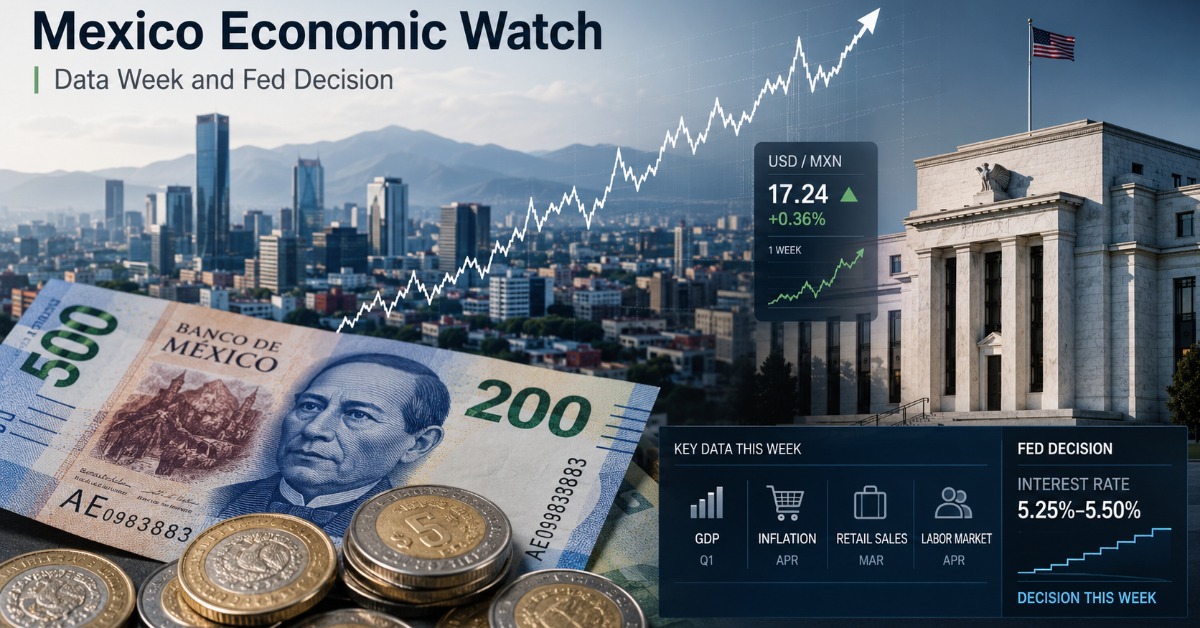
Puerto Vallarta, Jalisco, June 15, 2026 – Mexico’s economic calendar this week puts the peso back in focus, with new data on household spending, factory activity, and broader economic growth due before Wednesday’s U.S. Federal Reserve decision.
The story is national, but the local effect reaches Puerto Vallarta through the exchange rate. It affects dollar-based budgets, remittances, imported costs, tourism spending, and some real estate decisions.
The peso opened the week near 17.20 per dollar. Mexico’s official FIX rate for Monday was listed at 17.2067 pesos per U.S. dollar, keeping the currency near recent strong levels. That helps people earn pesos, but it reduces the buying power of visitors, retirees, and residents converting dollars.
Mexico’s first releases arrive Tuesday
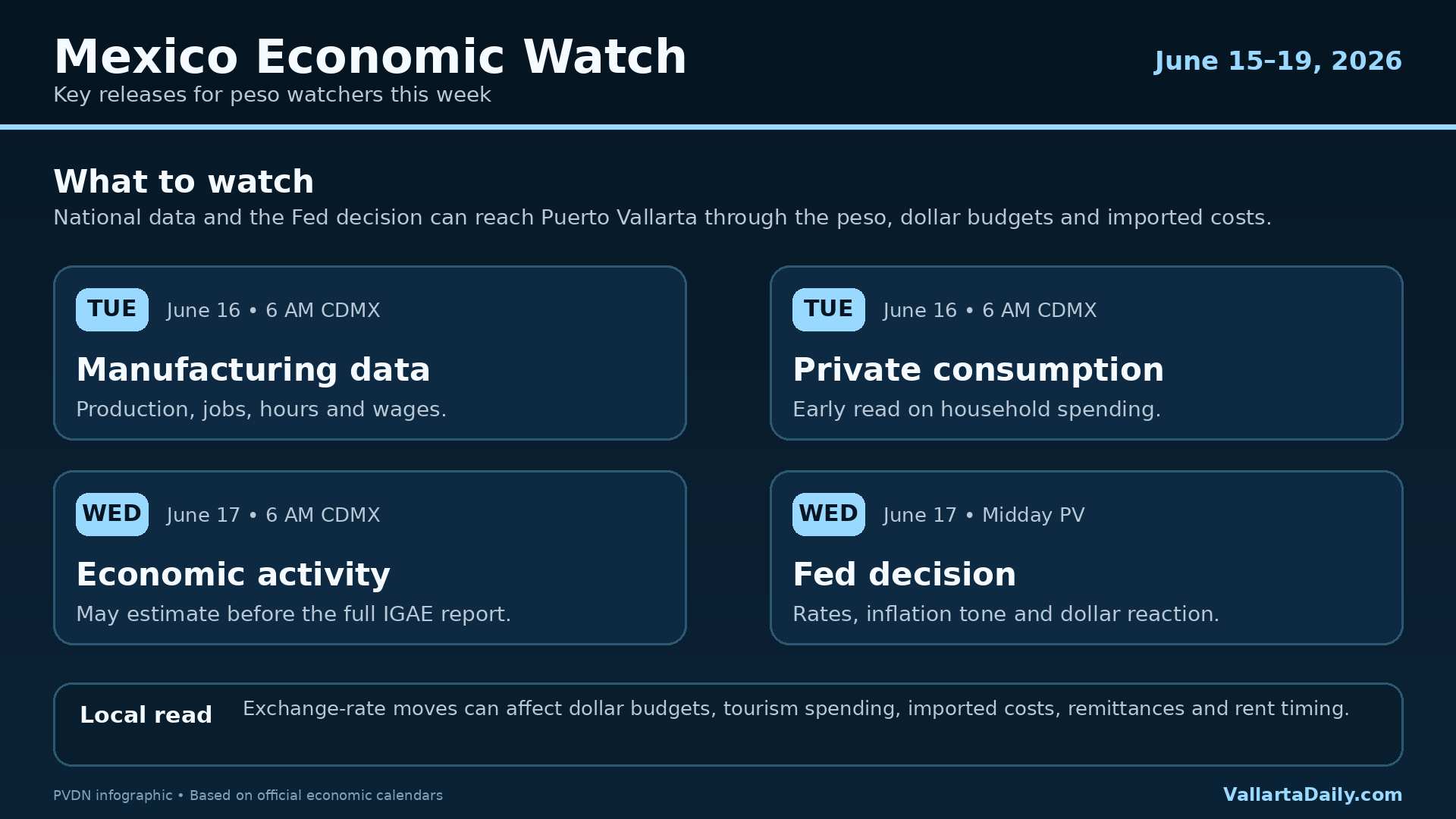
PVDN reviewed the official INEGI calendar for the week. On Tuesday, June 16, at 6:00 a.m. Mexico City time, INEGI is scheduled to publish April manufacturing data and its May timely private consumption indicator.
The manufacturing report tracks production, employment, hours worked, and wages in Mexico’s factory sector. It does not measure Puerto Vallarta’s tourism economy, but it helps show whether national weakness remains concentrated in industry.
Mexico entered the second quarter after a softer start to the year. INEGI’s revised first-quarter GDP data showed a 0.6% quarterly contraction, with declines in primary, secondary, and tertiary activities.
The private consumption indicator is more closely related to household spending. INEGI describes the IOCP as a model-based estimate of monthly private consumption prior to the full report’s release.
For Puerto Vallarta, that number is useful but limited in scope. It will not show whether restaurants in the Romantic Zone had a stronger weekend or whether local shops are moving more inventory. It can show whether Mexican households still have room to spend as inflation, interest rates, and slower growth compete for income.
Wednesday brings the larger market test
On Wednesday, June 17, INEGI is scheduled to publish the May timely economic activity indicator at 6:00 a.m. Mexico City time. The IOAE is an early estimate of Mexico’s broader monthly economic activity before the full IGAE report.
That release will be watched for signs of a rebound after the first-quarter contraction.
The same morning, the U.S. Census Bureau is scheduled to release May retail sales at 8:30 a.m. Eastern time, or 6:30 a.m. in Puerto Vallarta. U.S. consumer strength matters for Mexico because it can move rate expectations, the dollar, and travel spending.
The Federal Reserve’s policy decision comes later on Wednesday. The Fed calendar lists the two-day meeting for June 16 and 17, with the policy statement due at 2:00 p.m. Eastern time and a press conference at 2:30 p.m.
That puts the main market reaction around midday in Puerto Vallarta.
At its last meeting, the Fed kept the federal funds target range at 3.50% to 3.75%. Its statement said inflation remained “elevated” and cited uncertainty tied to developments in the Middle East.
This meeting also carries a leadership change. Kevin Warsh took office as Fed chair on May 22, and the Federal Open Market Committee selected him as its chair the same day. This will be his first policy meeting as chair.
Markets will be watching whether the Fed sounds more concerned about inflation or weaker growth. A recent Reuters poll found economists broadly expected the Fed to hold rates steady this year as inflation concerns persisted.
What peso moves mean in Vallarta
The peso is the fastest local channel for this week’s data.
A stronger peso can lower some imported costs, but it also cuts the purchasing power of people arriving with dollars. PVDN has previously reported that a strong peso can put pressure on tourist spending and restaurant checks in Puerto Vallarta.
A weaker peso can help dollar earners and some tourism businesses in the short term. It also raises the peso cost of imported food, appliances, vehicles, building materials, and business equipment.
For people planning a move to Mexico, this week’s data is a signal, not a decision point. A national indicator will not change a lease in Versalles or grocery prices in Fluvial overnight. But the trend matters when people are deciding when to transfer dollars, renew a rental contract, or budget for local services.
For business owners, the releases can help frame the rest of June. Stronger consumption would suggest households are still spending despite slower growth. A weak activity reading would keep attention on whether Mexico’s slowdown is spreading beyond manufacturing.
PVDN will be watching three points after the data is released: whether Mexico’s May activity estimate shows a rebound, whether the Fed leans harder against inflation, and whether the peso holds near 17.20 or moves sharply after Wednesday’s announcement.