They hadn’t been seen like this in more than a decade. Then, during a routine monitoring round, a white sweep of wings appeared over Texcoco’s water. Not one bird, not a lone wanderer, but dozens together—an unmistakable signal that something has shifted in the Valley of Mexico’s most contested landscape. The return raises an obvious question: what changed here, and what does it say about the long, messy effort to bring water and wildlife back to a place many assumed was gone for good?
A return written in wings, not headlines
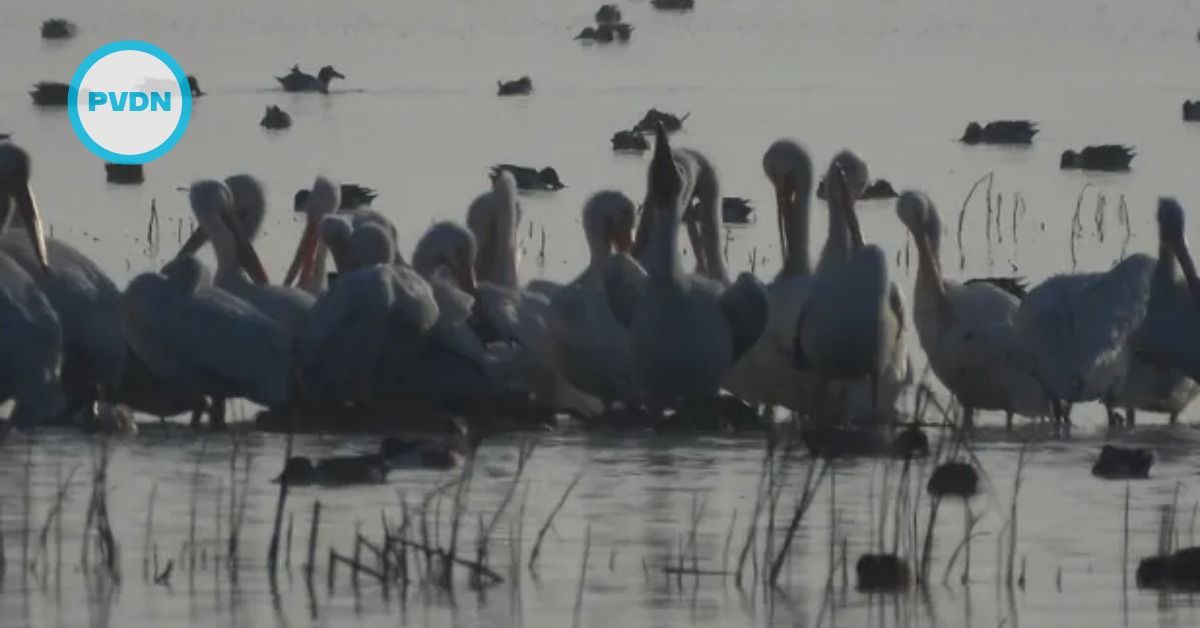
On January 22, monitors working inside the protected ex–Lake Texcoco zone spotted more than 40 American white pelicans on Lake Nabor Carrillo. For local conservation teams, the number mattered as much as the species. A single pelican can be chalked up to chance. A flock suggests a place has become useful again—reliable water, predictable food, enough calm to rest. Officials say it was the first time in over 15 years the birds had appeared in that kind of count in the area. Recent years offered only hints. In October 2024, one bird was reported in the Ciénega de San Juan wetland. Another was seen in December 2025 at Nabor Carrillo. This time was different. The birds arrived together, in broad daylight, during a formal patrol and monitoring route. For anyone who has watched Texcoco swing between megaproject and ecological promise, the sight lands like a quiet verdict. Nature doesn’t sign press releases. It simply shows up, or it doesn’t.
Why this species matters in the Valley of Mexico
American white pelicans are built for big water. They are among North America’s largest birds, and they move with an ease that makes their size look impossible. Most populations migrate, breeding in inland wetlands to the north and shifting south for winter, including into Mexico. They tend to gather where conditions are stable: shallow water, fish or other aquatic prey, and space to roost without constant disturbance. That last part is easy to overlook in a megacity basin. Birds can find water in many places, but safe water is rarer. Pelicans also travel socially. They feed and rest in groups, and this behavior can make them blunt indicators. If a flock chooses a site, it often means the site is meeting several needs at once. It doesn’t mean the ecosystem is “fixed.” It means it is functional enough, for now, to support a demanding visitor. In a landscape shaped by drainage works, dust storms, and urban sprawl, that is not a small distinction.
A wetland rebuilding itself, one rainy season at a time
The pelicans’ return is tied to a broader pattern: water returning to Texcoco. The area was declared a protected natural area in March 2022, after years of conflict over the canceled new airport project. Since then, restoration work has focused on recovering wetlands, rebuilding water flows, and stabilizing habitat across a vast, low-lying basin. Officials involved in the project have pointed to several measurable shifts. During the latest rainy season, roughly 43 million cubic meters of water were reported as captured across the protected area, with about 4,300 hectares covered by water. They also said that seven of nine rivers that had been diverted for airport works have been returned to their channels. Even within the basin, water is not distributed evenly. Nabor Carrillo alone has been reported to hold a large share of that stored volume, acting as a key receptor in the system. For expats living in Mexico, the Texcoco story can feel distant until you realize what it represents: a rare attempt to restore water at a scale that affects air, heat, and flooding across the wider metro region.
What Nabor Carrillo signals about the recovery
Nabor Carrillo is often described in hectares because it helps the mind grasp what’s at stake. The lake is commonly cited at about 900 hectares, making it one of the most important anchors for birds moving through central Mexico. As water has expanded, so has wildlife activity. Managers have reported hundreds of thousands of birds arriving to winter in the area in recent seasons, along with the detection of new species and new nesting activity. International attention has followed. In early 2025, UNESCO designated Lake Texcoco’s protected area as an Ecohydrology Demonstration Site, highlighting nature-based approaches meant to improve water quality, biodiversity, and climate resilience. It’s an ambitious label, but it fits the basic challenge: in the Valley of Mexico, water isn’t just a resource. It’s a system that shapes daily life, from dust and air quality to the risk of inundation. A flock of pelicans doesn’t prove every promise has been kept. It does suggest the system is changing in ways that living creatures can detect faster than politics can admit.
How to see the moment without turning it into a problem
There’s a temptation, when wildlife returns, to treat it like a spectacle. Texcoco can’t afford that. Pelicans are large, but they are not indifferent to pressure. Repeated disturbance pushes birds to spend energy they need for migration and winter survival. If you plan to visit, treat it like a protected area first and a photo opportunity second. Go early, keep your distance, and let binoculars do the work your feet shouldn’t. Stay on established access points and respect restricted zones, even when the view looks better from the other side. Avoid feeding wildlife or trying to “draw them in” for a closer shot. The best proof of recovery is continuity—birds returning again next season, and the one after that. Texcoco’s restoration has always been about more than birds. It’s about whether a damaged basin can hold water again, and whether people can learn to live beside a wetland without trying to remake it into something else. The pelicans have made their choice, at least for now. The rest is on us.
With information from La Jornada, Milenio, UNESCO, Cornell Lab All About Birds, Audubon Field Guide