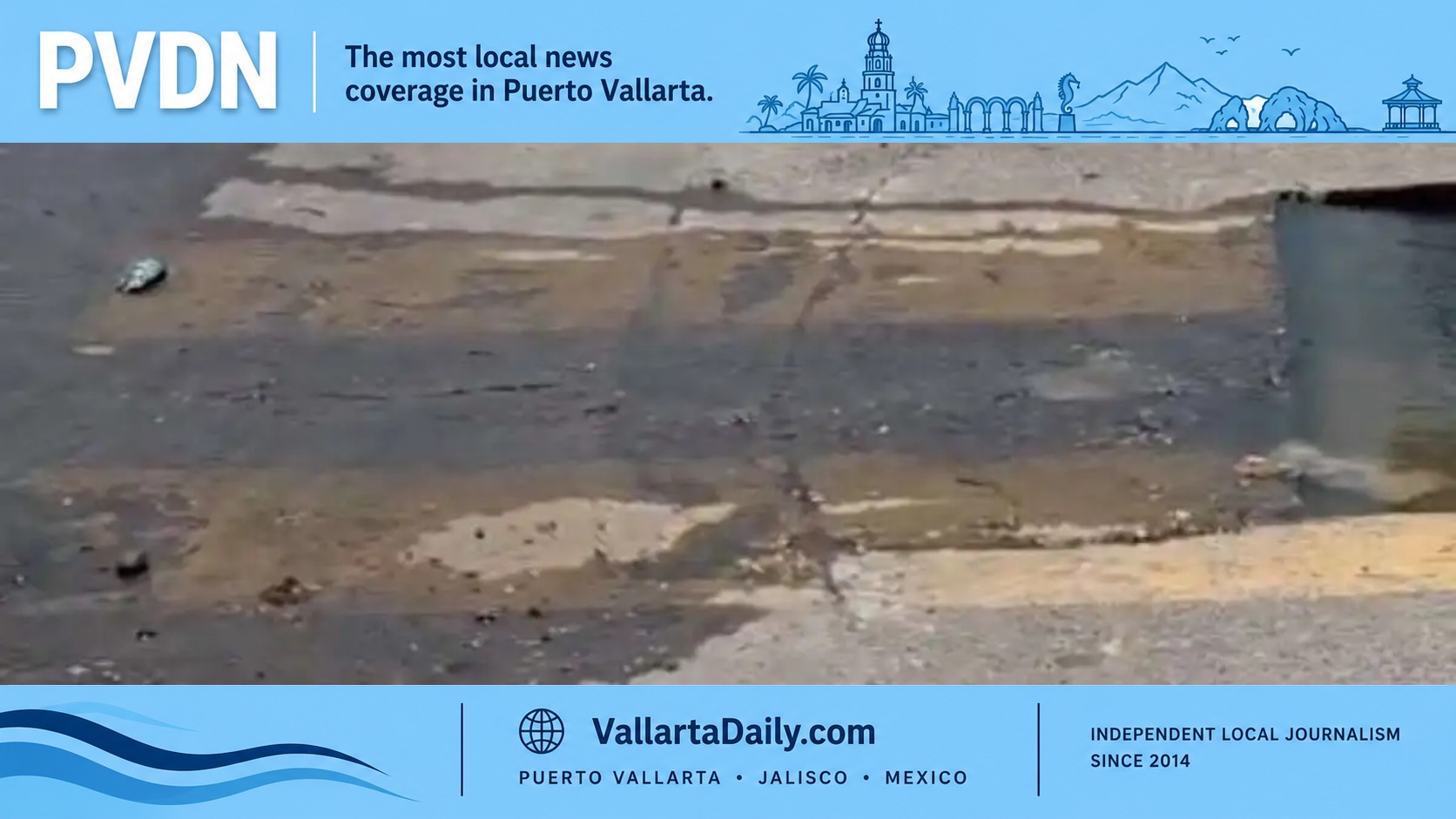
Puerto Vallarta, Jalisco, August 26, 2026 – Flooding that entered homes and a primary school in Las Mojoneras early Saturday has moved the city’s rainy-season problem beyond clogged drains. State Civil Protection says the water passage beneath Avenida México is too small to carry the runoff now reaching it, leaving a structural bottleneck whenever heavy rain and debris arrive together.
A post-storm assessment by the Jalisco Civil Protection agency identified the drainage opening as approximately three meters wide and 1.5 meters high. Regional commander Oswaldo Nicolás Hernández Arvizu said the outlet may need to be doubled in size. A temporary metal-pipe option similar to one used in La Desembocada could also be evaluated while Public Works determines the engineering needed at the site.
The assessment is the clearest official acknowledgment yet that removing trash and branches will not resolve the recurring flood risk without a larger outlet beneath the avenue.
State and municipal reports have produced different preliminary damage counts from Saturday’s flooding. Puerto Vallarta Civil Protection Director Jorge Misael López Muro initially reported 22 affected homes, with water reaching as high as 80 centimeters along Sinaloa and Guanajuato streets. No families were evacuated and no shelter was opened.
A later state assessment listed 18 affected homes, including 10 where furniture and other household belongings were damaged. It also recorded approximately 20 centimeters of water inside classrooms at a nearby primary school.
In a separate interview examining August flooding across the city, Hernández Arvizu placed the Las Mojoneras count at about 26 homes. He said water inside the houses ranged from 20 to 40 centimeters, while levels on public streets approached one meter. The figures appear to reflect counts taken at different stages of the response. No reconciled public census had been released by Wednesday.
Twenty-five municipal Civil Protection personnel, including lifeguards and emergency medical responders, worked in the neighborhood between 2 and 5 a.m. Saturday. Cleanup continued after daybreak with heavy machinery removing branches, mud and trash from the blocked drainage point.
The official accounts identify two problems occurring at the same location. Bags, branches and discarded household items are being carried into the drainage opening, creating an immediate obstruction. Municipal officials said crews have previously encountered objects as large as mattresses and refrigerators.
At the same time, state officials say the existing passage is no longer large enough to handle the volume arriving from Las Mojoneras, Villas Universidad, Puerto de Luna and surrounding higher ground. Continued paving and development have reduced the amount of rain absorbed by the soil, concentrating more runoff in channels that eventually cross Avenida México.
The failure described in Las Mojoneras centers on stormwater reaching a culvert beneath the avenue. Officials have not reported a rupture in the household sanitary-sewer network. That distinction changes the work required. Desilting can reopen a blocked passage, but it cannot increase the amount of water able to move beneath the road. PVDN’s earlier examination of why Puerto Vallarta streets flood during heavy rain explains how mountain runoff, low ground and paved development combine to place pressure on channels and street drainage.
The current infrastructure gap was not discovered this weekend. Hernández Arvizu said authorities attempted to include a structural solution in an emergency declaration last year, but the approved resources were directed toward household recovery rather than major hydraulic construction.
Following flooding on September 19, 2025, the Jalisco government distributed more than MXN 2.5 million among 93 affected families and reported water entering two schools. A separate October storm later damaged 703 homes, 85 businesses and two schools across Puerto Vallarta. Those were citywide events and do not represent the losses recorded this weekend, but they show the repeated cost of recovery once water has already entered buildings.
Seasonal maintenance was also underway ahead of this year’s rains. PVDN reported in May that the city’s canal-clearing program was 45 percent complete, with crews scheduled to continue through June 30. The new state assessment says that work cannot replace a larger drainage outlet at Avenida México.
López Muro said he would request a project to expand the ducts beneath the avenue. The public statements reviewed Wednesday did not identify an approved design, construction budget or starting date.
State Civil Protection says the risk remains active while the rainy season continues. Crews will monitor the outlet and request heavy machinery when debris begins restricting the flow. Until a higher-capacity crossing is funded and built, homes near Sinaloa and Guanajuato streets remain dependent on clearing operations and emergency response each time heavy runoff reaches Avenida México.