A construction property near Xcalacoco is now under state environmental closure after allegations that wastewater reached the sea. The case began with public complaints and municipal action, then grew into a wider enforcement issue involving Quintana Roo’s environmental prosecutor. The developer side has denied the sewage claim, saying the liquid was rainwater and groundwater from construction work. For Playa del Carmen residents and visitors, the case raises larger questions about coastal growth, beach protection, and who is watching what happens near the water.
State officials close Xcalacoco property after wastewater claims
Quintana Roo’s environmental prosecutor placed closure seals on a construction property in the Xcalacoco area of Playa del Carmen after allegations that wastewater had been discharged toward the sea.
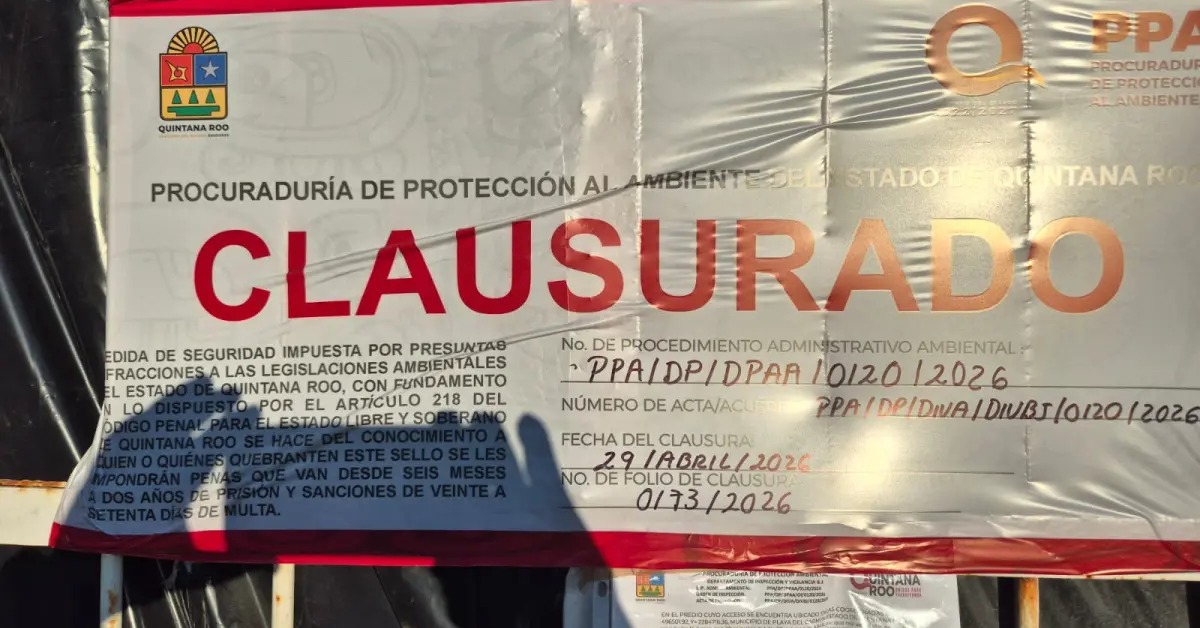
The action by the Procuraduría de Protección al Ambiente, known as the PPA, adds a state-level procedure to a case that had already drawn municipal attention. The property had previously been marked with a local suspension seal after public complaints about a suspected discharge along the coast.
The closure was carried out on Wednesday afternoon, according to reports from the site. State inspectors placed two closure seals on the property’s access gate. An inspection order was also posted, identified as PPA/DP/DPAA/0120/2026, along with a notice of an environmental administrative file.
The case remains under investigation. The closure does not, by itself, prove that a crime or environmental violation has been fully established. It does mean that state authorities found sufficient cause to stop the activity while the matter is reviewed.
The dispute over what was discharged
The central dispute is whether the liquid observed at the property was wastewater, commonly described locally as aguas negras, or water associated with construction activity.
A construction official connected to the project has denied that sewage was discharged. He said the liquid came from work related to a water-absorption well and described it as rainwater or groundwater mixed with soil from the area.
That explanation has not ended public concern. The property is in a sensitive coastal zone where any discharge can draw attention quickly. Xcalacoco is not just another construction area. It sits near the Caribbean shoreline, where beach conditions affect residents, visitors, hotels, small businesses, and marine ecosystems.
The municipality had already notified state authorities and the federal environmental agency, Profepa, after the initial reports. That is important because coastal cases in Mexico can involve more than one level of government.
Municipal officials may act on local permits, land-use rules, construction activity, and drainage concerns. State environmental authorities may open their own administrative procedures. Federal agencies may become involved when beaches, maritime federal zones, national waters, or protected ecosystems are at issue.
Why Xcalacoco draws public attention
Xcalacoco is north of central Playa del Carmen and is known as one of the quieter beach areas along the Riviera Maya. It has hotels nearby, but it also remains a beach used by locals and visitors looking for a less crowded stretch of coast.
That balance is part of the tension. Playa del Carmen has grown quickly, and each new project along the coast receives more scrutiny than it might have years ago. Residents are watching how construction affects beach access, water quality, dunes, mangroves, cenotes, and the nearshore reef system.
For many foreigners who live in the area, the issue may sound like a local permitting fight. But it connects to a wider concern in Quintana Roo. Coastal development depends on clean water, public confidence, and visible enforcement. When people see suspected wastewater near the sea, the reaction is often immediate.
The Riviera Maya also has a fragile underground water system. Much of the region sits on porous limestone. Water can move through the ground, into cenotes, and toward the coast. That does not mean every incident becomes a reef crisis. It does mean wastewater claims are taken seriously because pollution can travel in ways that are not always visible.
What the closure means now
A closure seal is a legal measure. It is used to stop activity at a site while authorities review documents, inspect conditions, and determine whether violations occurred.
In this case, the PPA’s action suggests that the issue has moved beyond the first municipal response. The property is now tied to a state environmental administrative procedure. That process could lead to findings, fines, corrective measures, or further action if authorities determine that environmental rules were breached.
If federal authorities intervene, the case could widen further. Profepa has authority in matters involving federal environmental law, including some coastal and maritime-zone issues. Conagua can also be relevant in cases involving wastewater discharges into national waters or bodies of water under federal jurisdiction.
Under Mexican water law, wastewater discharges into national receiving bodies generally require authorization. Wastewater must also be treated when needed to comply with discharge permits and official standards. Mexico’s NOM-001-SEMARNAT-2021 sets limits for contaminants in wastewater discharges into national receiving bodies.
Those rules are part of the reason cases like this do not end with a simple public denial or a viral video. Inspectors may need to determine what the liquid was, where it came from, where it went, and whether the project had the correct permits.
Beach growth and enforcement in Playa del Carmen
The Xcalacoco case comes at a time when public concern over beach development is high across Quintana Roo and other coastal areas of Mexico.
Tourism remains central to the local economy. Hotels, restaurants, beach clubs, tour operators, and service workers all depend on the coast. But the same growth that supports jobs also puts pressure on beaches, roads, drainage systems, waste services, and natural areas.
In Playa del Carmen, this pressure is easy to see. The city has expanded north, south, and inland. Areas that once felt distant from the center are now part of a wider development corridor. With that growth comes a harder question: whether public agencies have enough staff, resources, and political will to enforce environmental rules before damage is done.
The Xcalacoco closure is not only about one property. It is also a test of whether enforcement actions will be followed through. Residents often see closure seals placed after a controversy, but they also want to know what happens next.
The next stage will matter. Authorities will need to explain the findings, identify any responsible party if a violation is confirmed, and clarify whether the site can resume work. If no wastewater discharge is confirmed, officials will also need to say that clearly.
What residents and visitors should watch for
For now, the most important point is that the case remains active. The property has been closed by state environmental authorities, but the underlying facts are still being reviewed.
Residents should watch for any official statement from the PPA, the municipal environment department, Profepa, or Conagua. Those agencies can clarify whether testing was done, whether permits were missing, and whether any sanctions will follow.
Visitors should also understand that a closure of one property does not mean the entire beach is closed. It also does not automatically mean the water along all of Xcalacoco is unsafe. Those conclusions require official beach-water testing and public health information.
Still, the case shows why beach users pay attention to construction near the water. A single suspected discharge can raise broader concerns about how coastal projects manage wastewater, stormwater, and groundwater during construction.
In a destination built around the Caribbean Sea, environmental enforcement is not a side issue. It is part of daily life, public trust, and the future of Playa del Carmen’s coast.