Banxico raises Mexico’s 2026 economic growth forecast to 1.9%, but inflation, weak investment and U.S. trade uncertainty remain concerns.
Mexico City, Mexico, November 26, 2026 – Mexico’s economy is performing better than its central bank expected just three months ago, prompting Banco de México (Banxico) to raise its economic growth forecast for 2026 from 1.5% to 1.9%.
The improved outlook, announced Thursday in Banxico’s quarterly economic report for July through September, follows stronger-than-expected economic activity during the third quarter, particularly in the services sector.
But the report also contains some less encouraging news. Inflation remains a concern, expectations for formal job creation have been lowered, and uncertainty surrounding Mexico’s commercial relationship with the United States continues to weigh on investment.
The economy is growing faster than previously expected, but that doesn’t necessarily mean Mexicans are seeing more money in their pockets.
Mexico’s economy is picking up momentum
Banxico now expects economic growth for 2026 to fall somewhere between 1.7% and 2.1%, with 1.9% considered the most likely outcome.
That would represent a noticeable improvement over 2025, when Mexico’s economy expanded by just 0.7%.
The central bank maintained its growth forecast of 2% for 2027 and introduced a projection of 2.5% for 2028, including the effect of the additional calendar day in that leap year.
Thursday’s announcement comes after the National Institute of Statistics and Geography (INEGI) released its latest economic growth figures earlier this week.
Mexico’s economy expanded by 0.9% between July and September compared with the previous quarter and by 3.3% compared with the same period last year, after adjusting for inflation and seasonal factors.
As Vallarta Daily reported Monday, the services sector, which includes tourism, restaurants, transportation, retail and numerous professional services, was a major contributor to that growth.
Economic activity across the three main sectors increased compared with the same quarter last year:
- Services and commerce grew by 3.6%.
- Industrial activity grew by 2.7%.
- Agriculture and other primary activities grew by 1.5%.
The pace of economic expansion is expected to moderate during the final months of 2026 before gradually strengthening again.
A growing economy but fewer new formal jobs
Perhaps the most surprising detail in Thursday’s report is that Banxico lowered its employment forecast while simultaneously raising its economic growth forecast.
The central bank previously expected Mexico to add between 220,000 and 400,000 jobs registered with the Mexican Social Security Institute (IMSS) during 2026.
It now expects between 180,000 and 280,000.
These projections include workers affiliated with IMSS through the government’s digital platform employment program and do not account for all employment across Mexico.
The revised figures illustrate why economic growth alone doesn’t tell the whole story.
A company can increase production, improve efficiency or generate higher revenues without necessarily hiring more employees. Likewise, growth concentrated in particular industries may offer little immediate benefit to workers in other sectors.
For families struggling with everyday expenses, the availability of stable employment and improvements in purchasing power can matter considerably more than national economic growth figures.
Inflation remains an obstacle for households
Mexico’s improved economic outlook comes at a time when many households are once again feeling pressure at the supermarket.
Earlier this week, Mexico’s annual inflation rate climbed to 3.96%, with rising fruit and vegetable prices contributing to the increase.
Banxico’s latest quarterly report maintains the inflation forecast announced earlier this month, anticipating an average annual inflation rate of 3.7% during the final quarter of 2026, compared with the 3.5% projected in its August report.
The central bank still expects inflation to reach its 3% target during the final quarter of 2027.
For consumers, however, lower inflation does not mean lower prices.
It means prices are increasing more slowly. Groceries, restaurant meals, household services and other everyday expenses can remain considerably more expensive than they were a few years ago, even as inflation gradually returns to the central bank’s target.
That distinction is particularly important for retirees and others living on fixed incomes.
What about interest rates and the Mexican peso?
Banxico lowered its benchmark interest rate from 6.50% to 6.25% earlier this month after leaving it unchanged during its August and September meetings.
The central bank has indicated that keeping interest rates at their current level for an extended period could help bring inflation under control.
That suggests borrowers should not necessarily expect a rapid series of interest rate reductions in the coming months.
For people holding savings in Mexican pesos, including foreign residents who invest in government securities or fixed-term bank deposits, changes in monetary policy can also influence the returns available on new investments.
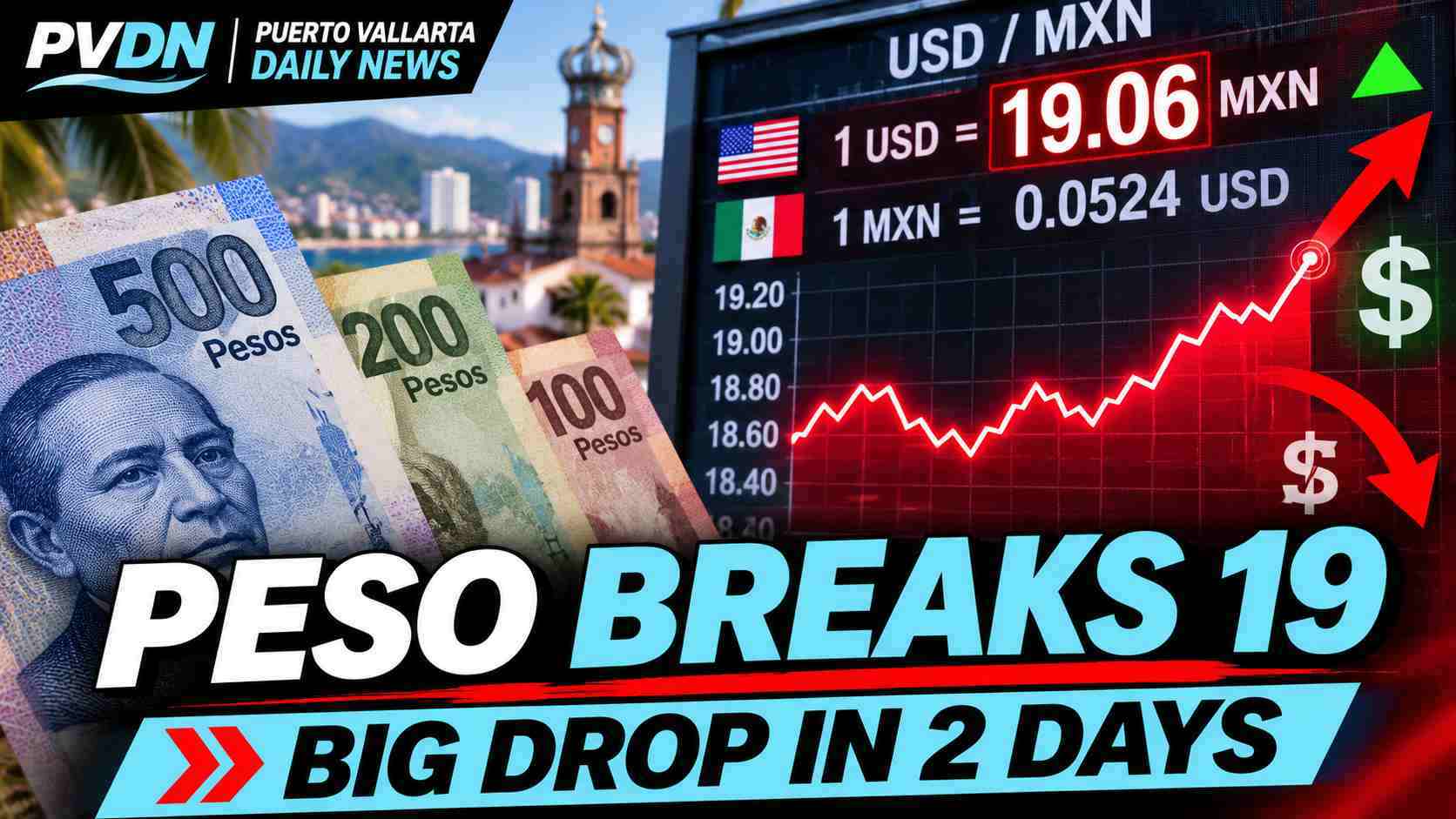
The exchange rate remains another consideration for residents receiving income in U.S. or Canadian dollars.
Stronger economic growth can support confidence in a country’s currency, but Mexico’s peso remains sensitive to international interest rates, trade policies and broader financial market conditions.
Thursday’s improved economic forecast does not guarantee a stronger peso or establish where the exchange rate will be next year.
Trade uncertainty continues to discourage investment
Despite the improved growth forecast, Banxico remains cautious about business investment.
Much of that uncertainty revolves around Mexico’s relationship with its largest trading partner, the United States, and the future of the United States-Mexico-Canada Agreement, known as the USMCA or T-MEC in Mexico.
Although Mexico avoided Washington’s latest round of proposed tariffs, a U.S. investigation involving Mexican manufacturing remains unresolved.
Businesses considering new factories, expansion projects or additional hiring may be reluctant to commit substantial amounts of money while future trading conditions remain uncertain.
Security is another concern.
A recent business survey found that insecurity is prompting some companies to reduce or reconsider investment in Mexico, while others are directing more resources toward protecting their existing operations.
Banxico continues to see greater risks of economic growth falling short of expectations than exceeding them.
Puerto Vallarta tells a different economic story
The national economic outlook also provides an interesting contrast with what has been happening in Puerto Vallarta.
While Mexico’s services sector has been growing, local tourism indicators suggest that Puerto Vallarta is facing a more challenging business environment.
State tourism officials have acknowledged declines in hotel occupancy and international airport traffic, contributing to concerns about Puerto Vallarta’s tourism competitiveness heading into 2027.
The destination received nearly four million visitors during the first nine months of the year, but as Vallarta Daily examined in its recent Insider report on the health of Vallarta’s tourism economy, visitor numbers alone do not necessarily establish whether local businesses are becoming more profitable.
Operating expenses, hotel occupancy, visitor spending and the growing supply of accommodation all influence how much economic benefit reaches the local community.
Banxico’s report does not provide a specific economic growth forecast for Puerto Vallarta.
For local businesses, the coming winter tourism season may provide a more meaningful indication of economic conditions than Thursday’s national forecast.
Mexico’s economy is expected to finish 2026 in better shape than economists previously anticipated. Whether that improvement translates into more jobs, greater purchasing power and healthier local businesses remains a question for the year ahead.