Mexico announces five advances in Pemex’s recovery, including higher refining output, new offshore platforms and plans to reduce its debt.
Paraíso, Tabasco, November 28, 2026 – For years, Mexico’s state-owned oil company has been making headlines for all the wrong reasons. Mounting debt, declining oil production, unpaid suppliers and government financial assistance have become recurring themes in discussions about Petróleos Mexicanos, better known as Pemex.
On Saturday, President Claudia Sheinbaum presented a considerably more optimistic picture of the company’s future, announcing five developments in the government’s efforts to restore its financial health and production capacity.
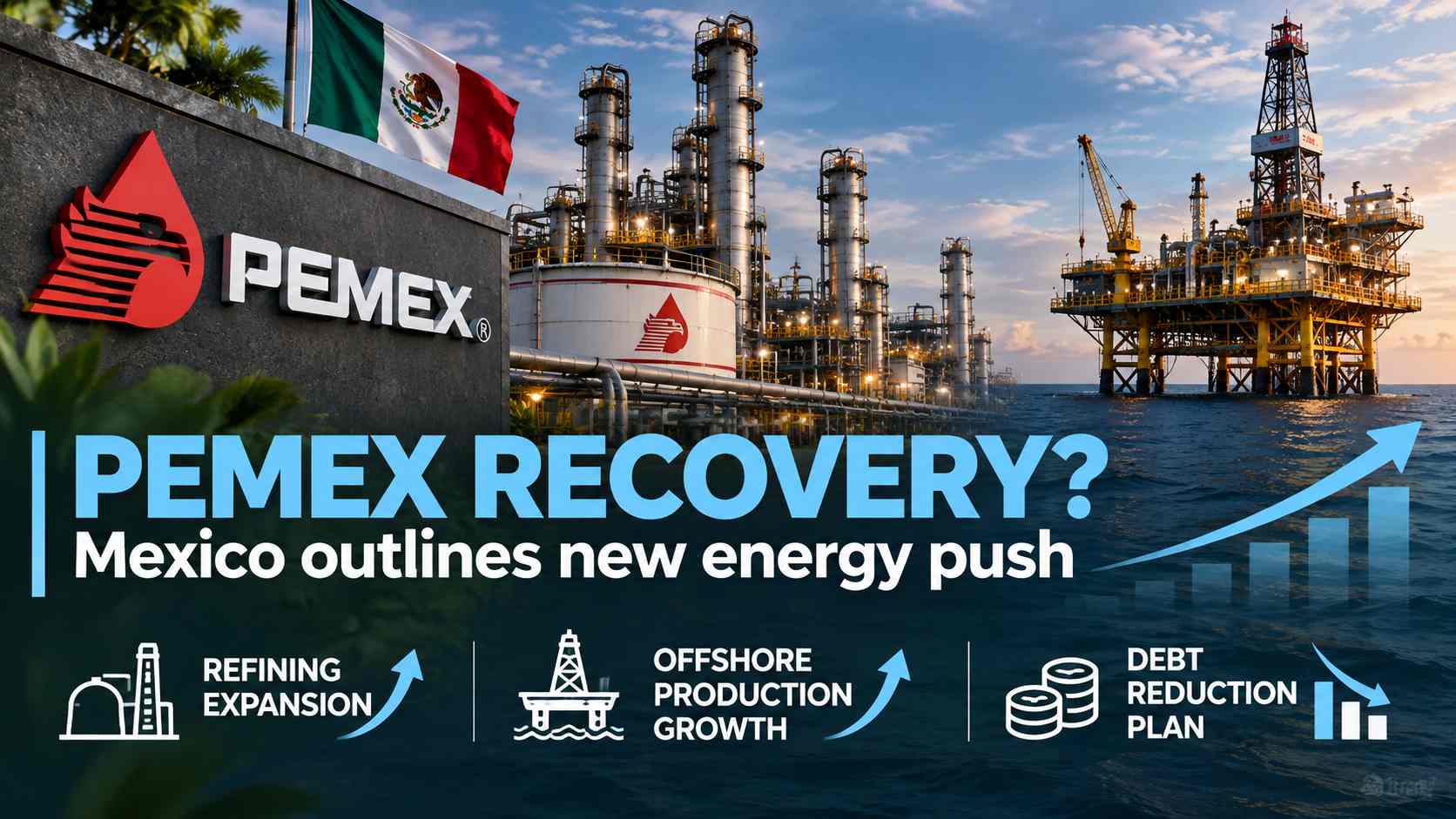
Speaking at the Dos Bocas maritime terminal in Tabasco, Sheinbaum highlighted increased refining activity, new offshore oil platforms, investments in natural gas recovery, the revival of fertilizer production and a projected reduction in the company’s financial debt to below US$70 billion by the end of 2026.
There are some encouraging numbers behind the announcements. However, a closer look at Pemex’s financial statements reveals that the company’s recovery remains a work in progress.
Mexico is refining more of its own oil
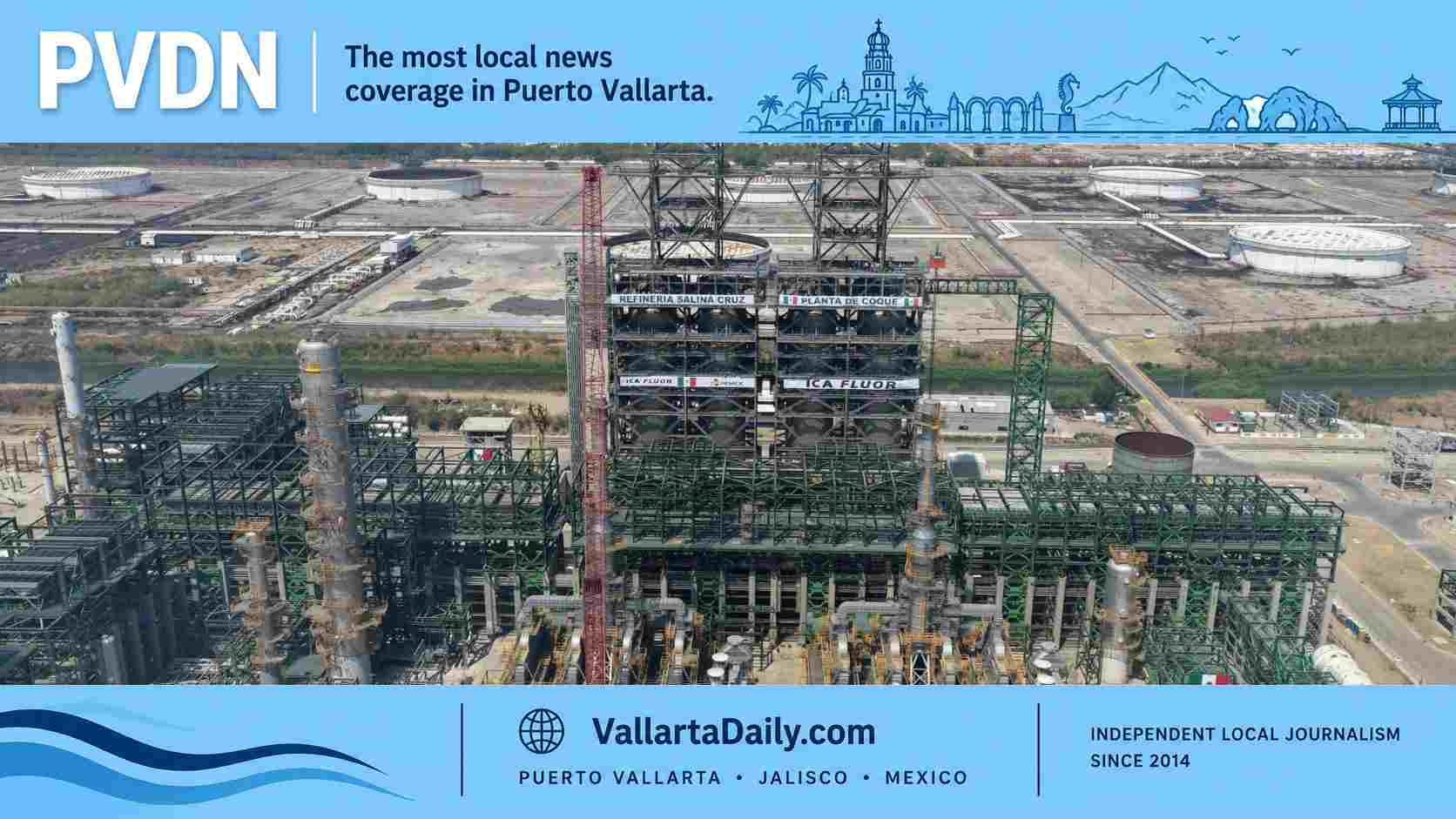
Sheinbaum said Pemex’s eight refineries are currently processing approximately 1.45 million barrels of crude oil per day.
Those facilities include the Olmeca refinery in Tabasco and the Deer Park refinery in Texas, which Mexico acquired during the administration of former President Andrés Manuel López Obrador.
The distinction is important because the combined figure includes refining activity outside Mexico.
Nevertheless, Pemex’s published figures confirm substantial improvements in its ability to turn crude oil into usable fuels.
During his November 9 appearance before the Chamber of Deputies’ Energy Commission, Pemex Director General Juan Carlos Carpio Fragoso reported the following changes during Sheinbaum’s second year in office:
- Crude oil processing increased by 19.6%.
- Gasoline production increased by 21.6%.
- Diesel production increased by 42.6%.
- Aviation fuel production increased by 8.2%.
- Gasoline imports declined by 12%.
- Diesel imports declined by 15%.
For a country that produces substantial quantities of crude oil but has historically depended heavily on imported refined fuels, those figures represent progress toward reducing that dependence.
Producing more fuel, however, doesn’t automatically mean producing it profitably.
Three new platforms could increase oil production
Saturday’s event also marked an important step toward expanding Pemex’s offshore production capacity.
The company is preparing to install three new maritime platforms serving oil fields discovered between 2024 and 2025 in the Gulf of Mexico.
The platforms were manufactured in Tampico, Tamaulipas, by a Mexican company and are expected to enter operation within approximately two months.
Carpio explained that the three oil fields could eventually produce a combined 54,000 barrels of oil per day, once the necessary drilling work is completed and production reaches its projected capacity.
The fields are also expected to contribute approximately 79 million cubic feet of natural gas per day.
Pemex is working toward a production target of 1.8 million barrels of oil per day, compared with approximately 1.65 million barrels reported during the previous 12-month reporting period.
The new platforms could help close that gap, although their expected contribution remains a projection rather than an immediate increase in production.
Making use of natural gas instead of burning it
Another focus of Sheinbaum’s weekend tour is a problem that has long concerned both environmentalists and energy economists.
Pemex has historically burned some of the natural gas extracted during oil production because it lacked the infrastructure necessary to capture, process and transport it.
The practice, known as gas flaring, releases greenhouse gases and wastes a resource that could otherwise be used to generate electricity or supply industrial customers.
On Friday, the president inaugurated new gas recovery infrastructure at the Ixachi field in Veracruz, including a 52-kilometer gas pipeline.
A similar project at the Bakté field in Tabasco forms part of the administration’s broader effort to reduce gas flaring and increase the availability of domestically produced natural gas.
Sheinbaum outlined both projects during her November 25 morning press conference.
For Mexico, capturing more of its own natural gas could help reduce its dependence on imported energy while providing environmental benefits.
The projects also complement other efforts to increase the country’s electricity generation capacity, including the US$12.5 billion in renewable energy projects under consideration by Mexico’s state electricity utility, which Vallarta Daily reported on in October.
The extent of the environmental and economic benefits will ultimately depend on how much gas the new facilities actually recover.
Pemex wants to produce more fertilizer
Oil and gasoline tend to dominate discussions about Pemex, but the company’s activities also extend into products that directly affect Mexico’s agricultural industry.
Sheinbaum reported Saturday that construction of a fertilizer plant in Escolín, near Poza Rica, Veracruz, has reached approximately 30% completion.
The facility is intended to produce urea, a nitrogen-based fertilizer widely used in agriculture.
Increasing domestic fertilizer production could help reduce Mexico’s dependence on imports and make agricultural producers less vulnerable to international price fluctuations.
Pemex previously reported that its urea production increased by 51.6% between January and September 2026 compared with the same period last year.
For consumers, this is another example of how developments in Mexico’s energy industry can eventually influence the cost of products that have little apparent connection to oil.
Fertilizer, electricity, transportation and fuel all contribute to the cost of producing and distributing the food we buy.
At a time when rising food prices are contributing to inflation in Mexico, reducing those production costs could provide some relief, although no immediate reduction in grocery prices should be expected from Saturday’s announcement.
Pemex’s debt is falling, but the company is still losing money
Perhaps the most significant announcement Saturday was Sheinbaum’s expectation that Pemex will finish 2026 with financial debt below US$70 billion.
That would represent a substantial improvement for a company that has spent years struggling with one of the heaviest debt burdens in the international oil industry.
According to Pemex’s third-quarter financial announcement, its financial debt stood at US$77.6 billion at the end of September, nearly US$8 billion below its level at the end of 2025.
But reducing debt and becoming profitable are two different things.
The Mexican Institute for Competitiveness (IMCO), an independent public policy research organization, examined the company’s latest financial statements in its third-quarter Pemex report.
| Financial indicator | January–September 2026 |
|---|---|
| Operating profit | MXN 222.6 billion |
| Net loss | MXN 38.8 billion |
| Financial debt at September 30 | US$77.6 billion |
| Federal government capital contributions | MXN 136.5 billion |
The net loss represents an improvement over the 45.1 billion pesos lost during the same period in 2025.
Still, the company continues to spend more than it ultimately earns after accounting for financing costs, taxes and other obligations.
IMCO’s November assessment of Mexico’s public finances also notes that the proposed 2027 federal budget includes another 81.1 billion pesos in financial support for Pemex.
And in its own financial disclosures filed with the U.S. Securities and Exchange Commission, Pemex identified federal government capital contributions as one of the primary factors behind its debt reduction.
The improvements are measurable, but the company has not yet eliminated its dependence on public resources.
Suppliers are still waiting to be paid
Another challenge that doesn’t always receive the same attention as Pemex’s financial debt is the money it owes to businesses that provide equipment, materials and services.
The company’s financial debt generally refers to obligations such as bank loans and bonds. Outstanding bills owed to suppliers are a separate matter.
Earlier this month, Carpio told lawmakers that Pemex had paid 952 billion pesos to suppliers and contractors between 2025 and September 2026.
However, some outstanding payments date back to 2024 and may not be resolved until next year.
On Friday, the Mexican Association of Petroleum Services Companies warned that the latest government-backed payment program may be insufficient to cover outstanding obligations.
For smaller companies that depend heavily on Pemex contracts, delayed payments can mean difficulty meeting payroll, paying their own suppliers or simply staying in business.
A successful financial recovery for Pemex needs to extend beyond its relationships with banks and international investors.
Will gasoline become cheaper in Mexico?
For many people living in Mexico, this is probably the most practical question raised by Saturday’s announcements.
Sheinbaum argued that investments in refining capacity have helped prevent gasoline prices from reaching 30 pesos per liter and diesel prices from reaching 35 pesos.
Those figures represent the president’s assessment of what might have happened without the investments, rather than independently established prices consumers would otherwise have paid.
Mexico’s government and participating fuel retailers also renewed their voluntary agreement to stabilize gasoline and diesel prices in August, targeting regular gasoline prices below 24 pesos per liter and diesel prices around 27 pesos.
Greater domestic refining capacity could help Mexico manage international fuel market disruptions. But retail prices are also influenced by international oil prices, exchange rates, transportation costs, taxes and government policies.
Nothing announced Saturday establishes that drivers in Puerto Vallarta or elsewhere in Mexico will be paying less at the pump next week.
Is Pemex finally turning things around?
Pemex is certainly showing improvements in several important areas. Refining activity is increasing, fuel imports are declining, financial debt is falling and new infrastructure could contribute to higher oil and natural gas production.
Those developments come at a time when Mexico’s central bank has raised its economic growth forecast for 2026, despite continuing concerns about inflation and investment.
A financially healthier national oil company could eventually reduce pressure on Mexico’s public finances, leaving more government resources available for other priorities.
But Pemex still has to demonstrate that its operational improvements can translate into sustainable profitability, reliable payments to suppliers and less dependence on government assistance.
Saturday’s announcements provide evidence of progress. The more difficult test will be whether Pemex can eventually finance that progress without continually asking Mexican taxpayers to help pay for it.