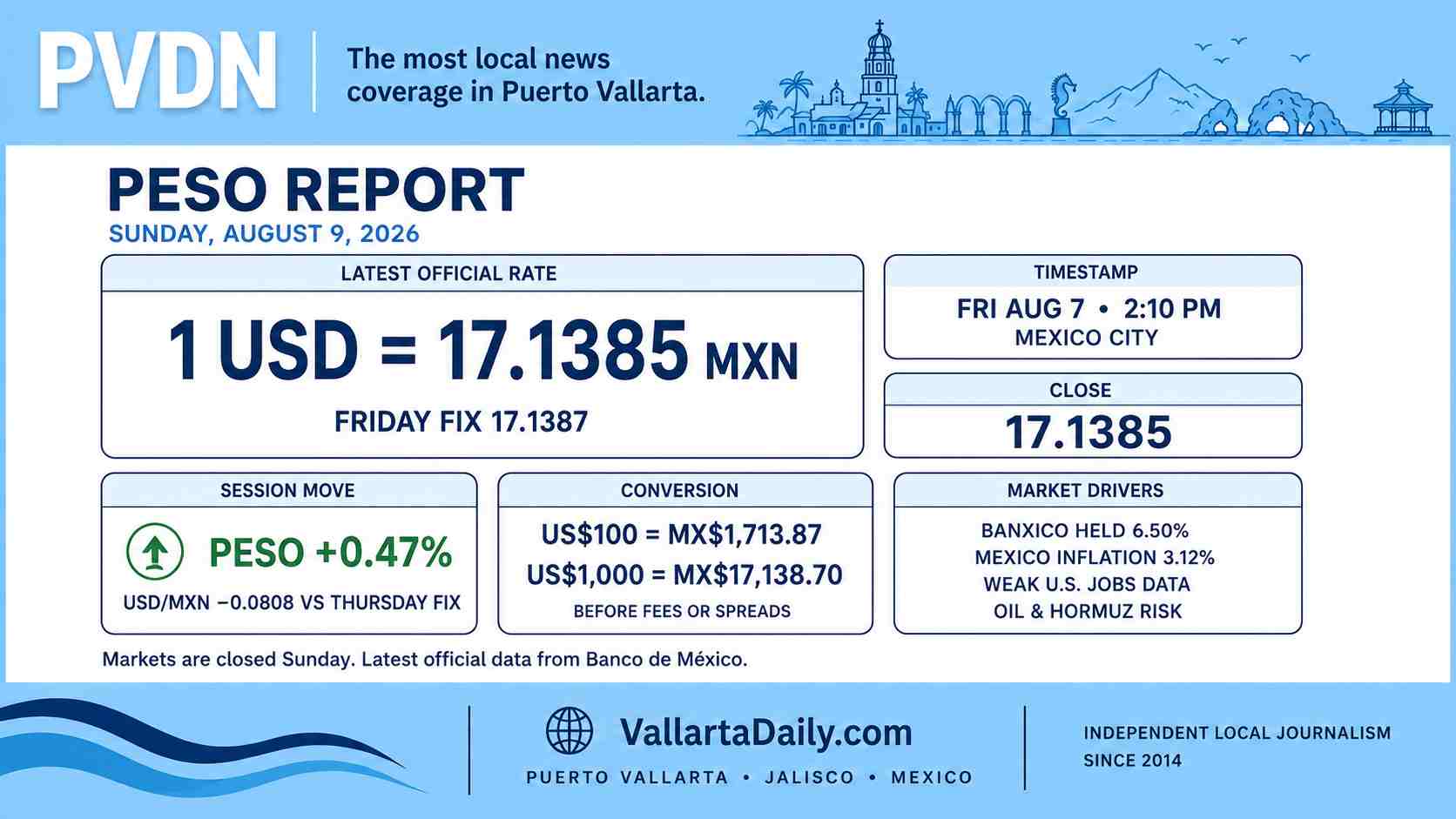
Puerto Vallarta, Jalisco, August 9, 2026 – The latest official USD/MXN closing rate is 17.1385 pesos per dollar, published by Banco de México at 2:10 p.m. Mexico City time on Friday, August 7.
Foreign-exchange markets are closed Sunday, so there is no new wholesale trading session to report. Weekend quotes shown by banks, exchange houses, and currency apps may be the Friday rate, an indicative quote, or a retail price that includes a spread.
Banxico’s Friday FIX rate was 17.1387, compared with 17.2195 on Thursday. That represents a decrease of 0.0808 pesos per dollar, or about 0.47%. A lower USD/MXN rate means the peso gained value against the dollar.
The separate Banxico rate used Sunday for certain dollar-denominated obligations payable in Mexico is 17.2195 pesos. The bank’s payment-rate table carries forward the legally applicable rate on weekends; it should not be read as a live market quote.
Mexico’s inflation data reinforced the policy pause
The peso ended the week after Banco de México’s governing board kept its benchmark interest rate at 6.50% on Thursday. The unanimous decision extended a pause that began in June.
Banxico said it expects to maintain the current rate for now. Although inflation continues to ease, the central bank warned that underlying price pressures are declining more slowly than previously expected. It now projects headline inflation will return to its 3% target in the fourth quarter of 2027.
Data released Friday showed that Mexico’s annual inflation slowed to 3.12% in July, down from 3.37% in June. Consumer prices rose 0.03% during the month.
Core inflation, which excludes volatile food and energy prices, remained elevated at 3.95%. The results were close to market expectations, limiting the case for treating the inflation report alone as the reason for Friday’s currency movement.
Holding the rate at 6.50% preserves the return available on peso-denominated assets. That can support demand for the currency, although exchange rates also respond to U.S. interest-rate expectations, trade risks and shifts in global markets.
Weak U.S. payrolls weighed on the dollar
The clearest international development Friday was an unexpectedly weak U.S. employment report.
The U.S. Bureau of Labor Statistics reported that nonfarm employment fell by 23,000 jobs in July. Economists had expected an increase. May and June employment figures were also revised downward by a combined 103,000 jobs.
The U.S. unemployment rate edged down to 4.1%, but the decline came as the labor force participation rate fell to 61.4%.
Following the report, the dollar index fell 0.44% to 99.50. Interest-rate markets reduced the probability of a Federal Reserve increase in September, while U.S. Treasury yields declined.
A weaker dollar was consistent with the peso’s Friday gain. The Banxico decision and Mexico’s inflation reading also formed part of the market backdrop, but a single session rarely has one isolated cause.
U.S. stocks rose after the employment report as investors placed greater weight on the possibility that the Federal Reserve would leave rates unchanged in September. That improvement in market sentiment can help emerging-market currencies, though sustained weakness in the U.S. economy would also pose risks for Mexico given the close trade relationship.
Oil added another source of uncertainty
Brent crude closed Friday at $83.55 a barrel, up 1.3% during the session, as traders monitored negotiations surrounding the Strait of Hormuz.
Mexico is an oil producer, but higher crude prices do not translate automatically into a stronger peso. Energy prices, geopolitical risk, and their effects on global inflation can pull the currency in different directions.
Reports Sunday said an Iran-Oman agreement covering shipping lanes was nearing completion, although an immediate reopening of the strait remained uncertain. Those developments came after Friday’s market close and are not reflected in the 17.1385 rate.
Budgeting in Puerto Vallarta at 17.14
At Friday’s FIX rate, US$100 converts to approximately 1,713.87 pesos, while US$1,000 converts to 17,138.70 pesos, before bank fees or exchange spreads.
Compared with Thursday’s FIX, someone converting US$1,000 would receive about 80.80 fewer pesos. For people earning in dollars and paying expenses in Mexico, the peso’s gain slightly reduces the local purchasing power of dollar income.
People earning or saving in pesos would need fewer pesos to cover a dollar-denominated expense at the wholesale reference rate. Actual card, bank transfer, ATM, and cash exchange rates can differ substantially, especially at airports, hotels, and exchange counters.
Monday’s opening may redraw the weekend rate
The first active market quotes Monday may differ from Friday’s 17.14 level as traders process the weekend’s geopolitical and energy developments.
Attention will then shift to the U.S. consumer inflation report scheduled for Wednesday. That release could alter expectations for the Federal Reserve’s September meeting and, in turn, affect the dollar-peso rate.
Until trading resumes, 17.1385 remains the latest official Mexican closing reference. It is a market benchmark, not a guaranteed consumer exchange rate.