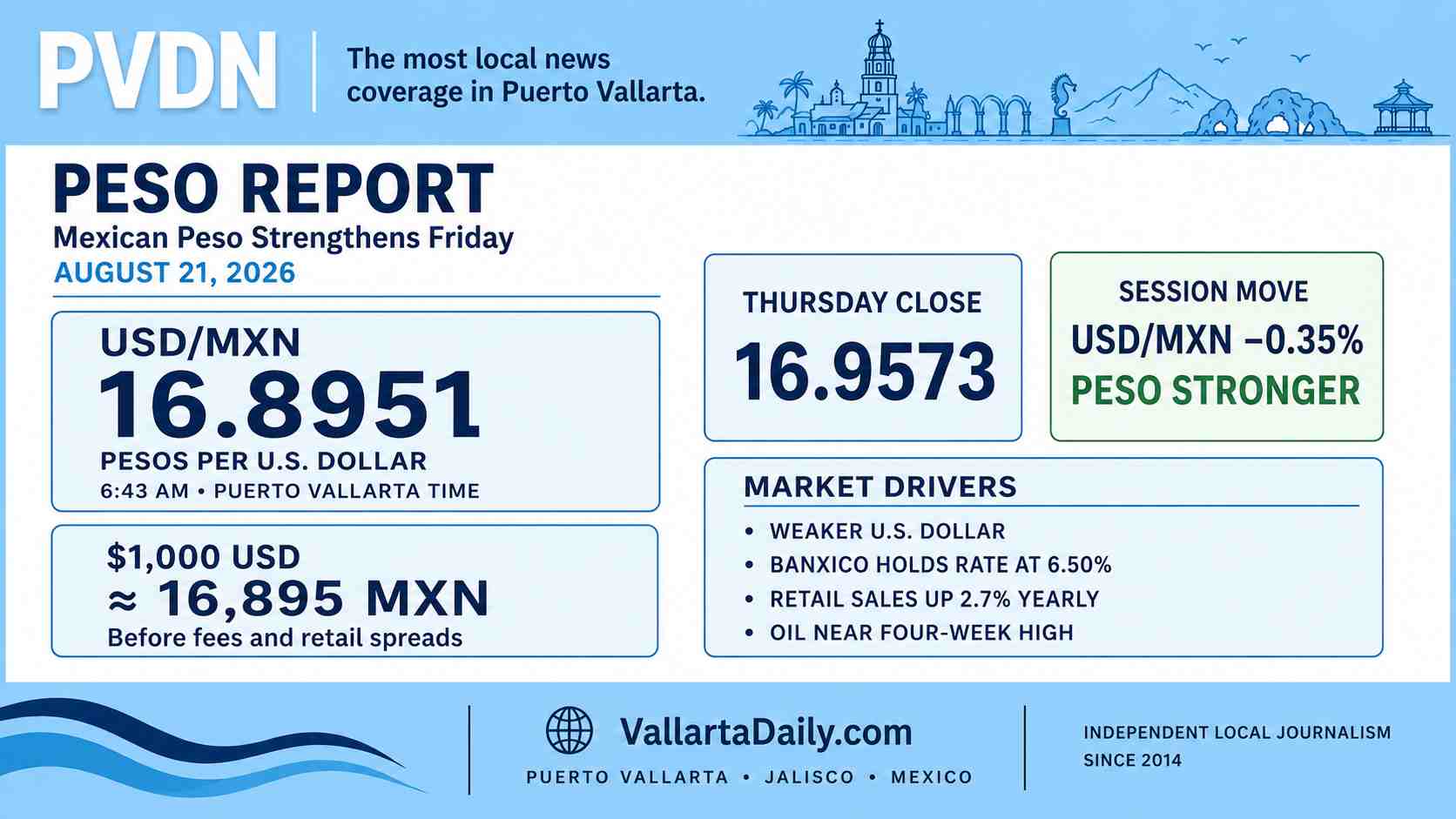
Puerto Vallarta, Jalisco, August 21, 2026 – The Mexican peso strengthened in early Friday trading, with USD/MXN quoted at 16.8951 at 6:43 a.m. Puerto Vallarta time. That wholesale market rate equals about 16.90 pesos per dollar.
The dollar was down approximately 0.35% from the previous session. USD/MXN had traded between 16.8880 and 16.9870 during the day, with a lower rate indicating a stronger peso.
Banco de México reported an official market close of 16.9573 on Thursday and a FIX reference rate of 16.9583. Friday’s FIX had not been published as of this report; Banxico normally releases it after noon on banking days.
Peso Holds Below 16.90 Early Friday
The peso’s advance coincided with broad weakness in the U.S. currency. The dollar index was near 98.68, down about 0.22% Friday morning and close to its lowest level in three months.
Investors have questioned whether expanded U.S. Treasury bond buybacks can calm long-term debt markets without creating additional pressure on the dollar. The dollar was headed for a weekly decline of nearly 1% against a basket of major currencies.
The global backdrop remained unsettled. Long-term U.S. bond yields were elevated, while diplomatic tensions involving Iran kept oil near a four-week high. Brent crude was trading around $94 a barrel and had gained more than 5% for the week.
Higher oil prices can raise inflation concerns and reduce demand for risk-sensitive currencies. In Friday’s early session, however, the peso continued to gain alongside other currencies as the dollar weakened.
Banxico’s Rate Stance Supports the Peso
Minutes released by Banco de México on Thursday indicated that policymakers may keep the benchmark interest rate unchanged for an extended period.
The central bank held its rate at 6.50% on August 6. Officials cited persistent services inflation and an uncertain international environment, despite an overall decline in Mexican inflation.
That leaves Mexico’s policy rate at least 2.75 percentage points above the upper end of the Federal Reserve’s 3.50% to 3.75% target range. The gap can support demand for peso-denominated assets, although it does not prevent sudden currency swings when global risk conditions change.
Banxico also acknowledged that the stronger peso has helped contain some price pressure. The currency has gained nearly 6% against the dollar since the beginning of 2026.
Retail Sales Give a Mixed Economic Signal
Mexico’s June retail figures, released Friday morning using INEGI data, showed sales rising 2.7% from a year earlier. That was an improvement from May’s 1.6% increase, but below the 3.1% market consensus.
On a seasonally adjusted monthly basis, sales fell 0.2%, following a 0.6% decline in May. The results suggest annual consumer spending remained positive while short-term momentum was still uneven.
The mixed report did not produce a clear reversal in the peso’s early gains. Currency traders were also waiting for preliminary August U.S. business activity readings later Friday morning. Stronger-than-expected U.S. data could revive expectations for higher Federal Reserve rates and support the dollar.
Attention will then turn toward the Federal Reserve’s Jackson Hole symposium, scheduled for August 27–29, for further signals on U.S. monetary policy.
Dollar-Peso Budgets in Puerto Vallarta
At the early market rate, $1,000 converted at the wholesale benchmark would equal approximately 16,895 pesos before bank charges, transfer fees or exchange-house spreads. The same amount was worth about 16,957 pesos at Thursday’s official close, a difference of roughly 62 pesos.
People receiving income or holding savings in dollars are getting slightly fewer pesos than during the previous session. Those earning pesos while paying dollar-denominated expenses are seeing a modest reduction in the peso cost of those bills.
Retail exchange rates can differ substantially from the market benchmark, particularly for airport kiosks, cash exchanges and credit card transactions. Friday’s rate can also move after the release of U.S. economic data.