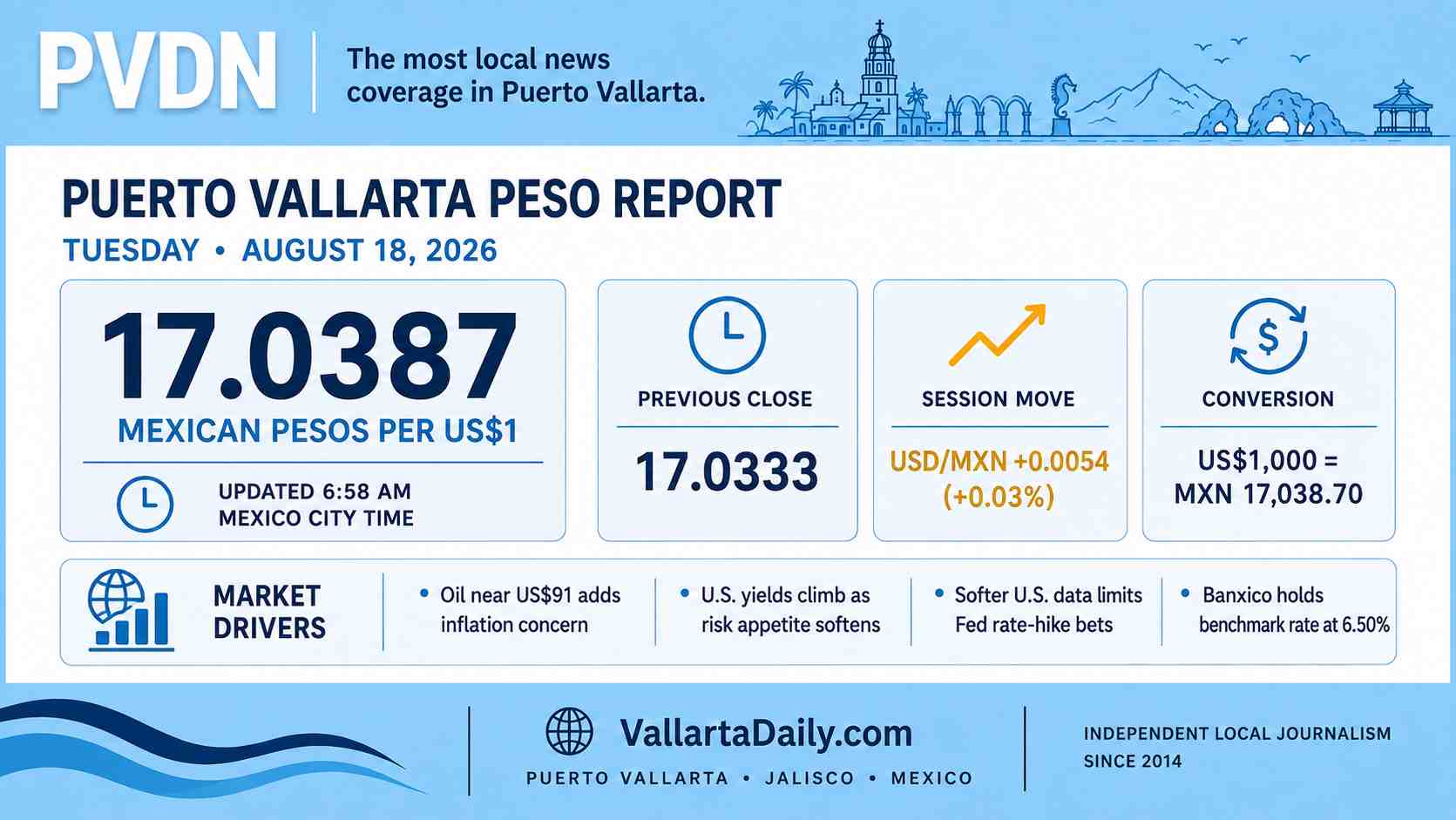
Puerto Vallarta, Jalisco, August 18, 2026 – One U.S. dollar bought 17.0387 Mexican pesos at 6:58 a.m. Mexico City time Tuesday, according to the latest USD/MXN market quote. Foreign-exchange rates move continuously, and bank, transfer, and cash-exchange prices will differ from the mid-market rate.
The dollar was up 0.0054 pesos, or 0.03%, from the previous close of 17.0333. Since USD/MXN measures how many pesos are needed to buy one dollar, the increase represented a fractional weakening of the peso.
Trading had ranged from 17.0283 to 17.0723. The latest Banco de México FIX rate, calculated Monday, was 17.0245. Tuesday’s FIX had not been published when this report was prepared; the central bank normally releases it after noon.
Global caution meets a softer dollar
The peso entered Tuesday between competing global forces. The dollar index rose about 0.1% to 99.66 but remained near multimonth lows as traders reduced expectations for another Federal Reserve rate increase.
Markets placed the probability of a September Fed increase at about 35%, down from 52% one week earlier. Recent U.S. employment and inflation reports have weakened the case for an immediate increase, although renewed Middle East tensions and higher oil prices provided some safe-haven demand for the dollar Tuesday.
Brent crude was trading near $91 a barrel as negotiations involving the United States and Iran remained stalled, and the Strait of Hormuz was effectively closed. The conflict has raised concerns about energy costs and future inflation.
Long-term bond markets showed more concern than currency trading. The U.S. 30-year Treasury yield climbed above 5.32%, its highest level since 2007, while the 10-year yield approached 4.74%. Higher U.S. yields can support the dollar and reduce demand for emerging-market currencies, although the peso showed little net movement during early trading.
Mexico exports crude oil, but conflict-driven price increases can have mixed effects. Higher prices may support petroleum revenue while also adding to inflation risks and reducing global appetite for risk-sensitive assets. Tuesday’s narrow exchange-rate move does not show one factor clearly dominating the others.
U.S. data add a mixed signal
New U.S. figures released Tuesday morning pointed to softer price and construction activity.
The U.S. import price index fell 0.4% in July, after a 0.3% decline in June. Petroleum import prices dropped sharply, although the report does not include tariffs or transportation costs.
Total U.S. housing starts fell 12.4% to a seasonally adjusted annual rate of 1.239 million, below the 1.35 million expected by economists. Building permits increased 5% to 1.443 million.
The peso remained close to Monday’s closing level after those releases. Traders are now waiting for the minutes from the Federal Reserve’s July meeting, which are due Wednesday, for more detail on the disagreement inside the central bank over inflation and interest rates.
Mexico’s interest-rate support remains in place
Mexico’s central bank held its benchmark interest rate at 6.50% on August 6. The Federal Reserve’s current target range is 3.50% to 3.75%.
That leaves Mexican rates 2.75 to 3 percentage points above the U.S. range. The difference continues to support demand for peso-denominated assets, although that support can weaken quickly when investors reduce exposure to emerging markets.
Mexico’s annual inflation slowed from 3.37% in June to 3.12% in July, its lowest level since May 2020. Banxico nevertheless said inflation is likely to return to its 3% target more gradually than previously expected and moved that estimate to the final quarter of 2027.
No new Mexican policy decision was scheduled Tuesday. The domestic focus shifts to the August 20 Banxico minutes, which should provide more detail on why all five board members supported keeping the rate unchanged.
The household math near 17 pesos
At 17.0387 pesos per dollar, a mid-market conversion would produce approximately:
- US$100 = MXN 1,703.87
- US$1,000 = MXN 17,038.70
- MXN 10,000 = US$586.90
- MXN 20,000 = US$1,173.80
Banks, ATMs, card issuers and transfer services normally add a spread or fee, so customers will receive a different rate.
For residents earning dollars and paying expenses in pesos, US$1,000 currently provides about 485 fewer pesos than it would have at Banco de México’s July 17 FIX rate of 17.5242. For someone earning pesos and covering a US$1,000 expense, the same movement has reduced the peso cost by roughly MXN 485 before fees.
Even within Tuesday’s early range, the value of a US$1,000 conversion varied by about MXN 44.