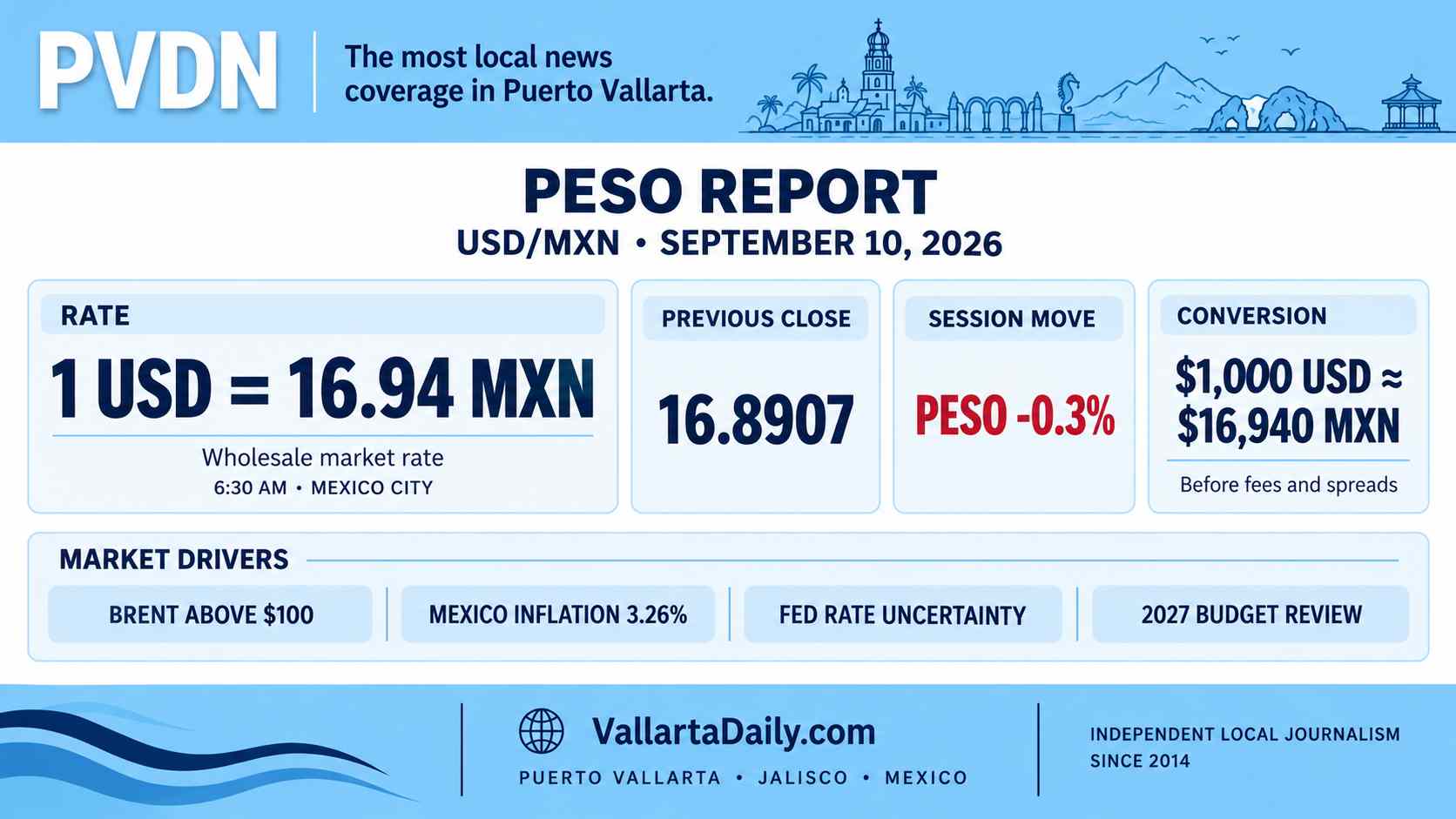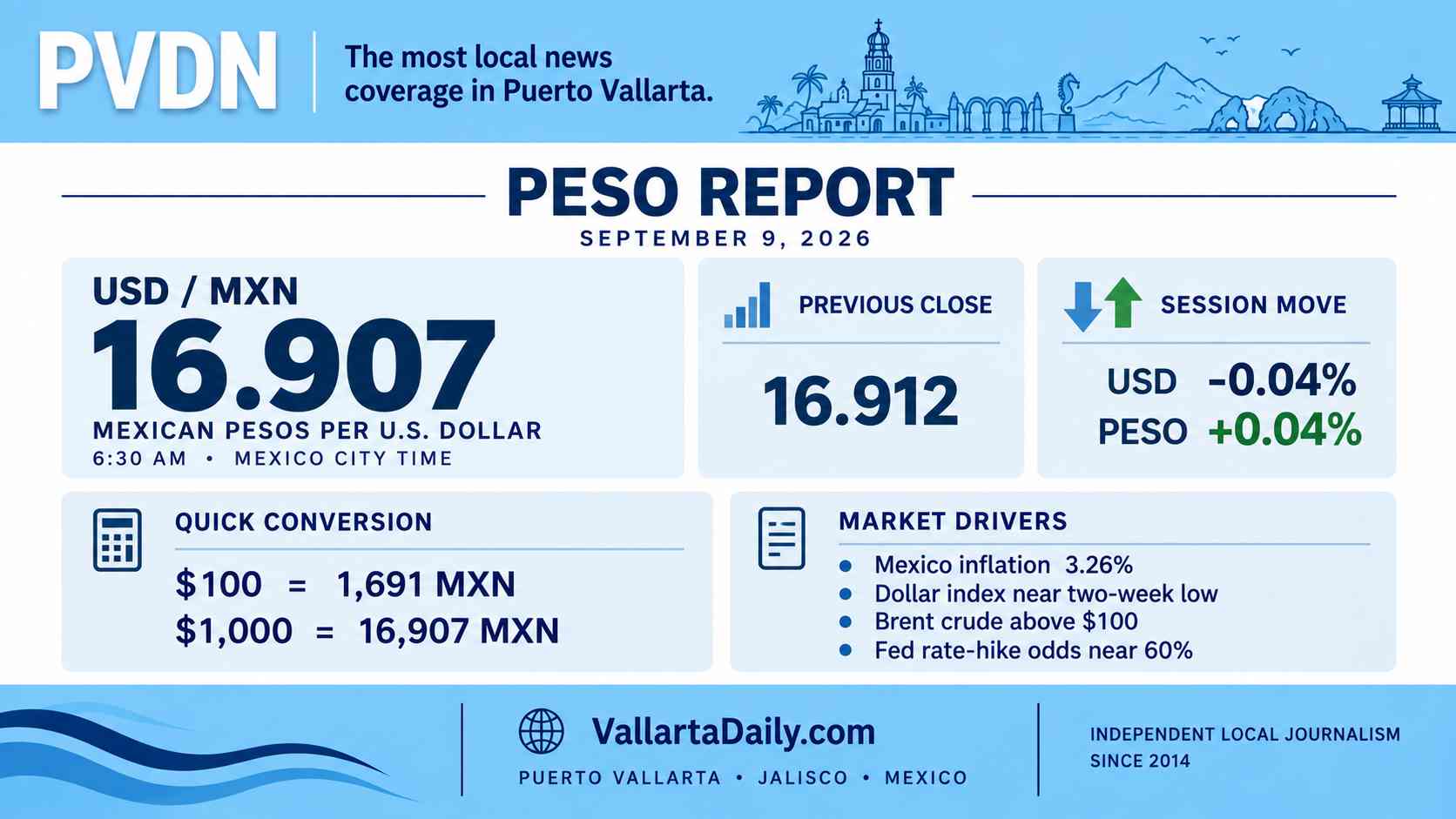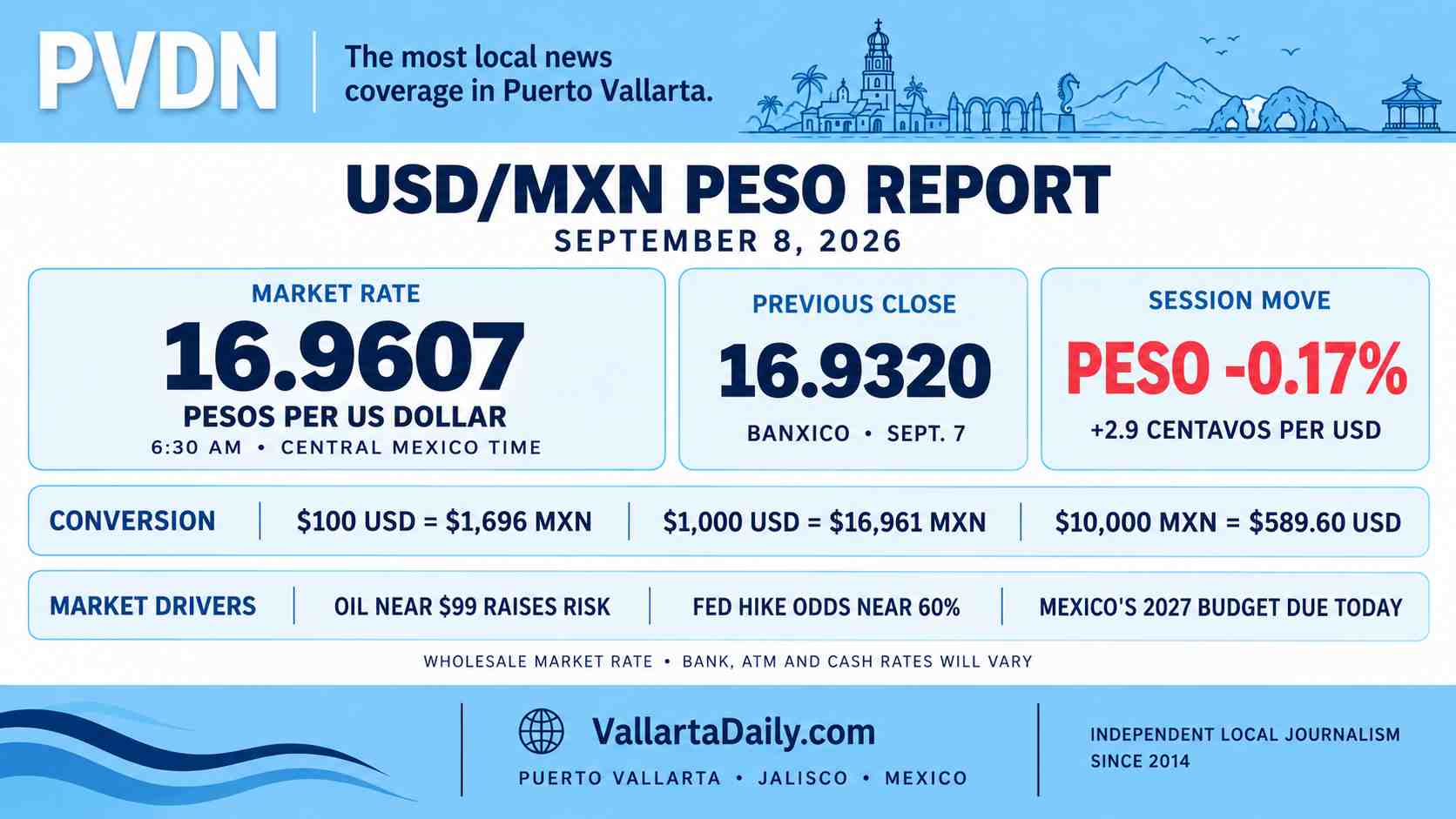
Puerto Vallarta, Jalisco, September 12, 2026 – The Mexican peso entered the weekend near 16.97 per U.S. dollar after posting a modest gain during Friday’s session.
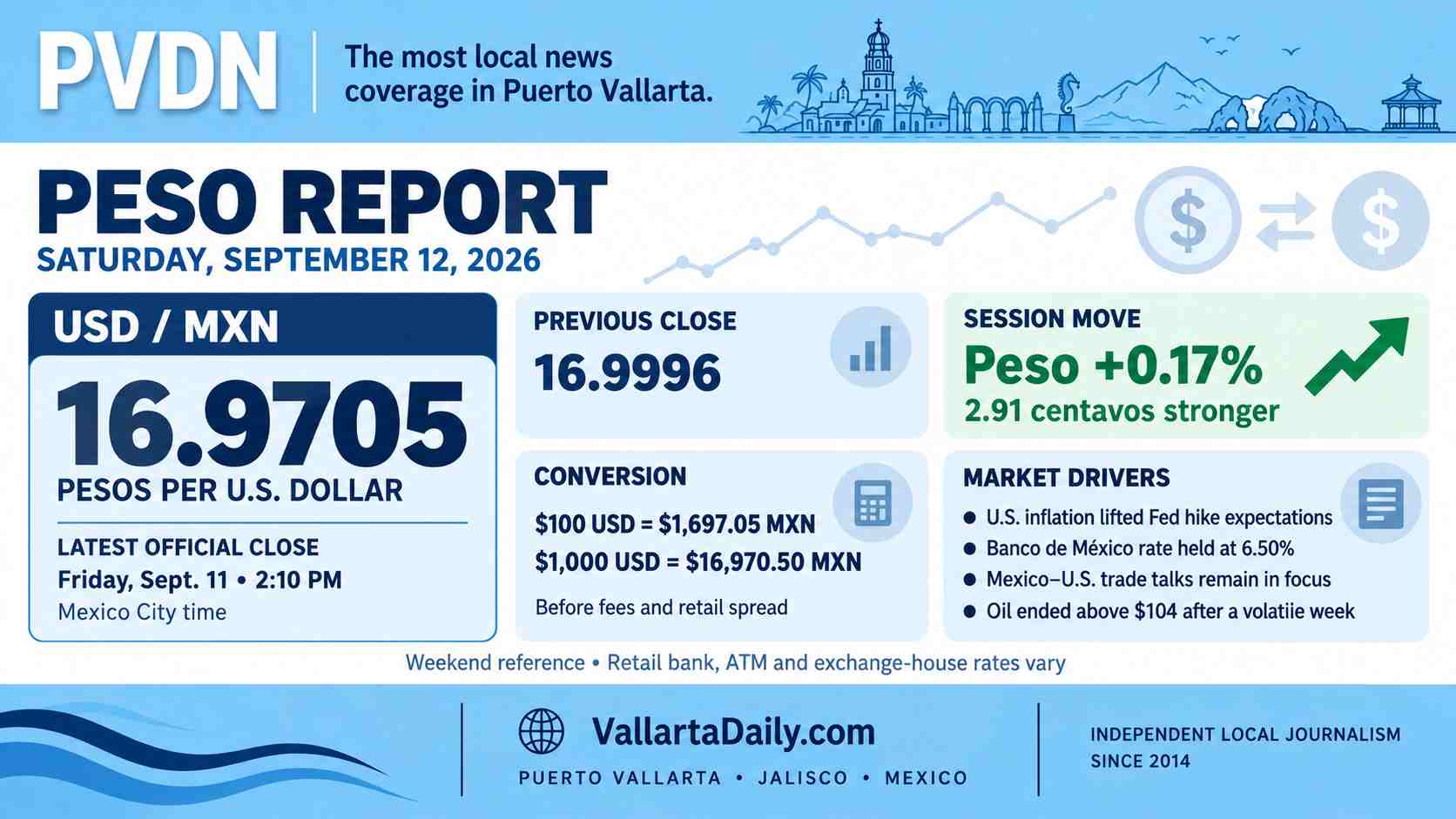
As of 6:51 a.m. Saturday, Puerto Vallarta time, there was no new Mexican wholesale-market session. The latest official closing reference remained 16.9705 pesos per dollar, calculated shortly before 2:05 p.m. Friday and released at 2:10 p.m.
The Banco de México exchange-market table showed the dollar trading between 16.9650 and 16.9810 pesos during the central bank’s observation period.
Peso strengthens slightly before the weekend
Friday’s official close was 2.91 centavos below Thursday’s 16.9996 rate. That represents a decline of about 0.17% in USD/MXN, meaning the peso strengthened by roughly the same percentage during the session.
Banco de México also set Friday’s FIX rate at 16.9707 pesos per dollar. The FIX is a separate official reference used for certain dollar-denominated obligations in Mexico and does not represent the retail rate offered by banks, ATMs or exchange houses.
The daily move was limited because several market forces were pulling in different directions. Higher U.S. inflation and rising expectations for a Federal Reserve rate increase supported the dollar, while firmer equity markets and an easing in oil prices during Friday’s session improved risk appetite.
U.S. inflation raises pressure on the Fed
The U.S. Bureau of Labor Statistics reported that consumer prices rose 0.4% in August and 3.4% from a year earlier. Core inflation, which excludes food and energy, increased 0.3% during the month and 2.4% annually.
Interest-rate futures subsequently placed about an 85% probability on a quarter-point Federal Reserve increase at its September 15–16 meeting, up from roughly 70% before the report.
A Fed increase would narrow the interest-rate gap between the United States and Mexico. Banco de México’s benchmark rate remains at 6.50%, while the current U.S. federal funds target is 3.50% to 3.75%. Mexico’s higher rate has helped attract some short-term capital to peso assets, although those flows can reverse when the dollar strengthens or investors become less willing to hold emerging-market currencies.
The broader dollar index finished Friday nearly unchanged at 99.12 and was down slightly for the week. Brent crude settled 2.81% lower at $104.61 a barrel, but remained about 8% higher for the week as conflict disrupted shipping and energy supplies in the Middle East.
Those energy and geopolitical pressures can affect the peso in conflicting ways. Mexico is an oil producer, but a sustained rise in global fuel prices can also increase inflation concerns and reduce demand for risk-sensitive currencies.
Mexico’s inflation, budget and trade talks
Mexico’s latest inflation report gave Banco de México little immediate reason to change course.
According to INEGI’s August inflation report, annual headline inflation rose from 3.12% in July to 3.26% in August. Core inflation eased from 3.95% to 3.88%, suggesting that some underlying price pressures continued to moderate.
Banco de México held its benchmark rate at 6.50% in August after ending its previous rate-cutting cycle. Its next decisions will depend partly on whether inflation continues moving toward the 3% target and how global energy and trade risks affect prices.
Markets are also assessing Mexico’s proposed 2027 budget. The government projects economic growth of 1.5% to 2.5% and expects the broader public-sector deficit to narrow from an estimated 4.1% of gross domestic product in 2026 to 3.9% next year. The proposal still requires congressional consideration.
Trade negotiations with Washington remain another source of uncertainty. Mexican and U.S. officials are working toward an interim agreement that could address tariffs on vehicles, steel and aluminum, along with U.S. concerns about Chinese investment and automotive content. No formal deadline or completed agreement has been announced.
The rate Vallarta residents actually receive
At Friday’s official wholesale close, $100 would equal 1,697.05 pesos, while $1,000 would equal 16,970.50 pesos, before commissions or exchange-rate spreads.
Compared with Thursday’s close, someone converting $1,000 into pesos would theoretically receive about 29 pesos less. A person earning pesos and paying a $1,000 dollar-denominated expense would theoretically need about 29 fewer pesos.
Those calculations use the wholesale reference. Puerto Vallarta banks, ATMs, card processors and exchange houses set their own buying and selling rates, sometimes with additional fees. Weekend spreads may be wider because the Mexican wholesale market is closed.
The peso’s next active sessions will bring renewed attention to the Federal Reserve decision, oil prices and any developments in Mexico-U.S. trade negotiations. A move above or below Friday’s narrow range could change the retail rates available locally when Mexican markets reopen.