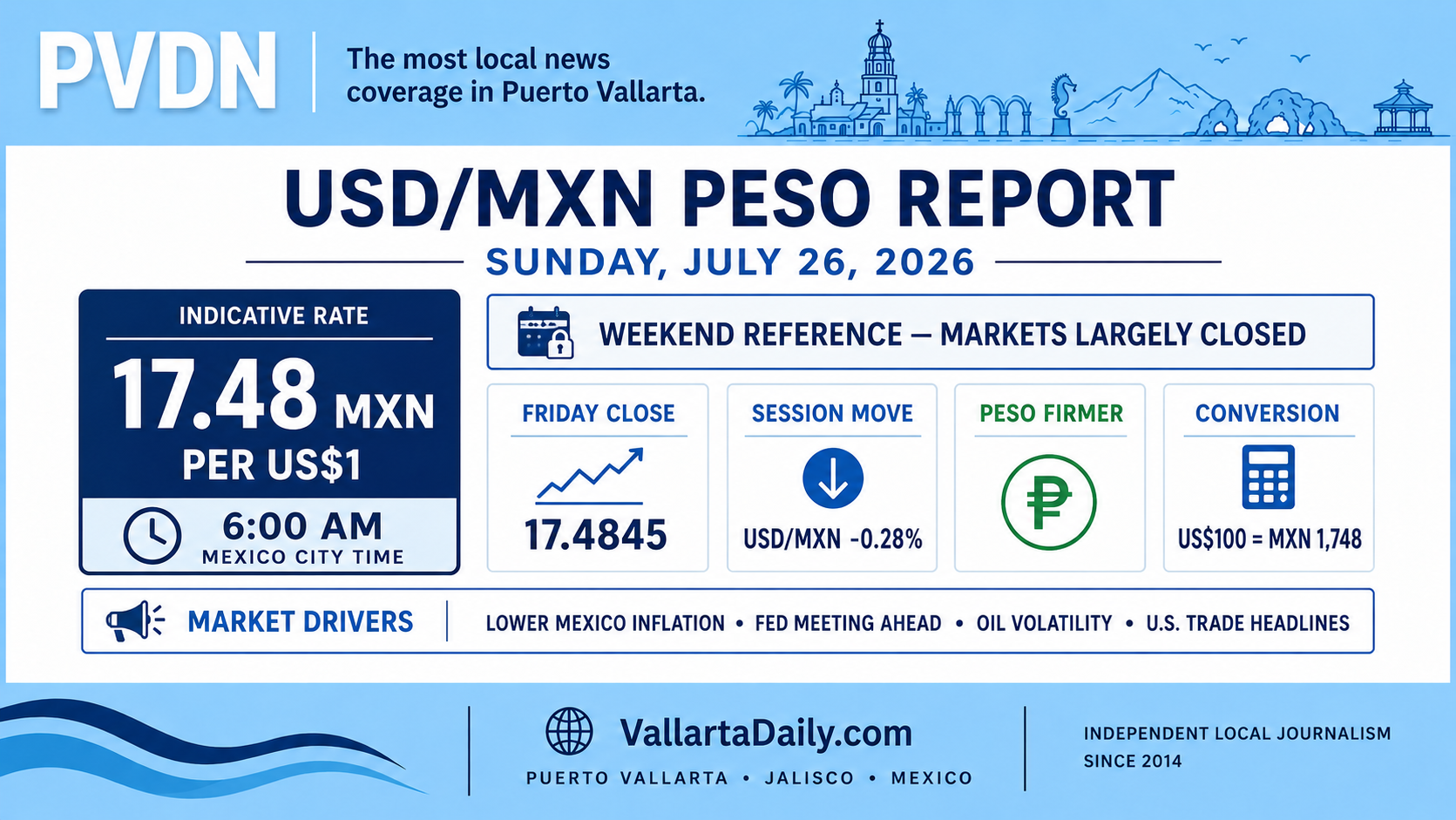
Puerto Vallarta, Jalisco, July 26, 2026 – The Mexican peso was holding near 17.48 per U.S. dollar early Sunday, based on an indicative mid-market quote checked at 6:00 a.m. Mexico City time.
Sunday’s figure does not represent an active domestic trading session. Foreign-exchange markets are largely closed for the weekend, so the latest meaningful movement came Friday. Prices may begin changing again when Asian markets open Sunday evening.
The Banco de México closing rate stood at 17.4845 pesos per dollar on July 24. The central bank’s separate FIX reference rate was 17.4635, compared with 17.5130 on Thursday. That was a decline of about 0.28% in USD/MXN, meaning the peso strengthened during the session.
Peso Ends the Week on Firmer Ground
Private market data placed USD/MXN near 17.46 late Friday, down approximately 0.34% from the preceding session. The pair traded within a relatively narrow range during the week, despite sharp movements in oil, bonds and global stock markets.
The difference between the market quote, Banco de México’s closing rate and the FIX rate reflects their separate calculation methods and collection times. Banco de México calculates FIX from wholesale-market quotations on banking days and publishes it after noon.
For residents exchanging cash or transferring money, none of these rates is necessarily the amount offered by a bank, exchange house or card company. Retail providers add their own spread and, in some cases, transaction fees.
Mexican Inflation Offers Support With a Caveat
Mexico’s latest inflation report gave the peso some domestic support. The National Institute of Statistics and Geography reported that consumer prices rose 0.07% during the first half of July, placing annual headline inflation at 3.10%.
Core inflation, which excludes some volatile prices, stood at 3.95%. That brought it back within Banco de México’s target range, although it remained close to the upper limit.
Cooling inflation reduces pressure on the central bank to keep borrowing costs high indefinitely. That can work against the peso if traders expect lower Mexican interest rates. For now, however, Banco de México’s benchmark rate remains at 6.50%, preserving a sizable interest-rate advantage over the United States.
The balance between lower inflation and Mexico’s relatively high interest rates helps explain why the peso strengthened Friday without making a larger move.
Fed Expectations and Oil Keep Markets Uneasy
The Federal Reserve begins a two-day policy meeting Tuesday, July 28, with its decision due Wednesday. The federal funds target range is currently 3.50% to 3.75%.
Most economists surveyed recently expected no change this year, but the possibility of another rate increase has grown as higher oil prices revive U.S. inflation concerns. Any shift toward higher U.S. rates can support the dollar and reduce some of the yield advantage that has helped the peso.
Energy markets added another layer of uncertainty. Brent crude briefly moved above $100 a barrel last week amid concerns about shipping and supply disruptions in the Middle East before retreating to $96.78 on Friday.
Mexico exports crude oil, but a higher oil price does not automatically strengthen the peso. An energy shock can also lift inflation, push global interest rates higher and reduce demand for currencies viewed as carrying greater risk.
U.S. Trade Measures Leave Mexico’s Position Largely Intact
New U.S. tariffs announced for dozens of trading partners also drew attention Friday. Economy Minister Marcelo Ebrard said Mexico’s effective treatment would remain unchanged because goods meeting the requirements of the United States-Mexico-Canada Agreement continue to receive tariff-free access.
Ebrard estimated that approximately 85% of Mexican exports to the United States qualify for that treatment. That is an official assessment, and the longer-term effects will depend on how the rules are applied and whether further trade measures are announced.
Because the United States receives most Mexican exports, changes to tariff policy, USMCA compliance, or cross-border manufacturing rules can quickly influence expectations for Mexico’s economy and currency.
Converting Dollars and Pesos This Sunday
At an indicative rate of 17.48 pesos per dollar:
- US$100 equals approximately 1,748 pesos.
- US$500 equals approximately 8,741 pesos.
- US$1,000 equals approximately 17,482 pesos.
- MXN 10,000 equals approximately US$572.
These are mid-market estimates before fees. Puerto Vallarta exchange houses, Mexican banks, U.S. banks and ATM operators may offer noticeably different rates.
People paid in dollars receive slightly fewer pesos when the peso strengthens. Those earning pesos gain some purchasing power against dollar-denominated expenses. For household budgeting, the provider’s final exchange rate and fees matter more than small movements in the wholesale quote.
Monday’s Open Faces a Crowded Calendar
Trading resumes with the peso near the middle of its recent July range. The immediate focus will be the Federal Reserve meeting, oil-market volatility, and any additional U.S. trade announcements.
Sunday’s 17.48 indication should therefore be treated as a weekend reference rather than a firm rate for Monday. Currency prices can move when global markets reopen, before Mexican banks and exchange houses begin updating their posted rates.