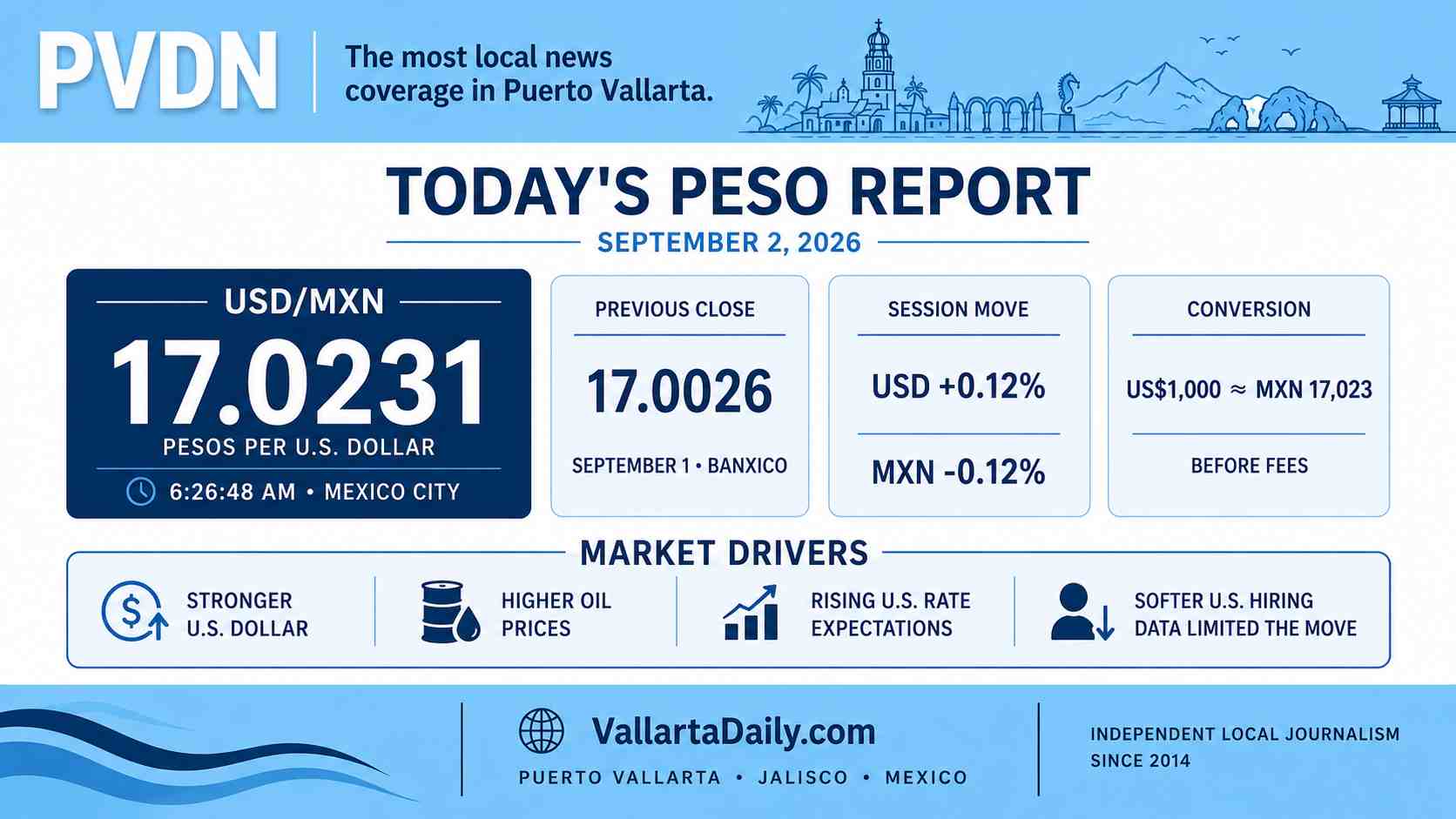
Puerto Vallarta, Jalisco, September 2, 2026 – The Mexican peso weakened in early Wednesday trading, with USD/MXN quoted at 17.0231 pesos per dollar at 6:26:48 a.m. Mexico City time, according to a live foreign-exchange market feed. The rate can change throughout the day.
That placed the dollar about 2.05 centavos, or 0.12%, above the Banco de México closing rate of 17.0026 on Tuesday. A rising USD/MXN rate means the dollar is gaining value and the peso is losing value.
Banxico had not yet calculated Wednesday’s FIX rate at the time of writing. The central bank publishes that reference after noon on banking days. For dollar obligations payable in Mexico on Wednesday, the official rate is 17.0147 pesos. That rate is used for qualifying legal payments and is separate from live bank, card and currency-exchange quotes.
Dollar and oil set the early direction
Most of Wednesday’s pressure came from outside Mexico. The U.S. dollar index rose 0.20% to 99.865, its highest level since August 17, as renewed fighting involving the United States and Iran increased demand for the dollar and raised concern about another energy-price shock.
The yield on the 10-year U.S. Treasury reached 4.8182%, its highest since November 2023. Markets were pricing a 68% probability of a Federal Reserve rate increase in September, up from about 40% one week earlier, according to early currency-market reporting. Market pricing reflects trader expectations and can shift quickly; it is not a Federal Reserve forecast.
Oil added to the uncertainty. Brent crude reached $97.04 a barrel earlier in the session before falling to $94.08 by 5:35 a.m. Mexico City time. West Texas Intermediate stood at $89.50 after touching $92.29.
The reversal showed how quickly energy markets were reacting to reports from the Strait of Hormuz. Higher oil prices can intensify inflation concerns, push bond yields higher and reduce demand for risk-sensitive currencies. Oil does not determine the peso’s direction by itself, but Wednesday’s sharp movement in crude prices was part of the broader pressure on emerging markets.
Weaker U.S. hiring data adds a counterweight
U.S. private employers added 38,000 jobs in August, below the 48,000 expected by economists. July’s increase was revised up to 46,000.
The ADP employment report offered some evidence that hiring remained restrained. Softer labor data can reduce pressure on the Federal Reserve to raise rates, which would normally limit dollar gains. However, the report has not always predicted the government’s employment figures accurately, and traders are still waiting for Friday’s broader U.S. jobs report.
Wednesday’s early peso movement therefore reflected competing signals: weaker U.S. hiring data on one side, and higher oil prices, rising bond yields and demand for the dollar on the other.
Mexico’s rate and trade backdrop
Banco de México has kept its benchmark interest rate at 6.50% since its August 6 meeting. The current Banxico rate continues to provide some support for the peso, although the relative difference between Mexican and U.S. interest rates becomes less favorable if traders expect the Federal Reserve to tighten policy.
Trade uncertainty remains a separate concern. Preliminary figures showed that total foreign direct investment in Mexico approached a record $35 billion during the first half of 2026, but only 7.8% represented new investment. New foreign investment fell 13% from the same period last year.
Business executives cited uncertainty over the future of the United States-Mexico-Canada Agreement when discussing delayed or reconsidered projects. Banxico has also identified the lack of a definitive USMCA resolution as an adverse factor for investment decisions, according to reporting on company investment plans. There was no clear evidence that this issue drove Wednesday morning’s exchange-rate movement, which was more closely aligned with global dollar and oil trading.
The 17-peso line in a household budget
At the 6:26 a.m. wholesale market rate, $1,000 would convert to approximately 17,023 pesos before fees. That is about 20.50 pesos more than the same conversion at Tuesday’s official close.
For someone earning pesos and paying a 10,000-peso expense from dollar savings, the market equivalent would be about $587.44. People paid in dollars receive slightly more pesos than they would have at Tuesday’s close, while those earning pesos face a slightly higher cost when buying dollars.
Actual bank, ATM, card, remittance and exchange-house rates will differ from the wholesale quote because each provider applies its own spread and fees. Anyone making a transfer or large purchase should check the final rate offered at the time of the transaction.