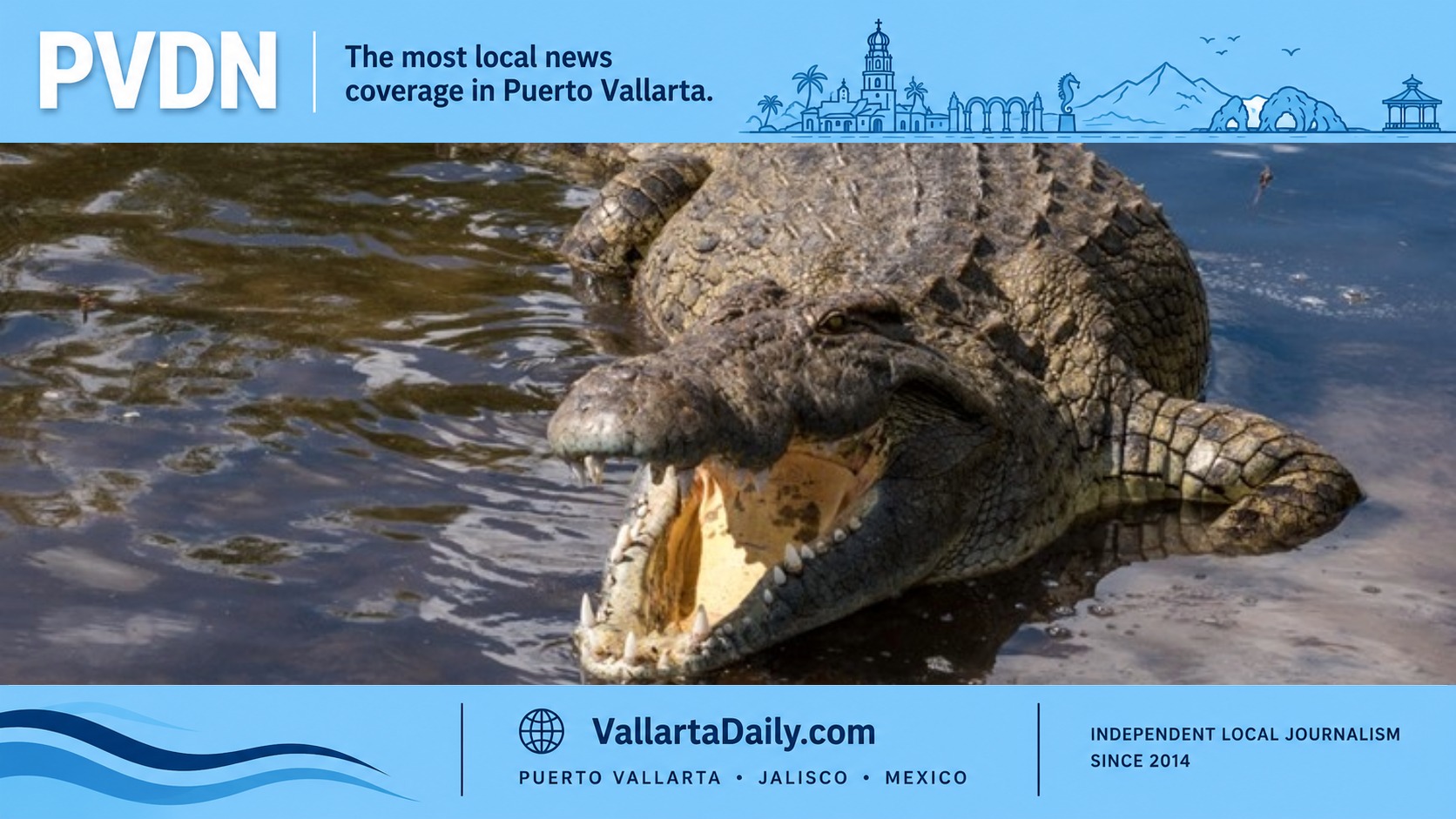
Puerto Vallarta, Jalisco, July 6, 2026 – The crocodile population along the coast from Puerto Vallarta to Barra de Navidad is estimated at fewer than 1,000 animals, a figure that challenges the idea that the region is facing a runaway crocodile boom even as beach safety concerns remain high after recent incidents.
The estimate, attributed to regional crocodile specialist Helios Hernández Hurtado, puts the issue in a different frame for Puerto Vallarta. The risk is not simply the number of crocodiles, but how little space remains between people, hotels, beaches, estuaries, canals, and the animals’ remaining habitat.
Hernández Hurtado, a researcher long associated with crocodile studies in Jalisco and Nayarit, said the population remains limited when measured across the long coastal stretch that includes Puerto Vallarta, Bahía de Banderas and the south coast toward Barra de Navidad. Researchers have monitored crocodiles in estuaries, rivers, mangroves and wetlands for more than two decades.
Sightings on beaches can make the population feel larger than it is. A crocodile moving through the surf near Marina Vallarta, Boca de Tomates, the mouth of the Pitillal River, or the Cuale River attracts immediate public attention. A stable group of animals inside an estuary usually does not.
Puerto Vallarta is still dealing with the aftermath of the fatal crocodile attack reported near Marina Vallarta in late June, after which Jalisco reinforced patrols around beaches and estuary zones. PVDN has also reported expanded red and purple beach warnings during rainy-season conditions, when water levels can more directly connect rivers, canals, and esteros to the shoreline.
Specialists are drawing a line between population size and encounter risk. A small or stable crocodile population can still pose serious danger when people enter known crocodile zones, swim near river mouths, walk pets close to estuary edges, ignore warning flags, or enter the water near dusk, at night, or early morning.
The Centro Universitario de la Costa said last week that crocodile research and training in the region has been ongoing for more than two decades. CUCosta researchers also pointed to urban growth and land-use changes as factors that have altered crocodile movement patterns and increased sightings in areas where people did not previously expect to see them.
That is especially visible in Puerto Vallarta because the city grew around and beside crocodile habitat. El Salado, Boca Negra and Boca de Tomates are not remote wilderness areas. They sit close to hotels, roads, residential areas, restaurants, beaches and public access points. In some places, the practical boundary between tourist space and wildlife habitat is only a sign, a fence, a canal bank or a few meters of sand.
CUCosta’s Reptilario Cipactli has also been part of the local response. In March, the university said specialists trained 32 Puerto Vallarta lifeguards in crocodile biology, behavior, conservation and safe handling, in coordination with local environmental officials and the Estero El Salado protected area. The training was designed to improve response to public reports and reduce dangerous improvisation when crocodiles appear in public areas.
The crocodile found in this region is the American crocodile, or Crocodylus acutus. It is a native species of Pacific coastal ecosystems and is protected under Mexican environmental rules. That protection does not remove the public-safety risk. It does mean the answer cannot be random killing, harassment, feeding, selfies, or attempts by untrained people to move the animal.
That point has become more urgent after reports of crocodiles being killed or mutilated in Puerto Vallarta. PVDN reported last week that killing crocodiles will not make Vallarta beaches safer, because the larger problem is unmanaged contact between people and crocodile habitat. Removing one animal does not remove the estuary, the river mouth, the rainy-season movement, or the next crocodile that uses the same corridor.