Federal authorities say a new round of operations in western Mexico struck drug-production networks in Jalisco, Nayarit, and Sinaloa. The seizures included methamphetamine, chemical precursors, and industrial materials used to make synthetic drugs. One part of the operation was linked to Audias Flores Silva, known as “El Jardinero,” a senior CJNG figure arrested in Nayarit in April. The case adds new attention to how synthetic drug production moves through Mexico’s Pacific corridor.
Federal raids target synthetic drug production
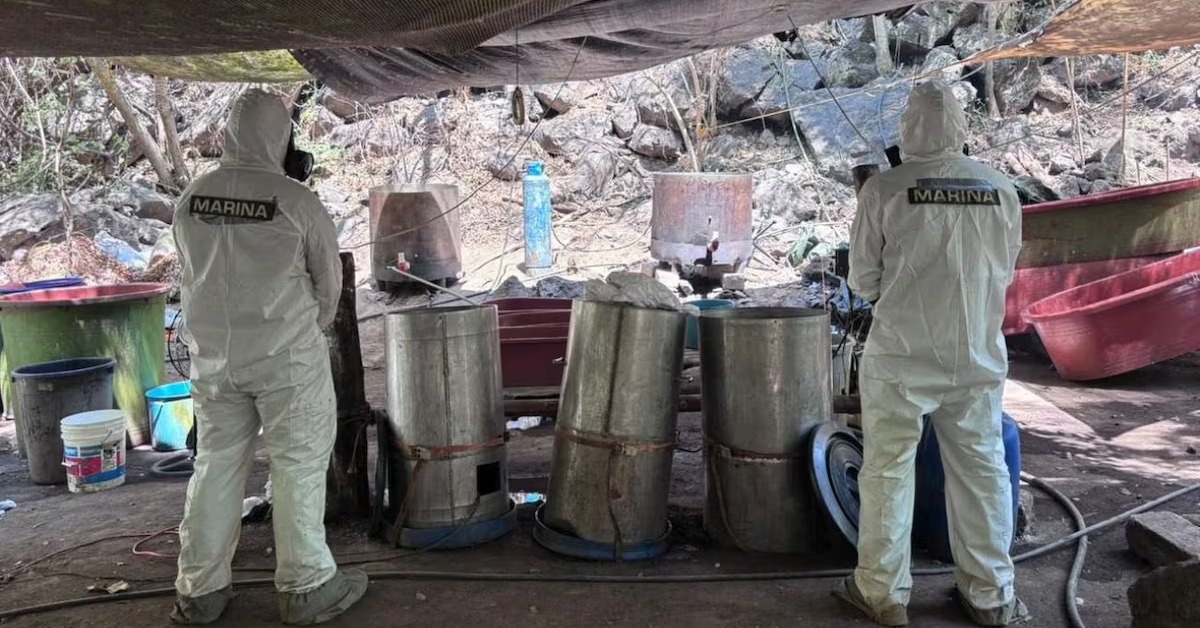
Federal authorities said they disabled five clandestine drug-production sites during coordinated actions in Jalisco, Nayarit, and Sinaloa.
The operation involved personnel from the Navy, the Security and Citizen Protection Secretariat, and the Federal Attorney General’s Office. Authorities said the actions were part of ongoing intelligence work aimed at weakening criminal groups involved in synthetic drug production.
The seizures included more than one ton of methamphetamine, nearly 10,000 liters of chemical precursors, and more than seven tons of substances used in the production process. Officials estimated the economic impact to organized crime at more than 650 million pesos.
The case is significant because one of the seizures was linked to Audias Flores Silva, known as “El Jardinero.” He is identified by Mexican and U.S. authorities as a high-ranking figure tied to the Jalisco New Generation Cartel, or CJNG.
What authorities found in the raids
In El Saucillo, Jalisco, authorities said they found a clandestine laboratory with about 600 kilos of finished product. They also reported 750 liters of chemical precursors, 425 kilos of solid substances, and equipment used to produce synthetic drugs.
In El Capomo, Nayarit, federal personnel reported the seizure of 780 kilos of solid methamphetamine and 300 liters of liquid methamphetamine. Authorities linked that seizure to El Jardinero’s regional operations.
In Sinaloa, the federal actions focused on the communities of Corralejo and Corral Viejo. Authorities reported several seizures there, including finished product, chemical precursors, dual-use substances, caustic soda, ammonium chloride, acetic acid, tartaric acid, methanol, and production tools.
The materials were disabled to prevent reuse and placed under the authority of the federal Public Ministry for the ongoing investigation.
The link to El Jardinero
El Jardinero was arrested on April 27 in Nayarit during a Navy-led operation. U.S. and Mexican authorities have described him as a senior CJNG operator with influence over trafficking routes, armed cells, and drug-production networks.
His arrest came during a sensitive period for CJNG after the death of Nemesio Oseguera Cervantes, known as “El Mencho,” earlier this year. Authorities in Mexico and the United States have treated El Jardinero as more than a local operator because of his alleged role in cross-border trafficking.
U.S. prosecutors recently expanded charges against him. The updated case includes allegations tied to methamphetamine trafficking and money laundering, in addition to earlier cocaine and heroin trafficking accusations.
For readers in western Mexico, the case has a regional layer. Nayarit, Jalisco, and Sinaloa sit along major Pacific routes used for the movement of chemicals, drugs, and criminal personnel. That does not mean these seizures point to an immediate risk in tourist areas. It does show why federal forces continue to focus on rural corridors and production zones outside major cities.
A broader pressure point for CJNG
Synthetic drugs remain a central concern in Mexico’s organized crime landscape. These operations depend on chemical supply chains, hidden production sites, and transport routes that can cross several states before drugs reach their final market.
The latest seizures show federal authorities are targeting the production side of that chain, not only street-level distribution. That matters because laboratories and precursor supplies are harder to replace than individual retail points.
CJNG has faced several major blows this year, including arrests of its leadership, U.S. charges, and increased scrutiny of its finances. Still, security analysts have warned that cartel networks can adjust after high-profile arrests. They often rely on regional cells, local alliances, and diversified income streams.
This operation appears aimed at that structure. By seizing chemicals, finished products, and equipment, authorities are trying to disrupt production capacity rather than detain only individual suspects.