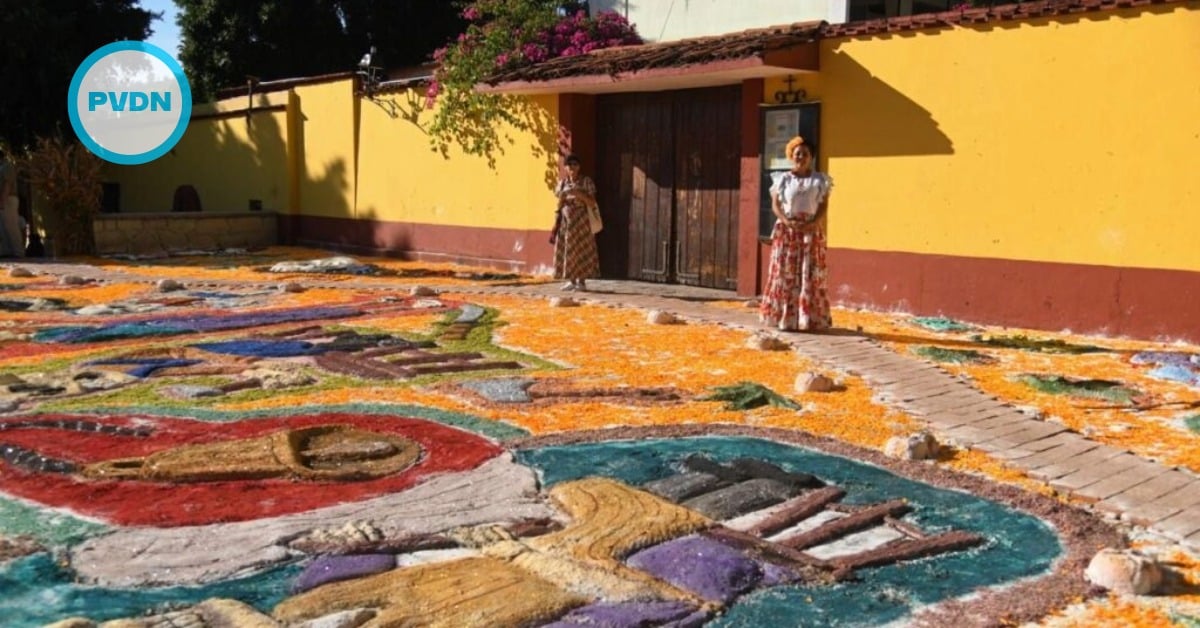
Oaxaca’s Day of the Dead just gained a new landmark. In Jalatlaco, a 250-square-meter sand tapestry by local artist Fernando “Beta” transforms a vanished river into a path of color. The piece, titled El río que se hizo camino, is on view in the atrium of San Matías Jalatlaco and will be on view through November 3. It’s art as public memory—quiet, vivid, and deeply Oaxacan. What looks like decoration is actually storytelling about a neighborhood split by water, then stitched together by a road.
Jalatlaco sand tapestry
On October 28, 2025, Jalatlaco unveiled a 250-square-meter sand tapestry that turns a lost river into a living memorial. Titled El río que se hizo camino and created by Oaxacan artist Fernando “Beta,” the work spreads across the atrium of the neighborhood’s San Matías church. It will remain on view through November 3 as part of Day of the Dead events. The state tourism office describes it as a metaphor for the river that once divided Jalatlaco from the city center, later straightened into today’s Calzada de la República
Quadratín Oaxaca first reported the unveiling, noting the piece’s scale and its purpose during this season of remembrance. Their dispatch places the installation at the heart of the Barrio Mágico, where residents and visitors move between altars, comparsas, and street-level art. The tapestry’s materials are humble—sand and natural pigments—but its impact is large, rendering geography and grief in the same frame.
Why this piece matters to Oaxaca’s Muertos
The tapestry sits within a broader city tradition of monumental ground art that appears for Muertos and then disappears, leaving only photos and memory. Officials emphasized the symbolism this year: a river that separated a community has “become a road,” and art makes that transformation visible, step by step, grain by grain. The state’s communication page credits Fernando “Beta” and situates the work within “La Fiesta más Viva de Todas,” Oaxaca’s official Muertos program, with viewing set to run through November 3.
Day of the Dead in Oaxaca isn’t just parades and face paint; it’s neighborhood-made installations, street altars, and the quiet labor of re-creating stories on the ground. Travel advisories and festival guides point to Jalatlaco as one of the most intimate places to feel that work up close—murals, cobblestones, and now this temporary river of color drawing people into the church atrium.
From river to road to ritual
Jalatlaco’s history helps the artwork land. For generations, the neighborhood sat just beyond the city’s core, defined in part by the watercourse that channeled around it. Over time, the river was engineered into a roadway—Calzada de la República—changing how people moved and how the neighborhood breathed. By laying sand where feet now pass, El río que se hizo camino doesn’t romanticize the past; it asks visitors to walk the present with intention. Local media and officials have highlighted that lineage in their coverage, connecting the installation to the place rather than treating it as a simple seasonal backdrop.
That context matters this week. Oaxaca’s Muertos has grown global, but its soul remains local: families refresh ofrendas, neighborhoods make public art, and city agencies support rather than script. This tapestry threads those levels together. It’s ephemeral, but that’s the point—mourning and memory aren’t meant to be permanent monuments. They are paths we keep making, as long as we keep walking them. The government’s documentation of the piece—its size, materials, and symbolism—confirms the basics; the neighborhood provides the rest.