Before sunrise on Thursday, a sequence of quakes off Jalisco nudged the Pacific quiet without turning it into a crisis. The strongest, a magnitude 5.7 at 4:16 a.m., struck far offshore between Boca de Iguanas and Cihuatlán, followed by a 5.1 minutes later. Civil Protection said there were no damage reports from coastal towns, and the Navy’s Tsunami Warning Center ruled out a tsunami threat. People along the bay still checked their phones, but the shoreline never changed. The morning became just another reminder that this coast is always in motion.
Jalisco offshore earthquakes
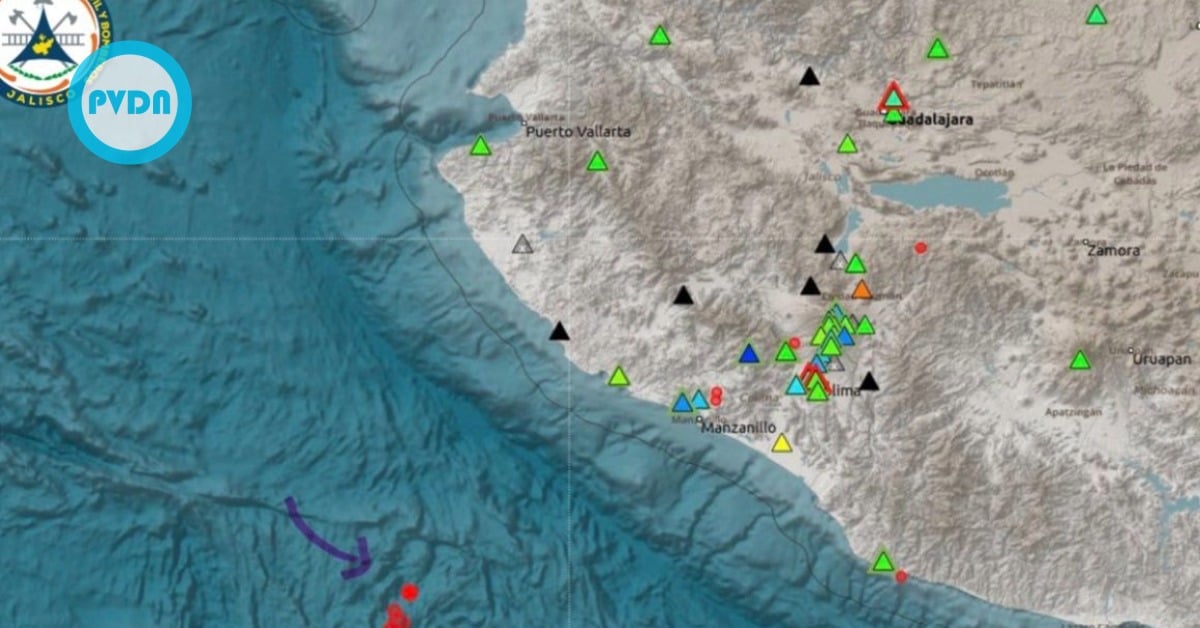
Two offshore earthquakes before dawn stirred nerves along Jalisco’s coast but left no damage. The strongest reached magnitude 5.7 at 4:16 a.m., with an epicenter roughly 194 kilometers southwest of Boca de Iguanas and a depth of 12 kilometers. A magnitude 5.1 earthquake followed at 4:21 a.m., about 179 kilometers southwest of Cihuatlán at a depth of 10 kilometers. The State Civil Protection agency reported that there were no significant perceptions in coastal municipalities and no damage reports as the morning unfolded.
Data posted overnight by media tracking the Servicio Sismológico Nacional (SSN) showed the sequence clearly: a 5.7, a 5.1, and smaller events in the same sector. Milenio’s live feed embedded SSN bulletins with coordinates and depths matching the state report. That alignment supports what residents felt—or didn’t. Offshore, moderate; on land, quiet.
Mexico’s Navy Tsunami Warning Center (CAT-SEMAR) ruled out a tsunami for the Pacific coast. That decision is consistent with the magnitude, depth, and distance from shore. State officials urged people to follow official channels and avoid rumors, a familiar reminder on a coast that is well acquainted with earthquakes.
Why this zone shakes often
This corner of the Pacific sits above the Middle America Trench, where the small Rivera Plate dives beneath the Jalisco Block and North America. Subduction there regularly produces offshore quakes that feel mild on land unless they grow large or strike closer to shore. Geophysical work over decades has mapped that geometry: a steep Rivera Plate is sliding under Jalisco, feeding the region’s seismicity. That’s why days like today happen without becoming disasters.
The pattern today fits that story. The main shocks were far offshore and relatively shallow, but not shallow enough or near enough to jolt towns along the bay. With no unusual sea-level readings reported, the Navy’s no-tsunami call matched international experience for events of this size and location. The ground moved. The day went on.