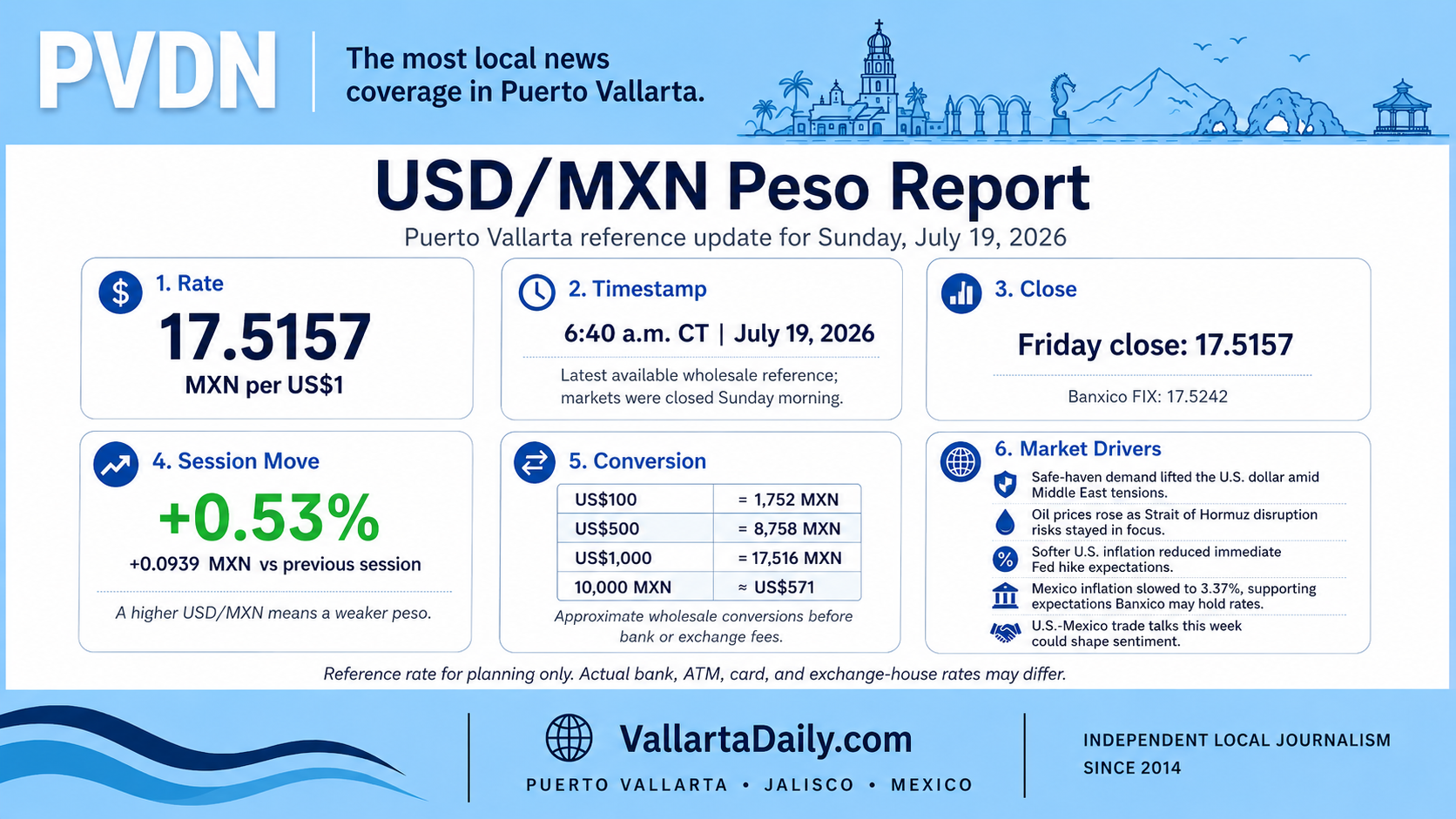
Puerto Vallarta, Jalisco, July 19, 2026 – The latest available wholesale-market quote stood at 17.5157 Mexican pesos per U.S. dollar as of 6:40 a.m. Sunday in central Mexico. The rate reflects Friday’s closing market because a new liquid trading session had not begun.
Friday’s market close was 0.53% higher than the previous session. Since USD/MXN measures how many pesos are needed to buy one dollar, that move represented a weaker peso.
The dollar gained about 9.3 centavos during the session. Banco de México’s official FIX rate was set at 17.5242 pesos on Friday, up from 17.4418 on Thursday. That was an increase of about 0.47%.
The FIX is an official wholesale-market reference calculated by the central bank. It is not the same rate customers will receive from banks, ATMs, credit cards or currency-exchange businesses.
Global risk pushed demand toward the dollar
Friday’s peso weakness came during a broader move away from risk-sensitive currencies and assets.
Renewed fighting between the United States and Iran, along with disruptions affecting traffic through the Strait of Hormuz, supported demand for the dollar as a perceived safe haven. Oil prices moved close to one-month highs while global stock markets fell, led by continued pressure on semiconductor shares.
The dollar index ended near 100.76. It was nearly unchanged Friday and still finished the week down about 0.2%, showing that the peso’s retreat was not driven by a large, broad-based dollar rally.
The dollar was caught between two competing forces. Geopolitical tension and falling equity markets encouraged investors to seek safety, while softer U.S. inflation reduced expectations that the Federal Reserve would raise interest rates at its July meeting.
Market pricing placed the probability of a July Fed increase at about 14%, down from 25% a week earlier. Traders were still pricing in roughly 30 basis points of additional increases by December, while recent retail sales and labor market figures pointed to continued U.S. economic resilience.
Mexico’s inflation and growth signals
Mexico’s domestic data offered a mixed backdrop for the peso.
Annual inflation slowed to 3.37% in June, its lowest level since December 2020 and inside Banco de México’s tolerance range. Core inflation, which excludes some volatile prices, remained higher at 4.03%.
Banxico held its benchmark interest rate at 6.5% in late June. Softer headline inflation has reduced immediate pressure for another increase, although officials continue to monitor core prices, international trade policy and geopolitical risks. The latest inflation report showed that market participants largely expect the central bank to remain on hold for now.
Mexico’s relatively high interest rate can support demand for peso-denominated assets. That support is being balanced by weaker economic activity.
Industrial production fell 0.8% in May compared with April, according to seasonally adjusted figures from INEGI. Manufacturing output separately declined 0.6% during the month. Slower industrial activity can make investors more cautious about Mexico’s near-term growth outlook.
Oil and trade produce mixed signals
Higher oil prices do not create a simple advantage for the peso.
Mexico can benefit from stronger crude export revenue, but the latest oil price increase was tied to military escalation, shipping disruptions and renewed inflation concerns. In Friday’s session, the associated flight toward safer assets appeared to outweigh any potential support for oil-exporting economies.
North American trade policy will return to the foreground this week.
President Claudia Sheinbaum is attending Sunday’s World Cup final with U.S. President Donald Trump and Canadian Prime Minister Mark Carney as Mexico and Canada seek greater certainty over the future of the regional trade agreement.
A third round of U.S.-Mexico trade talks is scheduled for Tuesday in Mexico City, with steel, automobiles, agriculture, and electronic payment systems among the expected subjects.
That announcement came after Friday’s market session, so it does not explain the peso’s closing move. The talks could influence trading this week if they produce new tariff threats, exemptions or clearer terms for companies operating across the border.
Household math at 17.52 pesos
Using Friday’s wholesale reference rate, before fees and exchange spreads:
- US$100 converts to approximately 1,752 pesos.
- US$500 converts to approximately 8,758 pesos.
- US$1,000 converts to approximately 17,516 pesos.
- A 10,000-peso expense is equivalent to about US$571.
For someone receiving income in dollars and spending in Puerto Vallarta, Friday’s move added roughly nine pesos to the value of each US$100 exchanged compared with the previous session.
For residents earning pesos but paying rent, tuition, insurance or other expenses in dollars, the same movement made those dollar obligations slightly more expensive.
Retail exchange rates will differ. Banks and card networks generally add a spread or fee, while airport and hotel exchange counters can post substantially different buying and selling rates. ATM users should also check whether the machine is offering its own currency conversion rather than allowing the cardholder’s bank to calculate the exchange.
Monday’s opening range
The next active market session will show whether Friday’s move continues or reverses.
Early trading will be sensitive to developments involving Iran and the Strait of Hormuz, oil prices, global stock markets and any trade comments surrounding the meeting of the North American leaders.
The Tuesday negotiations in Mexico City provide the week’s clearest scheduled Mexico-specific event for the peso. Until markets reopen, 17.52 pesos per dollar is the most useful wholesale reference for planning, while actual consumer rates will depend on the provider and transaction method.