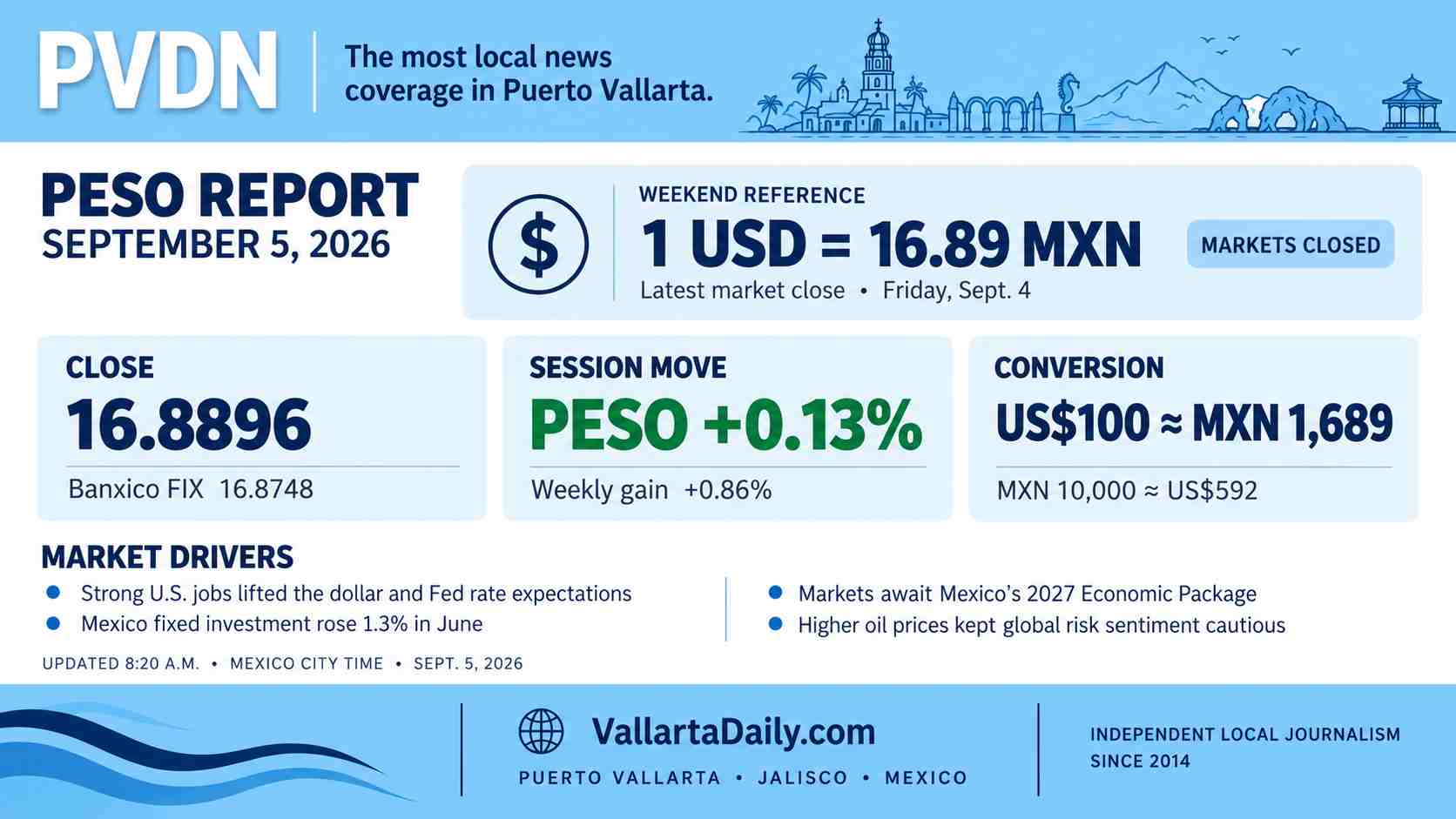
Puerto Vallarta, Jalisco, Sept. 5, 2026 — The Mexican peso entered the weekend near 16.89 per U.S. dollar after strengthening Friday and reaching its best closing level since May 2024.
As of 8:20 a.m. Saturday, Mexico City time, regular foreign-exchange trading was closed. The latest completed session placed USD/MXN at 16.8896 at Friday’s close, down 0.13% from Thursday’s 16.9121. A lower USD/MXN rate means the peso strengthened against the dollar.
The Banco de México exchange-rate series recorded Friday’s official FIX at 16.8748 pesos per dollar, compared with 16.9560 on Thursday. The FIX is calculated from wholesale-market quotes and is used as an official reference. It is not the rate consumers should expect at a bank, ATM or exchange counter.
Peso extends its weekly advance
Friday’s market close represented an advance of about 0.13% for the peso during the session. Compared with the Aug. 28 close of 17.0354, the currency gained approximately 0.86% during the week.
The close below 16.90 was the first at that level since May 2024. Friday’s trading range extended from approximately 16.8569 to 16.9460 pesos per dollar, showing that the currency continued to move within a relatively narrow band despite several market-moving developments.
U.S. jobs lift the dollar and rate expectations
The peso’s advance came during a session in which the broader dollar strengthened following a better-than-expected U.S. employment report.
The U.S. Bureau of Labor Statistics reported that employers added 162,000 jobs in August. The unemployment rate remained at 4.1%, while average hourly earnings increased 3.1% from a year earlier.
The report pushed U.S. Treasury yields higher and increased market expectations that the Federal Reserve could raise interest rates at its Sept. 15-16 meeting. By Friday afternoon, interest-rate futures indicated slightly better than even odds of an increase.
The dollar index finished 0.21% higher after giving up part of its initial gain. Two-year Treasury yields rose to about 4.37%, while the 10-year yield reached approximately 4.78%, according to a summary of Friday’s global trading.
A stronger dollar and higher U.S. yields can place pressure on emerging-market currencies. The peso’s gains indicate that the broad dollar move did not determine USD/MXN trading by itself. Domestic economic data, Mexico’s interest-rate advantage, and existing demand for the peso also remained part of the market picture, although their individual effect cannot be measured from one session.
Mexico investment improves with an uneven recovery
Mexico released stronger investment figures Friday. The national statistics agency reported that gross fixed capital formation increased 1.3% in June from May and 5.9% from a year earlier, based on seasonally adjusted figures.
Construction spending rose 3.5% during the month, while investment in machinery and equipment declined 1.1%. The figures pointed to an improvement in overall investment but showed that the recovery was not uniform across the economy.
Mexico’s interest-rate level also continues to provide support for the peso. Banco de México maintained its benchmark rate at 6.50% on Aug. 6, compared with a current U.S. federal funds rate range of 3.50% to 3.75%.
That gap can make peso-denominated assets attractive to short-term investors. It can also leave the currency exposed to reversals if U.S. rates rise, Banco de México cuts rates, or investors become less willing to hold emerging-market assets.
Mexico’s 2027 budget moves into focus
Mexico’s fiscal plans will become a larger market issue next week. The Chamber of Deputies is scheduled to receive the federal government’s 2027 Economic Package on Tuesday, Sept. 8.
The package will contain the government’s economic assumptions, revenue projections and proposed spending for next year. Investors will examine its growth estimate, deficit plans, debt outlook and the level of continued federal support for Pemex.
The complete documents had not been released as of Saturday morning, limiting any firm conclusions about their effect on the peso.
Oil and risk appetite add crosscurrents
Oil prices rose Friday as conflict involving the United States and Iran continued to affect supply routes and inflation expectations. Brent crude settled at $92.68 a barrel, while West Texas Intermediate finished at $91.48. Brent gained 7.6% during the week, and U.S. crude rose nearly 10%.
Higher oil prices can have mixed effects on Mexico. They may increase the value of crude exports, but they can also add to inflation pressures and reduce investors’ willingness to hold risk-sensitive currencies. Global stock markets ended Friday slightly lower.
Dollar and peso budgets in Puerto Vallarta
At the Friday market close of 16.8896, the mid-market conversions were approximately:
- US$100 equaled 1,689 pesos.
- US$500 equaled 8,445 pesos.
- US$1,000 equaled 16,890 pesos.
- A 10,000-peso expense equaled about US$592.08.
Those calculations do not include bank spreads, card charges, transfer costs, or ATM fees.
Someone converting US$100 received about 15 fewer pesos than at the previous Friday’s closing rate. The stronger peso reduces the amount received by households earning or saving in dollars. It lowers the peso cost of dollar-denominated expenses for people whose income is in pesos.
Retail quotes can differ considerably from the market rate, especially during weekends. Banks and exchange businesses normally publish separate buying and selling prices, and card transactions may be converted at a later processing rate.
A holiday weekend before key releases
Foreign-exchange trading is expected to resume Sunday evening, but Monday’s U.S. Labor Day holiday could reduce market activity.
Mexico’s 2027 Economic Package will follow Tuesday. U.S. producer-price data are scheduled for Thursday and consumer inflation figures for Friday, giving markets additional information before the Federal Reserve’s September meeting.
Anyone making a time-sensitive rent payment, property transfer, or other large conversion should confirm the rate offered by the bank or transfer provider when the transaction is made.