Puerto Vallarta, Jalisco, Sept. 3, 2026 – The Mexican peso hovered near 17 per dollar early Thursday, giving back part of Wednesday’s gain as markets waited for U.S. economic data and new signals from Federal Reserve officials.
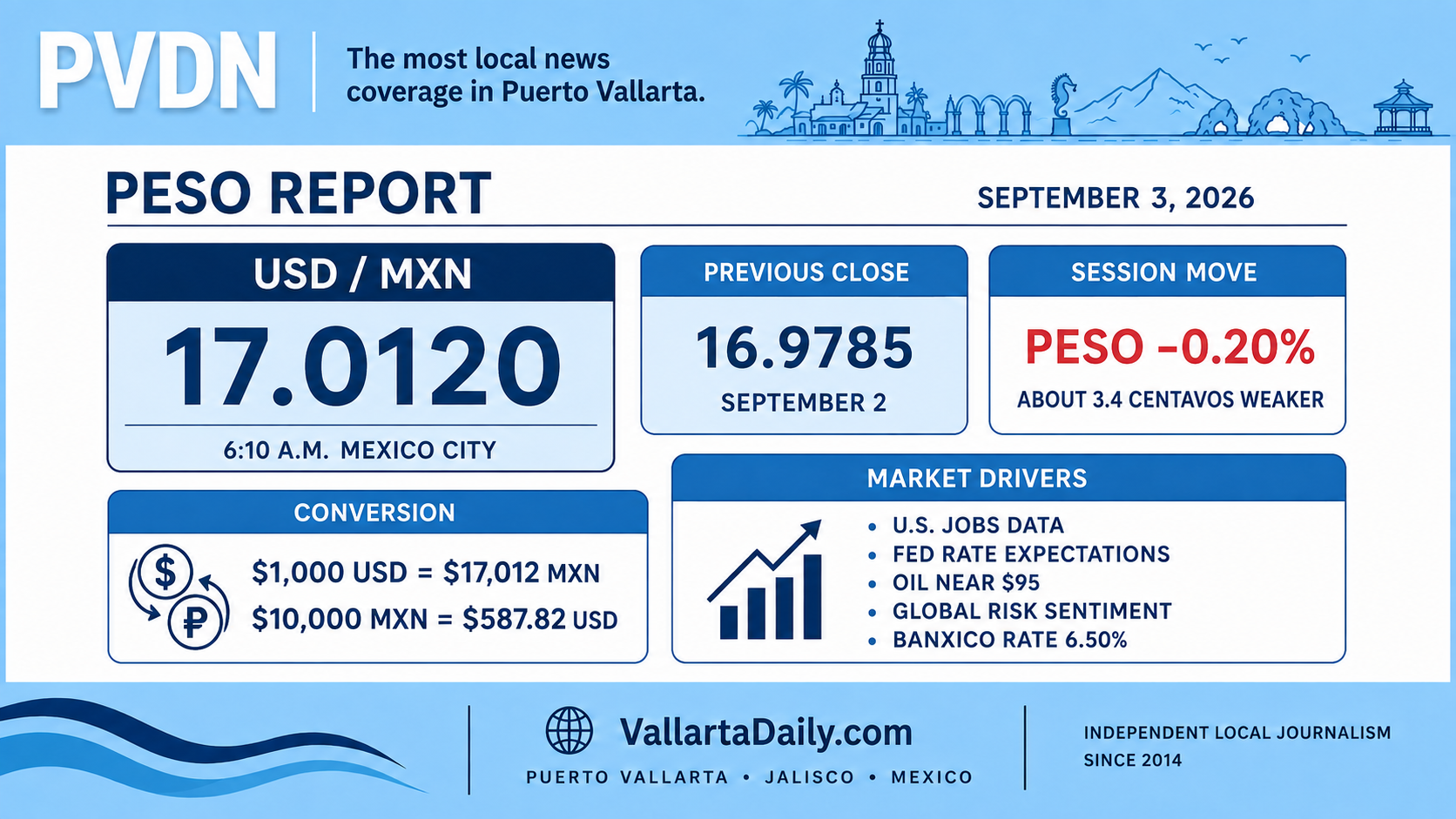
The USD/MXN spot rate stood at 17.0120 pesos per dollar at 6:10 a.m. Mexico City time, according to real-time wholesale market data. The quote was recorded before Banco de México’s regular domestic market observation period and can change throughout the day.
Official central bank data placed Wednesday’s closing rate at 16.9785 pesos per dollar. Compared with that close, Thursday’s early quote represented a decline of about 0.2% for the peso, or roughly 3.4 centavos per dollar.
Peso gives back part of Wednesday’s advance
The peso strengthened 0.14% during Wednesday’s official session, gaining 2.41 centavos against the dollar. Banco de México set Wednesday’s FIX reference rate at 16.9852.
The FIX is used for certain dollar-denominated obligations in Mexico. It is not the rate consumers should expect at banks, exchange houses, ATMs or card terminals, where spreads and fees produce different prices.
Thursday’s early movement was limited. The peso remained close to the 17-per-dollar level that has defined trading during the opening days of September.
Dollar weakens as markets wait for U.S. jobs report
The peso’s modest decline came even as the dollar weakened against several major currencies. In an early global market snapshot, the dollar index fell 0.34% to 99.25, driven partly by a sharp rise in the Japanese yen.
U.S. Treasury yields also eased. The benchmark 10-year yield fell three basis points to 4.766%, offering some relief after a recent bond-market selloff.
Investors are weighing signs of slower hiring against continuing inflation risks. Private employers added 38,000 jobs in August, below forecasts and down from the revised July increase of 46,000.
The more comprehensive U.S. employment report is scheduled for Friday at 8:30 a.m. Eastern time, or 6:30 a.m. in Puerto Vallarta. A large difference from expectations could move the dollar and peso quickly.
Markets were assigning about a 60% probability to a Federal Reserve rate increase in September, up from less than 40% a week earlier. That estimate reflects market pricing and can shift as new data arrives.
Oil and geopolitical risk complicate the session
Brent crude traded near $94.57 per barrel early Thursday, down about 1.1% during the session but still elevated because of renewed U.S.-Iran hostilities.
Higher oil prices can increase inflation concerns and strengthen expectations that the Federal Reserve will keep monetary policy tight. At the same time, geopolitical tension can reduce demand for emerging-market currencies, including the peso. Those forces do not always move USD/MXN in the same direction.
Thursday’s U.S. calendar includes weekly unemployment claims, July trade figures, revised productivity data and comments from Fed Governor Christopher Waller. U.S. services-sector data follows later in the morning.
Mexico’s interest-rate cushion remains
Banco de México has held its benchmark interest rate at 6.50% since May. The central bank kept the rate unchanged at its June and August meetings, citing persistent inflation risks and uncertainty surrounding international trade and economic growth.
That rate remains above the comparable U.S. policy range, supporting demand for peso-denominated assets. The advantage can narrow or lose influence when global volatility rises.
Mexico’s consumer-confidence indicator increased to 46.1 points in August from 45.0 in July, according to figures released Thursday through the INEGI-Banco de México consumer survey. The improvement offers a firmer domestic signal, although consumer confidence is usually a secondary influence on day-to-day currency trading.
Markets are also waiting for Mexico’s 2027 economic package. President Claudia Sheinbaum said in her Sept. 1 government report that the proposal would pursue gradual fiscal consolidation while maintaining public investment and social spending. The detailed revenue, spending and deficit assumptions have not yet been presented.
The difference in a household budget
At the early wholesale rate of 17.0120, $1,000 was equivalent to about 17,012 pesos before fees. A 10,000-peso expense required approximately $587.82.
For Puerto Vallarta residents receiving income in dollars and paying expenses in pesos, Thursday’s early move added about 34 pesos to the conversion value of $1,000 compared with Wednesday’s official close. The change was modest, and the amount delivered by a bank, transfer service or ATM may be lower after its exchange-rate margin and fees.