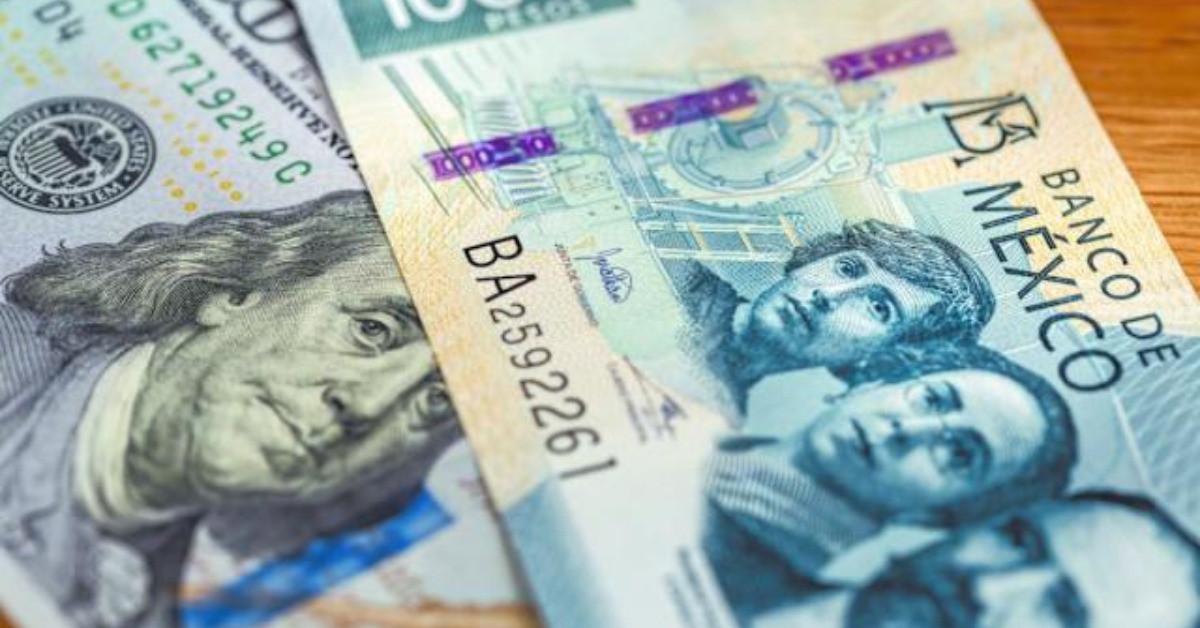
The Mexican peso weakened to 18.76 per dollar in Monday’s trading session, as a stronger U.S. dollar and new trade developments rattled currency markets. The greenback surged after the United States and European Union reached a tariff agreement that eased fears of escalating trade tensions, triggering a retreat in emerging market currencies.
The peso closed the day at 18.7634 pesos per dollar, falling from Friday’s level of 18.5469, according to the Bank of Mexico. That decline of 21.65 centavos, or 1.17 percent, marks the peso’s largest single-day drop in weeks.
Dollar rallies on US-EU tariff deal
The shift came after U.S. President Donald Trump announced a partial trade deal with the European Union. The agreement includes a 15 percent tariff on most EU goods, but crucially avoids deeper disputes between two of the world’s largest trading blocs. The announcement pushed investors toward the safety of the U.S. dollar.
The Dollar Index (DXY), which tracks the greenback against six major currencies, jumped 1.07 percent to 98.69—its highest level in over a month. In intraday trading, the dollar-peso rate fluctuated between a low of 18.5109 and a high of 18.7741.
“The peso begins the week under pressure, given the strength of the dollar following the agreement between the U.S. and the European Union,” said Juan Carlos Cruz Tapia, a financial consultant. “The 18.75 zone served as short-term resistance, and the next significant level would be 18.93.”
Mexican markets face a volatile week
Beyond Monday’s sell-off, markets are expected to face a high-volatility week, with several economic triggers on the calendar. Investors are preparing for key U.S. economic data, including jobless claims, durable goods orders, and inflation figures, as well as a monetary policy decision by the Federal Reserve.
In Mexico, the upcoming release of quarterly GDP figures will offer a clearer picture of the country’s economic health. Analysts are watching to see if sluggish domestic growth, combined with external pressures, will push the Bank of Mexico (Banxico) toward future rate adjustments.
Meanwhile, global trade concerns continue to shape the outlook. With Trump’s August 1 deadline approaching for a new round of U.S. tariffs, several economies—including China, Canada, and Japan—are working to strike last-minute agreements. U.S. officials have signaled there will be no further extensions, raising the stakes for foreign negotiators and adding to global market tension.
Peso outlook remains uncertain
Despite the peso’s relative strength in the first half of the year, it remains vulnerable to external shocks. Analysts say that while Mexico’s fundamentals—including a stable central bank, controlled inflation, and a trade surplus—have provided some cushion, global risk aversion could weigh heavily.
“The peso’s trajectory will depend not only on domestic data but also on how aggressive the Fed sounds in its upcoming statement,” said Cruz Tapia. “If markets sense a more hawkish tone, we could see a test of 19 pesos per dollar sooner than expected.”
For now, all eyes are on Washington and Banxico. Any signs of tightening from the Fed, or weak GDP numbers from Mexico, could prompt another wave of volatility in the foreign exchange market.
Sources:
Banco de México
Intercontinental Exchange
Statements from Juan Carlos Cruz Tapia
U.S. government announcements on EU trade negotiations
Mexican peso, US dollar, exchange rate, Bank of Mexico, US-EU trade agreement, Trump tariffs, Federal Reserve, GDP Mexico