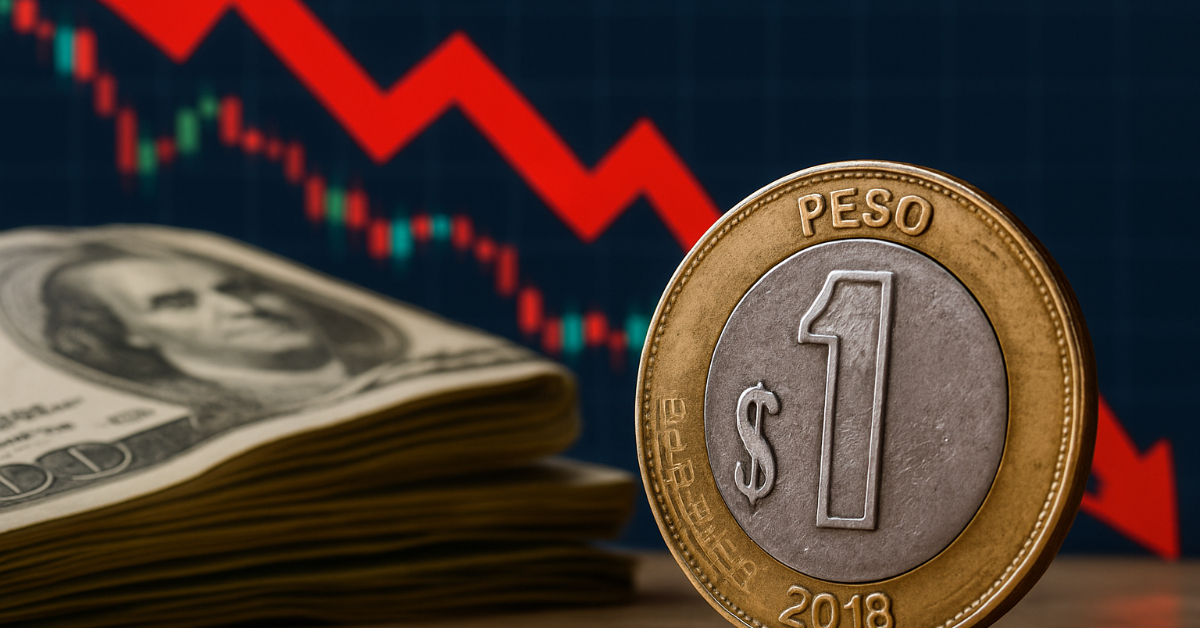
The Mexican peso weakened to 18.7293 per dollar after Donald Trump threatened a 30% tariff on Mexican imports. Analysts expect limited impact thanks to the USMCA agreement.
Mexican peso, exchange rate, USMCA, Donald Trump, Claudia Sheinbaum, tariffs, Mexico economy, peso depreciation, financial news, US-Mexico relations
The Mexican peso lost ground against the U.S. dollar in Monday’s trading session, reacting to renewed threats from former U.S. President Donald Trump to impose sweeping tariffs on Mexican imports.
According to data from the Bank of Mexico (Banxico), the peso closed at 18.7293 per dollar, down from 18.6444 at Friday’s close. The movement marked a depreciation of 8.49 centavos, or 0.46 percent.
During the day, the exchange rate fluctuated between a high of 18.7797 and a low of 18.6538, reflecting uncertainty in response to Trump’s comments over the weekend.
Trump Targets Mexico Over Fentanyl and Trade
On Saturday, Trump reignited tensions between the two trading partners by threatening a 30% tariff on all Mexican imports starting August 1, accusing Mexico of failing to sufficiently combat fentanyl smuggling and of contributing to the U.S. trade deficit.
“If Mexico doesn’t take stronger action, we’ll have no choice but to impose tariffs,” Trump said at a campaign event, referring to ongoing concerns about border security and drug trafficking.
Though Trump is currently a presidential candidate, his remarks sent a ripple through the currency markets, especially as they revive memories of earlier tariff battles during his previous administration.
Mexico Responds with Diplomacy
In response, Mexican President Claudia Sheinbaum said on Monday that her administration is working toward a resolution.
“We have a working group and hope to reach an agreement,” Sheinbaum said during her morning press conference. “We want to ensure that both security and trade issues are addressed with cooperation, not confrontation.”
Her comments aimed to soothe investor concerns and signal Mexico’s openness to continued dialogue with U.S. authorities.
Analysts Expect Limited Impact
Despite the peso’s dip, financial analysts emphasized that the reaction has been relatively restrained.
Markets appear to be growing numb to Trump’s inflammatory rhetoric, according to Banco Base, which noted that the threat represents an incremental increase—only 5% more than a previous 25% tariff announced in March.
“The reaction has been muted, as there is speculation that only 5% is being added to the existing tariff threat,” Banco Base stated. “And even that may not materialize, particularly if USMCA exemptions are honored.”
Juan Carlos Cruz Tapia, a financial consultant, echoed those sentiments, adding that the USMCA (United States-Mexico-Canada Agreement) could provide a buffer.
“The peso is starting this week with losses following the tariff announcement,” said Cruz Tapia. “The depreciation has been moderate, as the tariff’s impact is expected to be limited if the exemptions under the USMCA are maintained.”
The USMCA, which replaced NAFTA in 2020, provides a framework for tariff-free trade among the three countries, limiting the unilateral imposition of duties on most goods.
Dollar Strength Also Plays a Role
It wasn’t just Trump’s comments influencing the peso. The broader strength of the U.S. dollar also played a part.
The Intercontinental Exchange’s Dollar Index (DXY), which measures the greenback’s strength against a basket of six major currencies, rose 0.26% to 98.10 points, showing increased investor demand for the dollar.
What Comes Next?
While the peso’s immediate drop was modest, financial markets will continue to watch for signals from both Washington and Mexico City.
The potential for tariffs—real or perceived—can weigh on investor sentiment, especially in sectors that rely on cross-border trade such as automotive manufacturing and agriculture.
Market participants are also closely monitoring developments in U.S. politics, particularly as Trump ramps up his presidential campaign. Should his polling numbers rise or his trade policies gain traction within the Republican platform, traders may start pricing in greater risk for Mexico’s economy.
For now, though, the peso’s movement appears measured, bolstered by the belief that practical trade relationships and multilateral agreements like the USMCA will prevail over campaign posturing.