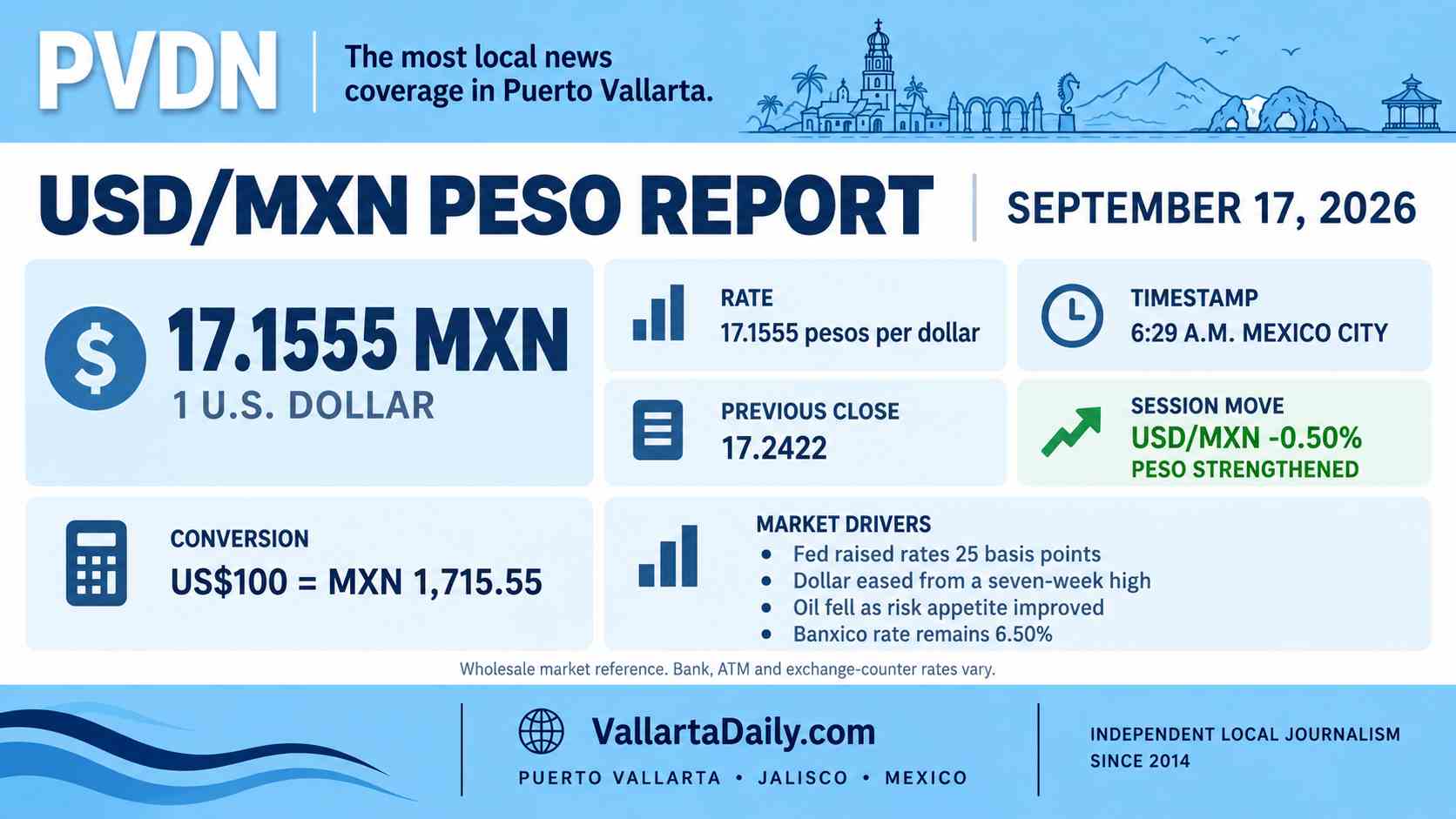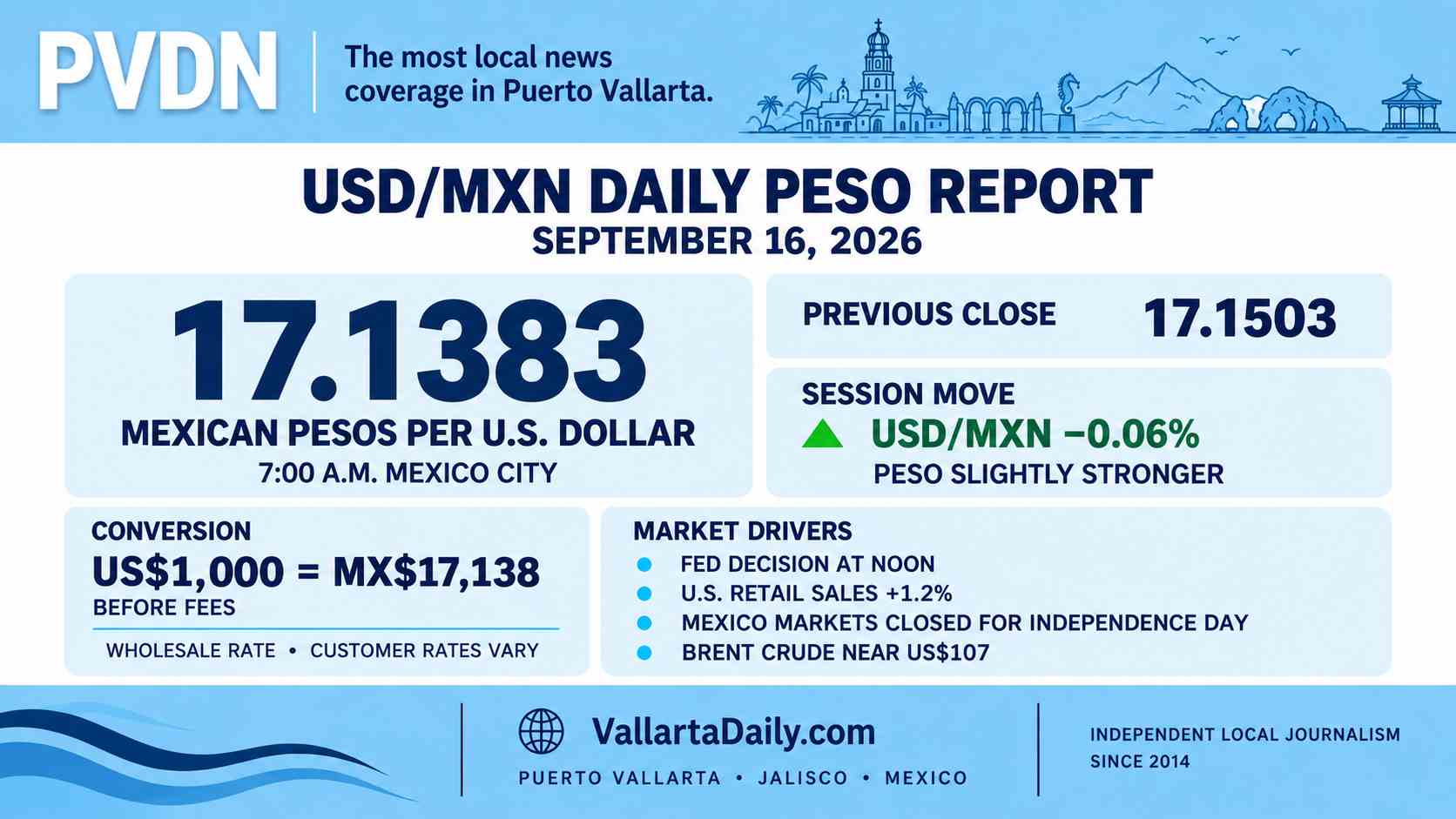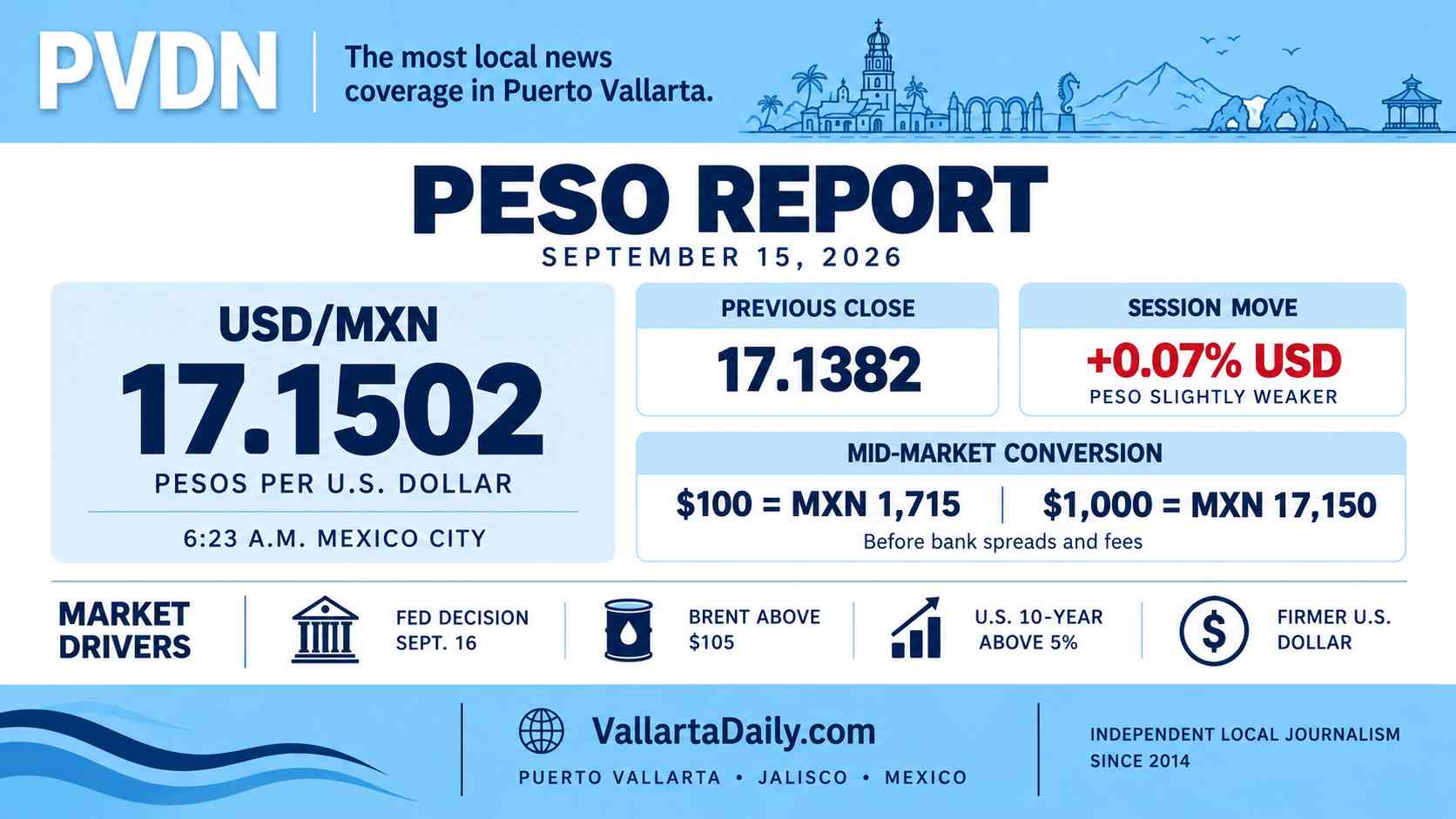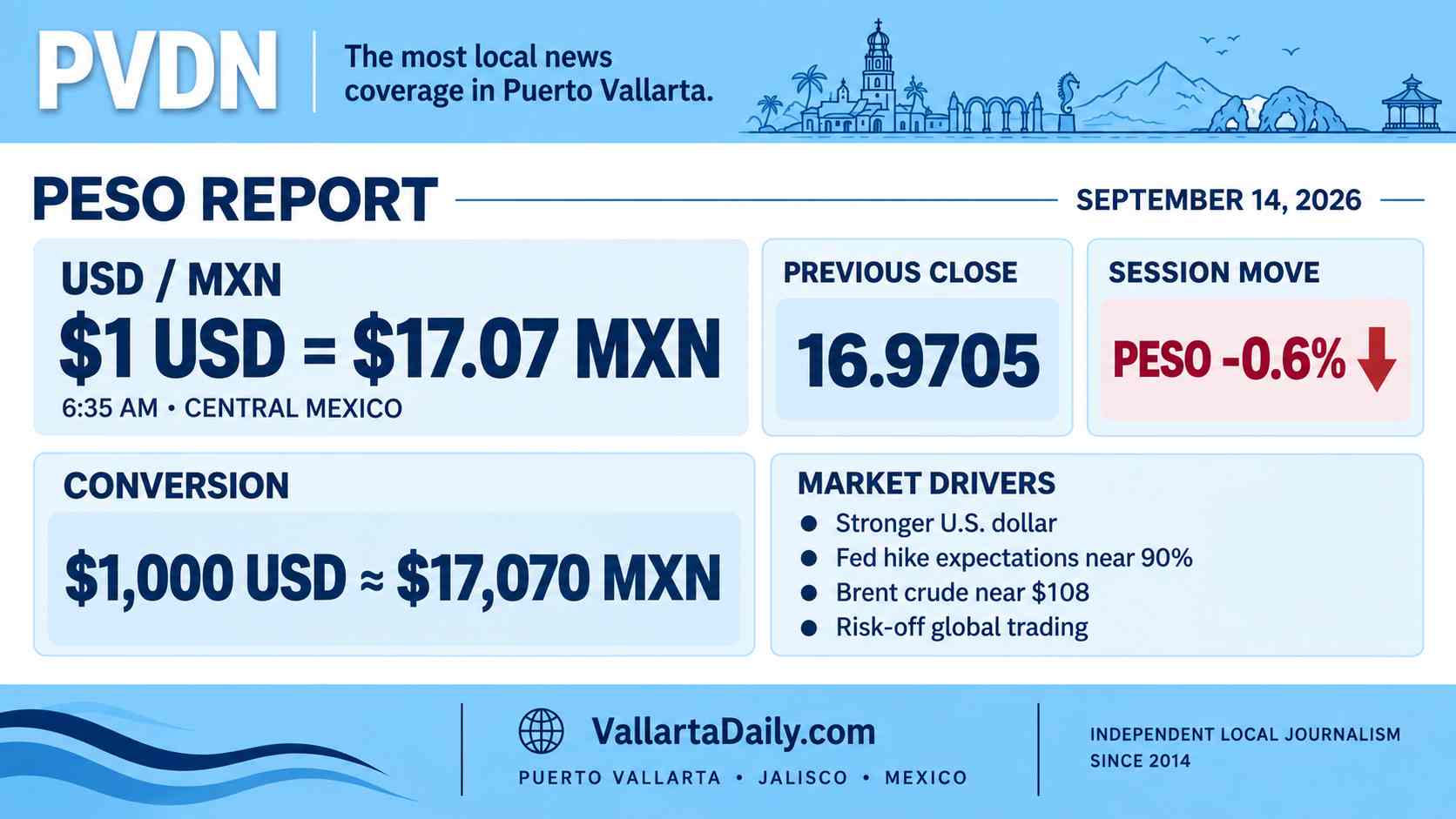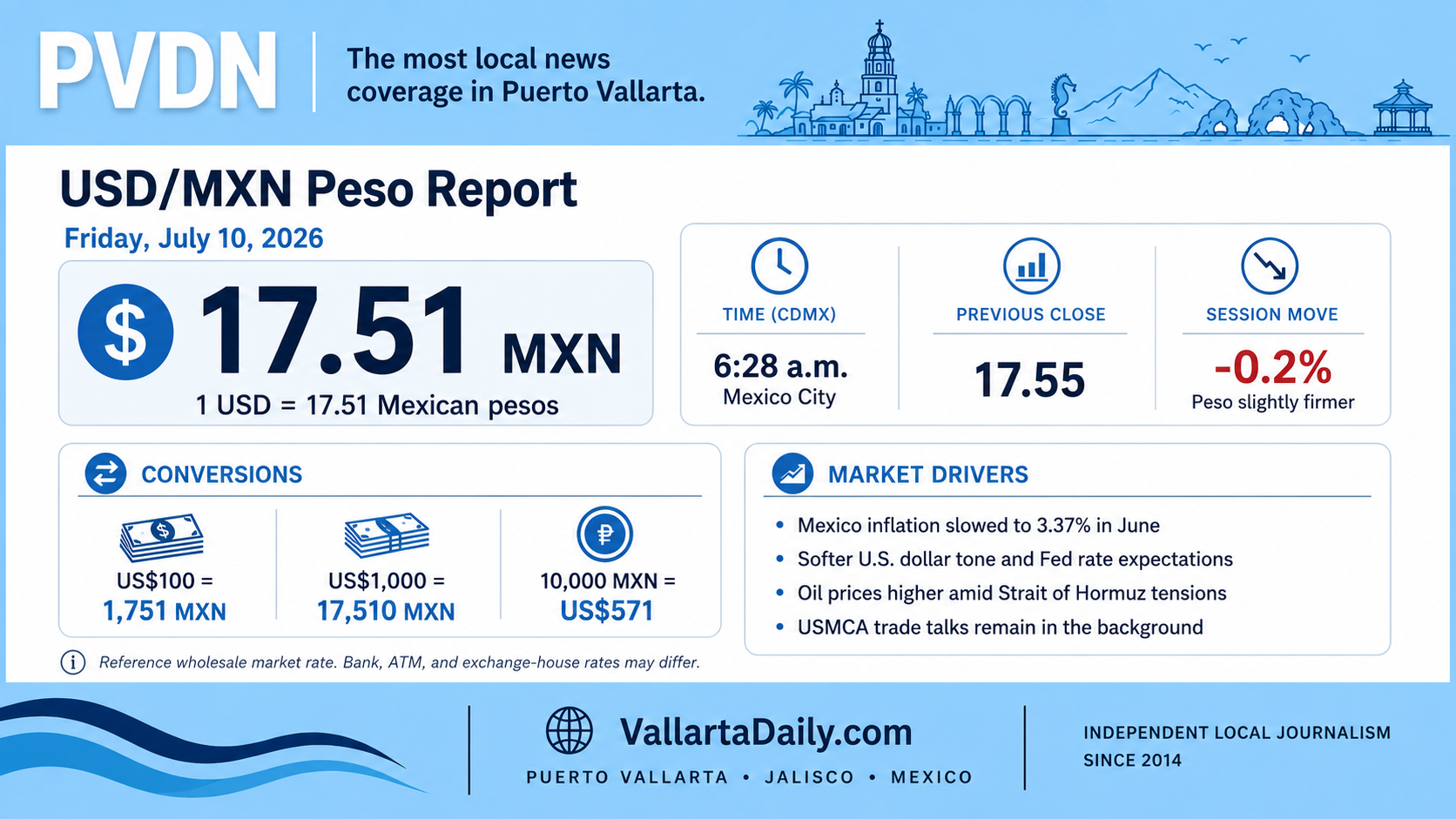
Puerto Vallarta, Jalisco, July 10, 2026 – The Mexican peso gained modest ground against the U.S. dollar early Friday, with USD/MXN trading near 17.51 pesos per dollar at 6:28 a.m. Mexico City time.
The live market rate was about 0.2% lower than the previous session, when the dollar traded near 17.55 pesos. A lower USD/MXN quote means the peso has strengthened. Market data showed the pair between approximately 17.51 and 17.52 during the early session.
The quote is a wholesale market reference rather than the rate available at banks, ATMs or currency-exchange counters. Fees and retail spreads normally result in customers receiving fewer pesos when selling dollars and paying more when buying them.
Peso opens firmer after softer dollar session
Friday’s move followed a slight decline in the broader U.S. dollar on Thursday. The WSJ Dollar Index fell 0.13%, ending three consecutive sessions of gains, while the DXY index was broadly stable near 100.87 during European trading Friday. U.S. Treasury yields also eased slightly.
The dollar’s direction remains tied closely to expectations for the Federal Reserve. Weaker U.S. employment data released earlier this month reduced expectations for an immediate interest-rate increase, but investors have not ruled out higher rates later in 2026 if inflation remains elevated.
That uncertainty limits the conclusions that can be drawn from Friday morning’s relatively small peso gain. The move appears consistent with a softer dollar and stable risk appetite rather than a major change in Mexico’s economic outlook.
The Banco de México exchange-rate system listed a FIX rate of 17.5350 pesos per dollar for July 9. Banxico typically publishes the day’s new FIX rate after noon, so Friday morning’s market quotation should not be mistaken for the official reference used for certain peso-denominated obligations.
Mexico inflation changes the interest-rate debate
Mexico’s latest inflation report is a central domestic factor for the peso.
The National Institute of Statistics and Geography reported that annual inflation slowed to 3.37% in June, down from 3.94% in May and below the 3.52% expected in a survey of economists. Consumer prices fell 0.27% during the month.
Core inflation, which excludes some volatile food and energy prices, remained higher at 4.03%. That figure is slightly above the top of Banxico’s target range of 3% (plus or minus 1 percentage point).
The softer headline number reduces immediate pressure on Banxico to raise borrowing costs. Mexico’s central bank held its benchmark rate at 6.50% on June 25 and said keeping it at that level was appropriate under current economic conditions.
Lower inflation can support household purchasing power, but the currency effect is less direct. Expectations of lower Mexican interest rates can reduce the yield advantage that has attracted some foreign investors to peso assets. For now, the inflation report appears to be limiting expectations of higher rates without causing a sharp retreat in the currency.
Oil and Middle East tensions remain a risk
Oil prices rose Friday as renewed fighting between the United States and Iran disrupted traffic through the Strait of Hormuz. Brent crude traded near $76.90 per barrel, up about 7% for the week, while U.S. crude approached $72.54.
Higher oil prices can provide some support for Mexico as an oil-producing country. The effect is not automatically positive for the peso, however. Sustained increases in energy prices can raise inflation expectations, strengthen demand for safe-haven currencies, and make central-bank policy more difficult to predict.
Markets have remained calmer than the military headlines might suggest, but conditions around the Strait of Hormuz can change quickly. A sharper escalation could reverse Friday’s early improvement in emerging-market currencies.
Trade negotiations remain in the background
The unresolved review of the United States-Mexico-Canada Agreement continues to weigh on the longer-term outlook.
The United States declined on July 1 to approve an automatic 16-year extension of the agreement. USMCA remains in force, but it will now face annual reviews unless the three governments agree on changes. Further U.S.-Mexico negotiations are scheduled for the week of July 20.
The current talks include disputes over automotive rules, steel and aluminum tariffs, trade deficits and supply chains linked to countries outside North America. These issues have not produced a major peso move Friday morning, but uncertainty can delay investment and leave the currency more sensitive to trade headlines.
Friday’s exchange rate in household terms
At a wholesale rate of 17.51 pesos per dollar:
- US$100 equals approximately 1,751 pesos.
- US$1,000 equals approximately 17,510 pesos.
- 10,000 pesos equals approximately US$571.
These figures exclude bank charges, transfer fees, ATM commissions and exchange-counter spreads.
People earning income in dollars are receiving slightly fewer pesos than during Thursday’s session. For residents earning pesos but paying dollar-denominated expenses, including travel, imported products or some rental agreements, the firmer peso provides a small improvement.
The change remains limited enough that retail fees may exceed the day’s currency movement. Anyone making a transfer or withdrawal should compare the final amount delivered rather than relying only on the published market rate.
USD/MXN can move throughout Friday as North American markets open and investors respond to Federal Reserve commentary, oil prices, and new developments involving Iran or the USMCA negotiations.