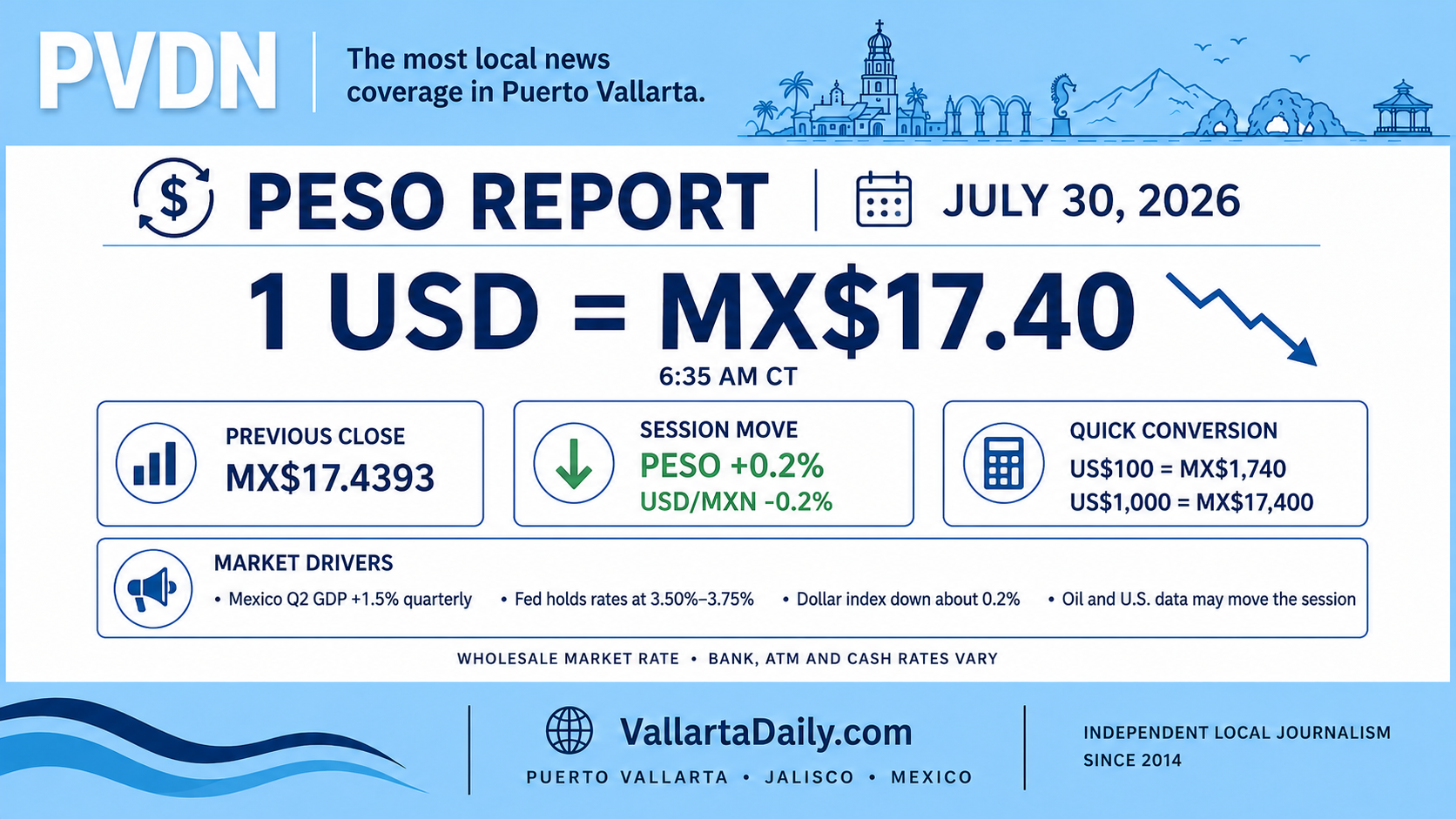
Puerto Vallarta, Jalisco, July 30, 2026 – The Mexican peso strengthened in early trading Thursday after new data showed that Mexico’s economy rebounded sharply during the second quarter.
The USD/MXN exchange rate traded near 17.40 pesos per dollar at 6:35 a.m. Central Time, about 0.2% below Wednesday’s market close of 17.4393. A lower USD/MXN rate means the peso has gained value against the dollar.
The rate remained within an early-session range of approximately 17.39 to 17.48, according to live wholesale market pricing. Currency quotes can change quickly, especially as markets process economic releases from Mexico and the United States.
Mexico’s economy rebounds in the second quarter
Mexico’s economy grew an estimated 1.5% from April through June compared with the previous quarter, according to the preliminary GDP report released Thursday by INEGI.
The result marked a strong reversal from the 0.6% contraction recorded during the first quarter.
Primary activities, which include agriculture and fishing, grew 3.3% during the quarter. Industrial activity increased 1.6%, while commerce and services expanded 1.5%.
Compared with the second quarter of 2025, GDP increased 2.1% using seasonally adjusted figures. INEGI reported annual growth of 2.2% using original figures. The agency stressed that the report is an early estimate and may be revised as more information becomes available.
The stronger domestic figures gave the peso support Thursday morning, although foreign-exchange movements cannot be attributed to a single report.
Fed leaves U.S. rates unchanged
The peso was also trading through the market reaction to Wednesday’s Federal Reserve decision.
The Federal Open Market Committee kept its benchmark rate between 3.5% and 3.75%. The decision passed by a 9-3 vote, with three policymakers favoring a quarter-point increase.
The divided vote showed that inflation remains a concern inside the central bank. It also left investors without a clear signal about whether the Fed will raise rates later this year.
The dollar index was down about 0.2% early Thursday, providing some room for the peso and other currencies to gain. Longer-term U.S. Treasury yields remained elevated, however, reflecting continued concern about inflation and the direction of monetary policy.
U.S. second-quarter GDP, personal spending and the Federal Reserve’s preferred PCE inflation measures were scheduled for release at 6:30 a.m. Central Time. Those figures were arriving as this report was prepared and could produce additional movement in the peso during the morning.
Oil and global risk remain unsettled
Oil prices eased Thursday after rising sharply during the previous session amid renewed conflict involving the United States and Iran.
Brent crude traded near $87.13 per barrel, down about 1.1%, while U.S. crude was near $83.61. Lower prices offered some relief after the earlier surge, but energy markets remained volatile.
Oil can affect the peso through several channels. Mexico exports crude, but higher global energy prices can also increase inflation, weaken international risk appetite and complicate interest-rate decisions. Those competing effects make the currency’s response less predictable.
Market rate differs from bank and cash prices
Banco de México reported an official closing reference of 17.4628 pesos per dollar Wednesday. Its FIX rate was 17.5133.
Those figures differ from the live market rate because they are calculated at specific times and for specific purposes. The central bank publishes the daily FIX after noon, while its closing rate is based on transactions recorded during a short afternoon window. The central bank explains the calculation and timing on its foreign-exchange portal.
Neither figure should be treated as the price residents, or visitors, will necessarily receive at a Puerto Vallarta bank, ATM, exchange counter, or card terminal. Consumer rates include spreads and, in some cases, commissions.
The difference for Puerto Vallarta budgets
At a wholesale rate of 17.40, $100 converts to approximately 1,740 pesos and $1,000 converts to about 17,400 pesos before fees.
At Wednesday’s market close, $1,000 was worth roughly 17,439 pesos. Thursday morning’s movement therefore reduced the peso value of that amount by about 39 pesos.
People receiving income or savings in dollars get slightly fewer pesos when the Mexican currency strengthens. Residents earning pesos face a somewhat lower cost when paying dollar-denominated bills or making dollar purchases.
For most daily transactions, the difference between providers may be larger than the morning’s movement in the wholesale rate. Cardholders and ATM users should check the conversion offered by their bank and avoid assuming that the interbank quote will be the final rate applied.