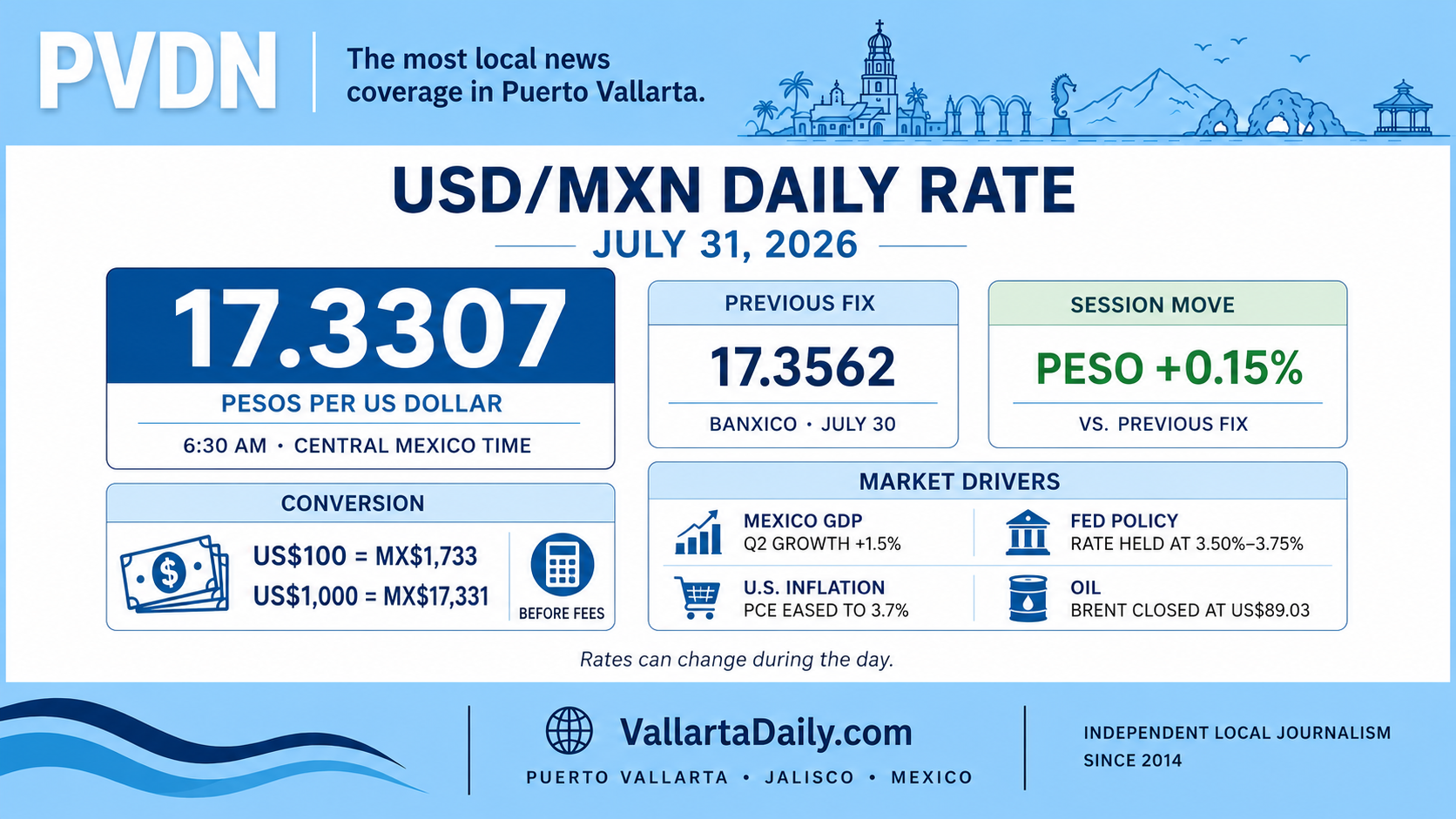
Puerto Vallarta, Jalisco, July 31, 2026 — The Mexican peso traded near 17.33 per U.S. dollar at 6:30 a.m. Central Mexico time Friday, beginning the final session of July with a modest gain.
An indicative mid-market quote placed USD/MXN at 17.3307, about 0.46% below its level 24 hours earlier. A lower USD/MXN rate means the peso has strengthened because fewer pesos are required to buy one dollar.
The latest official reference available early Friday was the 17.3562 FIX rate calculated Thursday by Banco de México. Banxico normally publishes the new business-day FIX rate after noon. The FIX is an official wholesale-market reference and should not be confused with the retail prices offered by banks, exchange houses or transfer services.
Mexico’s growth rebound supports the peso
Mexico’s latest economic figures supplied some domestic support for the currency. The economy expanded 1.5% during the second quarter compared with the first, according to preliminary data from the national statistics agency.
That was stronger than the 1.3% growth forecast in a survey of economists. The economy contracted by 0.6% in the first quarter.
Agriculture, fishing and mining grew 3.3% from the previous quarter. Manufacturing and construction increased 1.6%, while services expanded 1.5%. Compared with the second quarter of 2025, economic activity rose 2.2%.
The stronger-than-expected GDP estimate may reduce pressure on Banco de México to loosen monetary policy. Some analysts said it could eventually strengthen the case for higher rates if inflation remains persistent, although a single quarterly report does not determine the central bank’s next decision.
Mexico’s Finance Ministry maintained its 2026 growth forecast of 1.8% to 2.8%. Private-sector and international forecasts remain lower, reflecting concern that activity could slow after the temporary spending and construction associated with the 2026 World Cup.
Fed expectations pull the dollar in both directions
The U.S. dollar regained about 0.3% against a basket of major currencies early Friday after falling roughly 2.4% Thursday, its largest one-day decline since January 2023.
The Federal Reserve left its benchmark rate at 3.50% to 3.75% this week. Three of the 12 voting members preferred a quarter-point increase, an unusually divided decision that left markets reassessing the timing of the next move.
Traders Friday placed the probability of a September rate increase near 67%, down from more than 80% a week earlier. Those expectations can change quickly with inflation, employment, and energy market developments.
The U.S. Bureau of Economic Analysis reported that personal income increased by 0.2% in June, while consumer spending rose by 0.3%. The Federal Reserve’s preferred inflation measure, the Personal Consumption Expenditures price index, was 3.7% higher than a year earlier, easing from 4.1% in May.
Slower inflation can weaken the case for higher U.S. interest rates, potentially reducing support for the dollar. Continued inflation above the Fed’s target, however, limits how far markets can move in that direction.
Trade and oil remain sources of volatility
Mexico’s trade relationship with the United States remains part of the peso’s broader risk picture. Economy Minister Marcelo Ebrard said the latest U.S. tariff changes would not alter Mexico’s effective rate because goods that comply with the United States-Mexico-Canada Agreement remain exempt.
Ebrard estimated that about 85% of Mexican exports to the United States would continue entering tariff-free. The statement reduced the immediate tariff concern, but uncertainty surrounding the USMCA review and existing duties on some vehicles and metals has not disappeared.
Oil markets also remain unsettled by the conflict involving the United States and Iran. Brent crude settled Thursday at $89.03 a barrel, down 1.9% for the session, while U.S. crude finished at $83.59. Both contracts moved sharply during the day as markets followed developments related to attacks, shipping risks, and diplomatic discussions involving the Strait of Hormuz.
Mexico exports crude oil but also imports large volumes of refined fuel. Higher energy prices can therefore produce mixed effects through government revenue, domestic inflation and Pemex’s finances.
Converting dollars in Puerto Vallarta
At the early-Friday mid-market rate, US$100 was worth approximately 1,733 pesos, while US$1,000 was worth about 17,331 pesos before fees or exchange spreads.
Using Thursday’s official FIX rate instead would yield about 25 pesos more per US$1,000 converted. The difference is modest for daily spending but becomes more noticeable for rent, tuition, property expenses or large transfers.
People receiving income in dollars get fewer pesos when the Mexican currency strengthens. Those earning pesos and paying dollar-denominated expenses benefit from the same movement.
Banks, ATMs and exchange houses generally offer rates below the international mid-market value and may add fixed fees. Card issuers and transfer services can also apply their own conversion time, meaning a transaction may not use the rate visible when the purchase was made.
Friday’s rate remains a moving target
The early quote reflects trading before the full North American session. The rate can move after U.S. markets open, particularly if Treasury yields, oil prices or trade headlines change.
Banco de México’s Friday FIX rate will provide the next official benchmark after noon. Retail customers should compare the final peso amount they receive rather than relying solely on the advertised exchange rate.