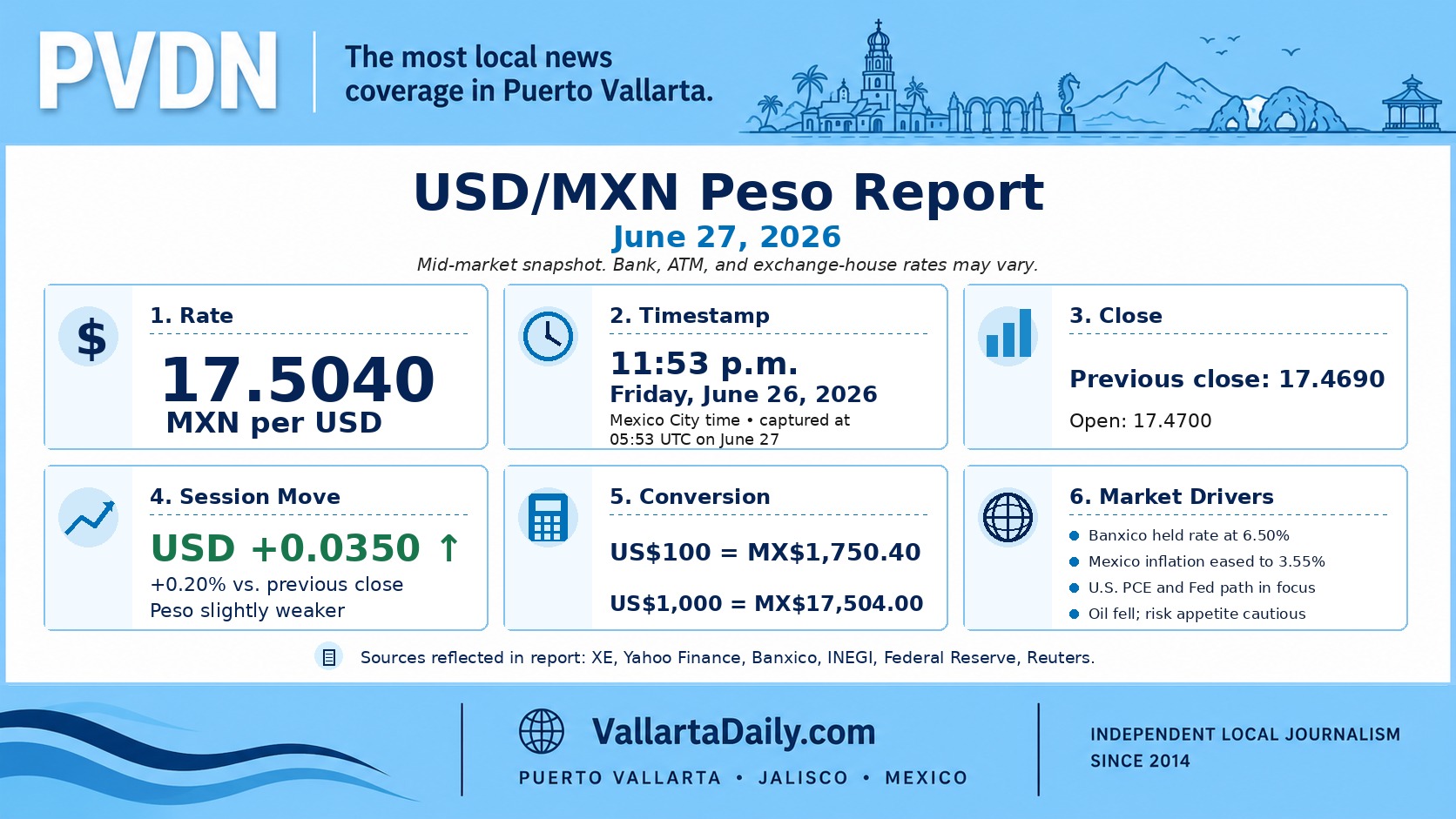
Puerto Vallarta, Jalisco, June 27, 2026 – The U.S. dollar was trading near 17.50 Mexican pesos in the latest available weekend market data, keeping the peso close to the range seen at the end of the Friday session.
As of 05:53 UTC on June 27, XE’s mid-market converter showed 1 U.S. dollar at 17.5040 pesos. That timestamp corresponds to 11:53 p.m. Friday in Mexico City, because Mexico City is six hours behind UTC. Currency markets are largely in weekend mode on Saturday, so bank, ATM, and casa de cambio rates in Puerto Vallarta can differ from live mid-market quotes.
Yahoo Finance market data listed the previous close at 17.4690 pesos per dollar and the open at 17.4700. Against that reference, the dollar was modestly higher. Wise’s Saturday exchange-rate page also placed USD/MXN near 17.51 and showed the pair little changed over the latest 24-hour window.
The peso after Banxico’s rate pause
The peso is starting the week on Saturday, with investors still digesting Banco de México’s latest policy decision. Banxico’s Governing Board voted unanimously on June 25 to keep its overnight interbank interest rate target at 6.50%.
The central bank said it considered the exchange-rate level, weak economic demand pressures, and the current degree of monetary restriction. It also said the peso had depreciated since the previous monetary policy decision, while Mexican government interest rates had decreased for most terms.
That rate pause matters for the peso because Mexico’s interest-rate advantage over the United States remains one of the factors that can support demand for peso-denominated assets. It does not prevent day-to-day currency swings, especially when the U.S. dollar strengthens or global risk appetite weakens.
Mexico’s latest inflation data gave Banxico room to hold steady rather than react immediately. INEGI reported that annual inflation slowed to 3.55% in the first half of June, while core inflation remained higher at 4.12%. The core figure remains important because it strips out more volatile items and is closely watched for signs of underlying price pressure.
U.S. inflation and Fed expectations
The U.S. side of the exchange rate remains focused on inflation and Federal Reserve policy.
The Federal Reserve kept its target range for the federal funds rate at 3.50% to 3.75% at its June 17 meeting. Its statement said inflation remained elevated relative to the Fed’s 2% goal, with supply shocks contributing to price increases in some sectors, including energy.
U.S. inflation data released this week kept that debate active. The Bureau of Economic Analysis reported that the May personal consumption expenditures price index rose 4.1% from a year earlier. Core PCE, which excludes food and energy, was up 3.4% year over year.
Those figures keep markets sensitive to any change in Fed expectations. A stronger dollar can put pressure on emerging-market currencies, including the peso. A softer dollar can give the peso more room to recover, provided local and global risk conditions do not deteriorate.
Oil and global market tone
Friday’s global market tone was mixed and leaned cautious. Reuters reported that world stocks edged lower as technology and chip shares sold off, while crude prices fell sharply as supply concerns eased.
Brent crude settled at $72 a barrel, down 4.34% on the day. The dollar index eased 0.16% to 101.35 on Friday, but it remained on track for a second straight weekly gain.
Lower oil prices can reduce some inflation concerns in the United States, but the effect on the peso is not automatic. For USD/MXN, traders are balancing U.S. rate expectations, Banxico’s pause, Mexico’s inflation path, and broader demand for emerging-market currencies.
Local budgeting in Puerto Vallarta
For residents, retirees, and visitors in Puerto Vallarta, the practical number today is still around 17.50 pesos per U.S. dollar before fees and spreads.
At that rate, $100 equals about 1,750 pesos at the mid-market level. A $1,000 transfer equals about 17,504 pesos before bank charges, transfer fees, ATM commissions, or exchange-house margins.
People earning in dollars and spending in pesos are still receiving more pesos per dollar than they would at stronger-peso levels near 17.00. People paid in pesos but facing dollar-linked costs, including some rents, imported goods, travel, and services quoted in dollars, may feel the exchange rate working against them.
The rate to watch going into the next active session is whether USD/MXN stays near 17.50 or moves back toward the stronger-peso levels seen earlier in the week. For now, the Saturday reading points to a modestly weaker peso from the prior close, not a sharp currency move.