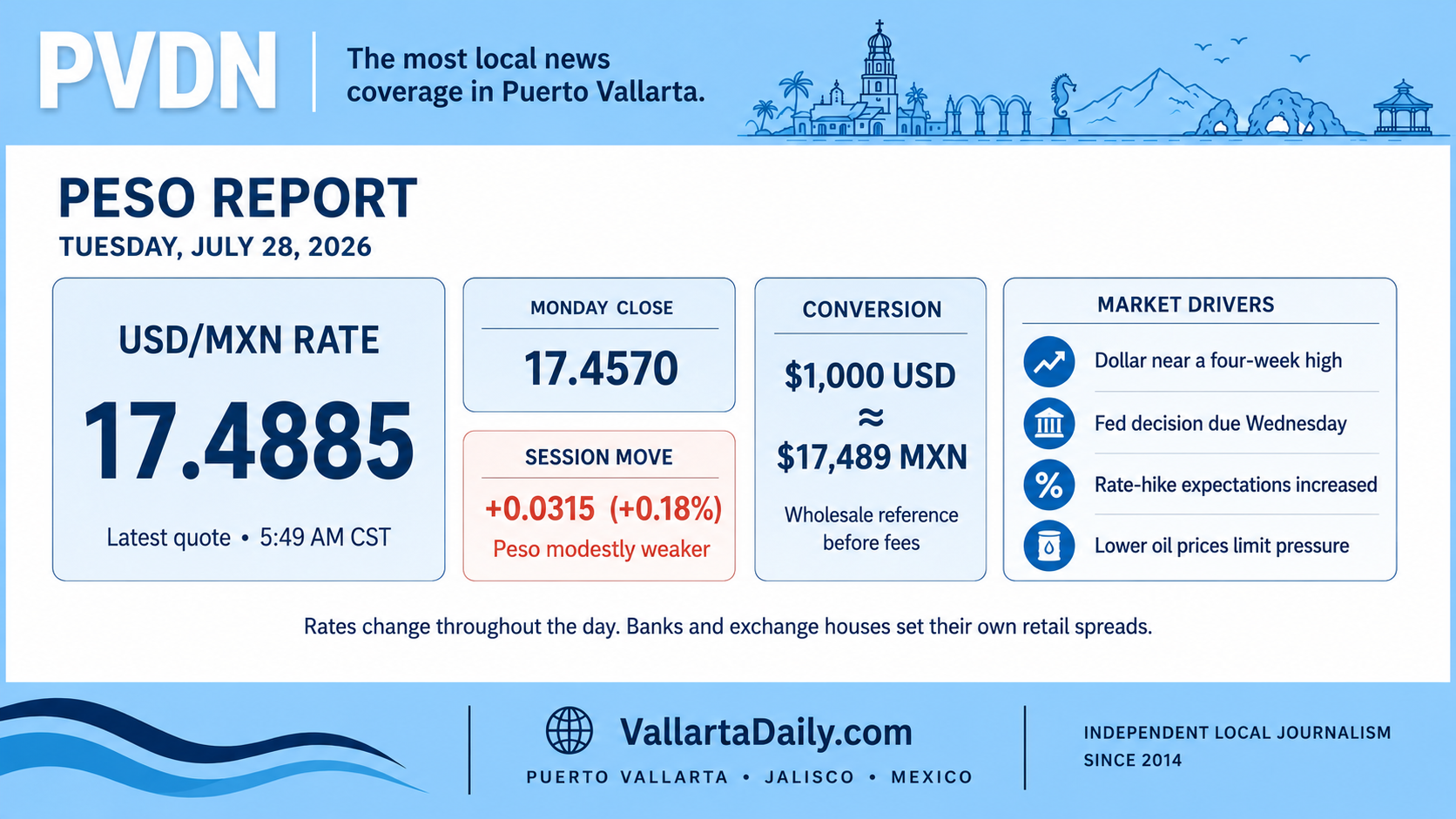
Puerto Vallarta, Jalisco, July 28, 2026 – The Mexican peso weakened modestly against the U.S. dollar early Tuesday as currency markets prepared for this week’s Federal Reserve decision.
At 6:30 a.m. Central Mexico time, the latest available market quote placed the dollar at 17.4885 pesos, according to USD/MXN trading data timestamped at 5:49 a.m. The rate was up 0.18% from Monday’s close of 17.4570, meaning the peso had lost about three centavos per dollar.
The pair had traded between 17.4436 and 17.4980 during the session. Rates can change throughout the day, and the wholesale market price will differ from the amount offered by banks, exchange houses and card providers.
A stronger dollar sets the early direction
The peso’s decline was limited, but it came as the U.S. dollar held near a four-week high against a basket of major currencies.
Global currency trading remained focused on the Federal Reserve’s two-day meeting, which begins Tuesday and concludes Wednesday. Markets were assigning roughly a 40% probability to a quarter-point rate increase this week, up from about 20% one week earlier, according to market pricing reported Tuesday.
Expectations of higher U.S. interest rates can strengthen the dollar by making dollar-denominated assets more attractive. The effect on the peso is not automatic, however, because Mexico continues to offer a higher domestic interest rate and remains closely tied to the U.S. economy.
The Federal Reserve’s decision is due Wednesday afternoon. U.S. second-quarter economic growth and the core personal consumption expenditures inflation index are also scheduled this week, giving traders additional information about inflation and the direction of U.S. rates.
Mexico’s interest-rate advantage remains in place
The Bank of Mexico held its benchmark rate at 6.50% in June, while the U.S. federal funds target range stands at 3.50% to 3.75%.
That gap has continued to provide some support for the peso, although lower Mexican inflation has raised questions about when Banxico could resume cutting rates. Annual inflation fell to 3.10% during the first half of July, its lowest reading since December 2020.
Mexico also reported a merchandise trade surplus of $9.86 billion for the first six months of 2026, compared with $1.43 billion during the same period last year, according to data released Monday by INEGI. Strong export flows can support demand for pesos, though daily exchange-rate movements reflect a much wider mix of market activity.
Trade policy remains a source of uncertainty. Economy Minister Marcelo Ebrard said last week that new U.S. tariffs would not change Mexico’s effective tariff treatment because goods complying with the USMCA will remain exempt. He estimated that about 85% of Mexican exports to the United States would continue entering tariff-free. That figure is the Mexican government’s assessment and will depend on how the U.S. rules are applied.
Oil prices ease after a volatile month
Lower global oil prices offered some relief Tuesday after a temporary pause in U.S. attacks on Iran reduced immediate concern about supply disruptions.
Brent crude fell toward $86 per barrel after trading above $100 earlier in July. Mexico’s export crude closed Monday at $79.19 per barrel, still well above the $54.90 average used in the federal government’s 2026 economic assumptions.
Cheaper oil can reduce inflation pressure and improve global risk sentiment, both of which may help emerging-market currencies. For Mexico, the calculation is mixed because lower crude prices can also reduce export and government revenue.
Exchange counters will show a wider spread
At the wholesale rate of 17.4885 pesos, $1,000 was worth about 17,489 pesos before fees. That was only 32 pesos more than at Monday’s closing rate, showing how small Tuesday morning’s movement was for an ordinary household transaction.
People receiving income in dollars gained slightly more peso purchasing power, while residents earning pesos faced a modest increase in the cost of dollar-denominated expenses. The difference may be absorbed by conversion fees and retail spreads.
Published bank rates early Tuesday ranged from approximately 16.25 pesos for dollar purchases to 18.00 pesos for dollar sales. Airport counters and tourist-area exchange houses may offer different rates, so the wholesale quote should be treated as a market reference rather than the amount a customer will receive.