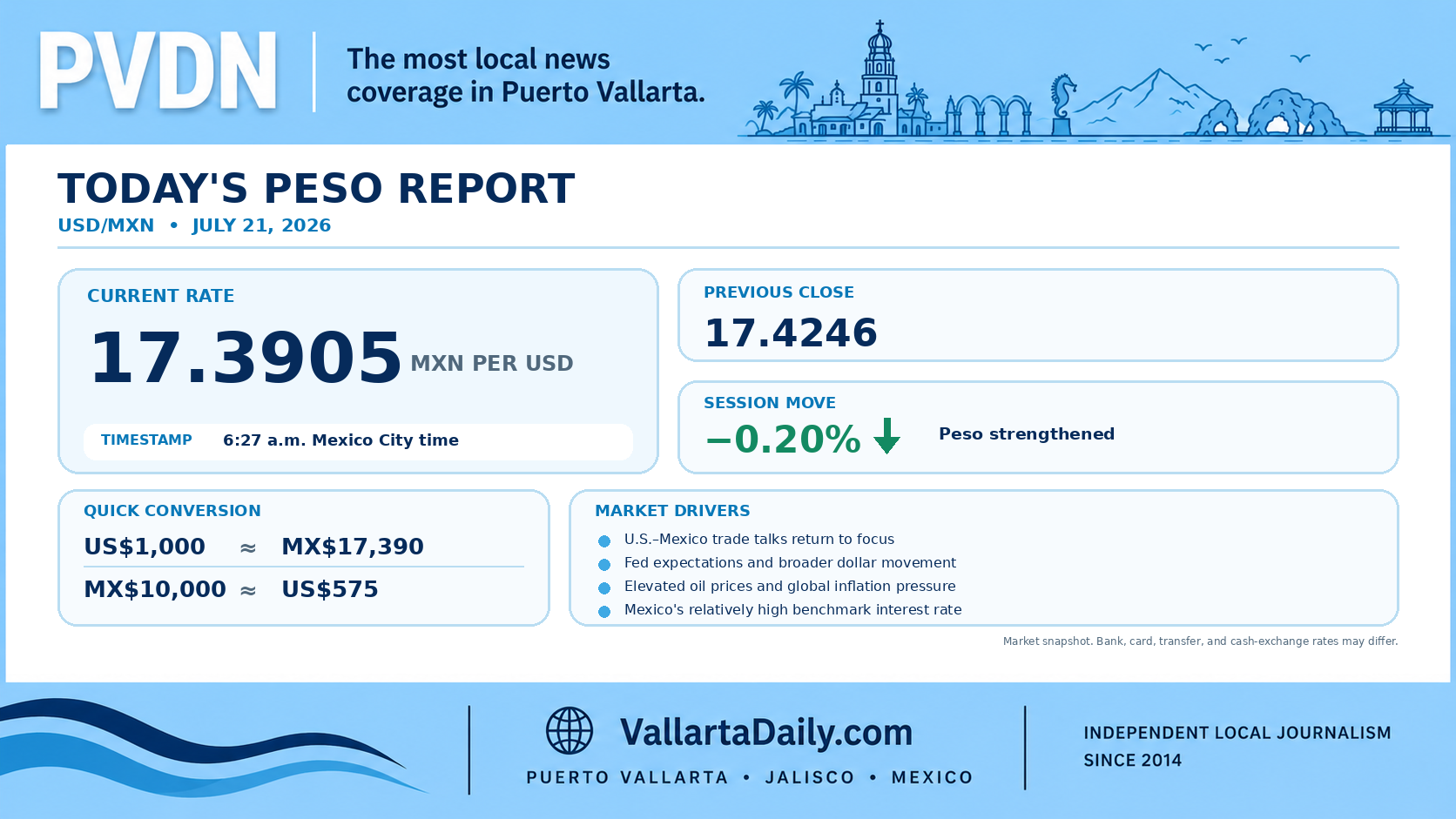
Puerto Vallarta, Jalisco, July 21, 2026 – The Mexican peso strengthened modestly against the U.S. dollar early Tuesday, with USD/MXN trading near 17.39 as markets assessed a new round of U.S.–Mexico trade negotiations, shifting Federal Reserve expectations and continued volatility in oil markets.
At approximately 6:27 a.m. Mexico City time, a live market quote placed the exchange rate at 17.3905 pesos per dollar, compared with a previous close of 17.4246. That represented a decline of about 0.2% in USD/MXN, meaning the peso had gained roughly the same amount. The session range was 17.3755 to 17.4377.
A separate market data service showed USD/MXN near 17.394 and also calculated a 0.21% decline from the previous session. Quotes can differ slightly between platforms and change continuously during trading.
Peso gains remain limited
Tuesday’s movement was relatively small and kept the peso within the range seen during recent sessions. The currency has remained near 17.40 per dollar despite renewed concern about North American trade rules and a firmer U.S. dollar during parts of July.
The early gain did not point to a single decisive development. Instead, traders were balancing several forces that can pull the peso in different directions, including trade negotiations, geopolitical risk, oil prices and expectations for interest rates in Mexico and the United States.
The quoted market rate is also different from the amount available through banks, card networks, money-transfer companies or currency-exchange counters. Those providers generally apply their own spreads and fees. It is also separate from the official FIX rate, which the Bank of Mexico calculates from representative wholesale-market quotations for specified settlement purposes.
U.S.–Mexico trade talks return to focus
Trade policy was the main Mexico-specific event on Tuesday’s calendar. U.S. and Mexican officials were beginning three days of negotiations in Mexico City over proposed revisions to the United States-Mexico-Canada Agreement.
The bilateral discussions cover automobiles, steel, aluminum, agriculture, labor rules and economic security. They are the first formal talks since the U.S. government declined on July 1 to grant a new 16-year extension of the agreement, starting a process that could eventually wind down the pact unless the countries reach new terms.
Constructive negotiations could reduce some uncertainty surrounding Mexican exports and investment. Proposals affecting vehicle-content requirements, tariffs or access to the U.S. market could have the opposite effect. No agreement had been announced early Tuesday, making the talks a source of potential volatility rather than a confirmed explanation for the peso’s initial gain.
Concern about the trade framework has already affected expectations for Mexico’s economy. A recent survey of economists lowered the median 2026 growth forecast to 1.1%, from 1.5% in an April survey, largely because uncertainty has weakened private investment.
Dollar and oil markets send mixed signals
The broader U.S. dollar was nearly unchanged against a group of major currencies early Tuesday. The dollar index stood near 100.97 as investors weighed safe-haven demand linked to the U.S.–Iran conflict against softer American inflation figures released the previous week.
Those inflation figures reduced expectations for another Federal Reserve rate increase. Market pricing placed the probability of a September increase at about 63%, down from 90% before the latest inflation report. Lower expectations for U.S. rates can reduce support for the dollar, although geopolitical uncertainty has continued to generate demand for safer assets.
Oil remained another source of pressure. Brent crude was trading above $90 per barrel after rising sharply during July as conflict threatened shipping routes near the Strait of Hormuz. Higher oil prices can add to global inflation concerns and complicate expectations for the Federal Reserve and other central banks.
Mexico’s inflation and interest-rate backdrop
Mexico’s annual inflation rate slowed to 3.37% in June, down from 3.94% in May. The official consumer-price report showed that the national index declined 0.27% during the month, although underlying inflation remained higher at 4.03%.
The Bank of Mexico kept its benchmark rate at 6.50% on June 25 after reducing it earlier in the year. Relatively high Mexican interest rates can support demand for peso-denominated assets, but inflation, economic growth and future central-bank decisions remain part of that calculation.
Planning around a 17.39 peso
At a market rate of 17.39, US$1,000 converts to approximately 17,390 pesos before fees or exchange-rate markups. A 10,000-peso expense would equal about US$575 at the same rate.
For Puerto Vallarta residents earning in dollars and spending in pesos, Tuesday’s stronger peso slightly reduces the local buying power of dollar income compared with the previous close. People receiving pesos but paying dollar-denominated bills would see a modest improvement.
The daily change is small enough that bank spreads, card fees and transfer charges may have a greater effect on an individual transaction. Anyone budgeting for rent, property expenses, travel or recurring transfers should compare the rate actually offered by the provider rather than relying only on the wholesale market quote.
USD/MXN can move quickly during U.S. trading hours, particularly as details emerge from the trade meetings in Mexico City or as oil and geopolitical headlines change.